All species › Swifts › Hummingbirds › Costa's Hummingbird
Costa's Hummingbird | Calypte costae
Costa's kolibrie | Colibrí de Costa
Costa's Hummingbird is the hummingbird of the Sonoran and Mojave deserts: small, compact and short-tailed, the male with a violet crown and a gorget trailing far down each side of the neck. It nests in late winter, when ocotillo and chuparosa flower, and leaves the hottest desert before summer begins.

Click a thumbnail to switch the photo above.
Voice
The male sings a thin, high whistle, both from a perch and during his wide U-shaped dive. The note carries far across open desert washes but lies at the upper edge of hearing for many ears. High-speed video has shown that the sound of the dive does not come from the throat but from the tail feathers, and that the male twists his tail sideways on the way down so that the whistle stays aimed at the perched female. The female gives a short dry tic while foraging; the male calls only rarely.
Recording: Ayala Berger — CC BY-NC-SA 4.0 · Lompoc, CA, United States · xeno-canto
Identification
The male has crown, face and throat in one continuous sheet of violet-purple, the gorget running out into long points down both sides of the neck. That purple is an interference colour from the fine structure of the feathers and not a pigment: it lights up only when the bird faces the light, and otherwise the whole head looks black. The back is green, the underparts white with a green wash on the flanks. Female and young birds are green above and dingy white below, with a pale eyebrow stripe and a plain throat. The posture is characteristic: small and hunched, with a tail that on a perched bird barely reaches past the wingtips.
Confusion species
Anna's Hummingbird is larger and longer-tailed, and its crown and throat are rose-red rather than violet, with much shorter points. The male Lucifer Hummingbird also has a purple throat drawn out into points, but a green crown, a curved bill and a long forked tail. Females are the most alike: a female Costa's is known by its short bill and short tail, while a female Black-chinned is longer in both bill and tail and pumps its tail emphatically while hovering.
Habitat
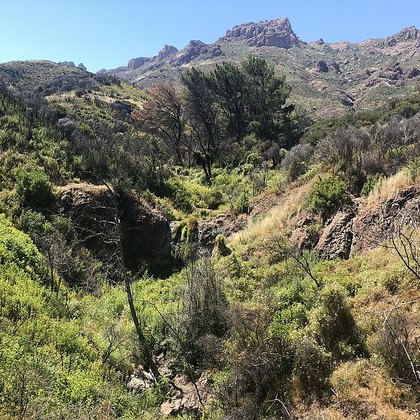
Desert scrub in the Sonoran and Mojave deserts, with palo verde, creosote bush, cholla, ocotillo and chuparosa, and in addition chaparral and sage scrub along the coast of southern California and Baja California. It occurs from sea level to about twelve hundred metres, and within that seeks the washes and the lower parts of dry canyons, where most of the flowers are. Closed forest it avoids entirely. Outside the breeding season it also visits gardens and higher mountain slopes, where it invariably comes off worst against larger hummingbirds.
Where the bird is most often found, arranged by the USNVC — the vegetation classification of the United States and Canada — and CMECS for sea and coast.



Range and movements
A breeding bird of the arid southwestern United States, from southern California and southern Nevada to southwestern Utah, Arizona and the edge of New Mexico, and on across Baja California and northwestern Mexico. In California and Baja California part of the population stays all year. The desert breeders begin in February and are gone by June: they move to the coast or to higher ground, and some reach west-central Mexico. In cities with plantings that flower year-round, more and more birds stay put.
- Resident
- Breeding (summer)
- Winter
- Passage
- dark = core range, pale = thinly spread
Where and when to look
Go to a desert wash with flowering ocotillo at sunrise in March or April and stand still: the male flies his wide U from a fixed perch and whistles as he goes. Watch along the slope rather than upwards, because the dive ends low, right beside the female. If you cannot hear the high whistle, look for the small hunched shape on a projecting twig.
Conservation
Partners in Flight puts the breeding population at 3.4 million birds; the IUCN rates the species as of least concern (LC). Between 1968 and 2019 numbers stayed roughly level or declined slightly. The main pressure is the clearing of desert scrub for building and grazing, above all around the fast-growing cities of Arizona and southern California, where it is precisely the low-lying washes with the richest flowering that disappear.
Scientific name
Calypte costae | (Bourcier, 1839)
Jules Bourcier described the species in 1839 as Ornismya Costae; because it was later moved to another genus, author and year stand in parentheses. The genus Calypte was introduced in 1856 by John Gould, from Greek kalyptre, 'veil' or 'head-dress', a reference to the coloured crown; this species is its type species. The species name honours Louis Marie Pantaléon Costa, Marquis de Beauregard, a French nobleman who collected and studied hummingbirds. The locality given for the specimen described was "California"; it actually came from Magdalena Bay in Baja California.