All species › Swifts › Hummingbirds › Calliope Hummingbird
Calliope Hummingbird | Selasphorus calliope
Calliopekolibrie | Colibrí calíope
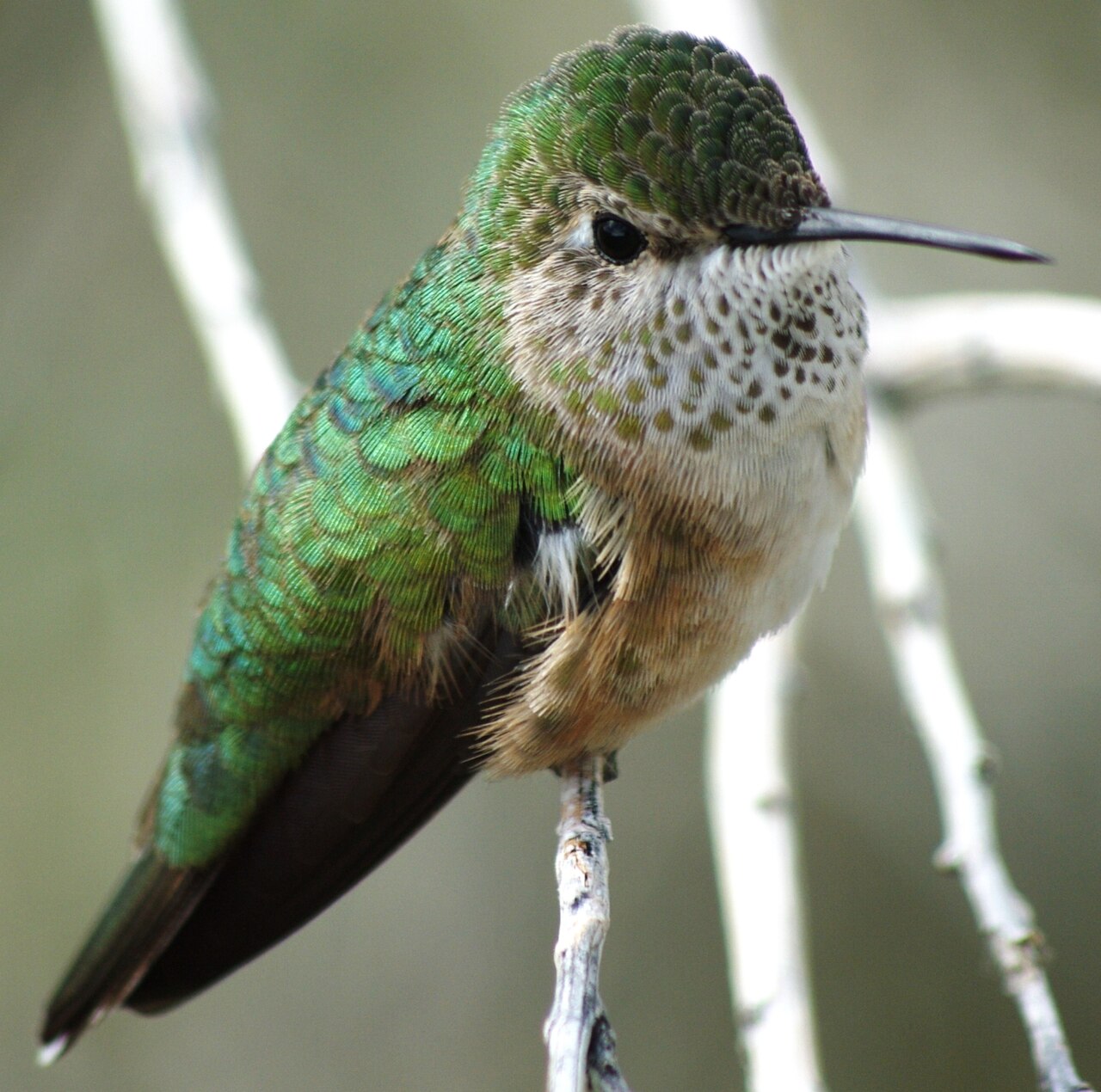
The Calliope Hummingbird is the smallest breeding bird of the United States and Canada: a little over two grams, and yet it flies thousands of kilometres each year between the mountains of the northwest and the forests of southern Mexico. The male wears no solid gorget but loose magenta rays on a white throat.
Voice
Its voice is slight: a high, thin chip while feeding and in disputes, and little else. Most of the sound it makes is mechanical. In the display flight the male dives from some thirty metres up and produces a sputtering, bumblebee-like buzz with his tail feathers, followed by a sharp, high zing. He then shuttles back and forth in front of the female, the wing feathers buzzing loudly again. All of that sound comes from feathers and not from the throat.
Recording: Don Profota — CC BY-NC-SA 4.0 · South Bozeman, Gallatin County, Montana, United States · xeno-canto
Identification
The male is green above, with a greenish wash along the sides of the white underparts, and carries loose magenta-pink rays on a white throat that splay downward. Those rays are an interference colour from the structure of the feather: they light up only in direct light from in front and look black against the light. Female and young birds are green above with a peachy wash across the underparts and fine dark streaking on the throat. Build is the best mark: small and hunched, with a short thin bill and a tail so short that on a perched bird the wingtips reach its end or extend past it.
Confusion species
Female and immature Rufous and Allen's Hummingbirds are larger, show clear rufous on the flanks and the base of the tail, and have a tail that on a perched bird projects beyond the wingtips. A female Broad-tailed Hummingbird is likewise larger and longer-tailed and lacks the peachy wash across the whole underside. The male of that species has a solid rose-red gorget instead of loose rays and makes a loud, sustained wing trill in flight. When in doubt, the relation between wingtip and tail tip is the most reliable mark.
Habitat
Breeds in cool mountain country roughly between 1200 and 3300 metres: mountain meadows, willow and alder thickets along streams, and above all open forest regenerating after fire or logging. It wants low, flower-rich growth with a few high bare twigs to watch from; dense forest and warm lowlands it avoids while breeding. On migration it uses desert washes, coastal scrub and lower forest. In Mexico it winters in thorn forest, pine-oak woodland and brushy woodland edges.
Where the bird is most often found, arranged by the USNVC — the vegetation classification of the United States and Canada — and CMECS for sea and coast.





Range and movements
A breeding bird of the mountains from British Columbia and southwestern Alberta south to California, Nevada, Utah and western Colorado. Migration runs as a loop: north in spring through the Pacific lowlands, and from July south again through the Rocky Mountains and the ranges of the southwest. The entire population winters in western and southern Mexico. For its size the distance is exceptional: the round trip runs to thousands of kilometres, more than for any other bird of this weight. A small number now stay on the Gulf Coast instead.
- Resident
- Breeding (summer)
- Winter
- Passage
- dark = core range, pale = thinly spread
Where and when to look
Look for it in July and August in a mountain meadow of paintbrush and penstemon, or along a stream with willow thickets: that is when males move south through the Rockies and hang low over the flowers. On a perched bird check the wing-to-tail relation — if the wingtips reach the end of the tail, you have this species. Because it feeds low and quietly, it is often overlooked among larger hummingbirds.
Conservation
Partners in Flight puts the breeding population at about 4.5 million birds; between 1968 and 2019 the decline was less than a tenth of a per cent, so numbers have stayed much the same. Even so the species is on the Yellow Watch List, for one reason: the whole population winters in a comparatively small area of Mexico, so changes in those forests reach the species as a whole. On the breeding grounds it depends on young, flower-rich regrowth, which closes over again within a few decades.
Scientific name
Selasphorus calliope | (Gould, 1847)
John Gould described the species in 1847 as Trochilus (Calothorax) Calliope; because it was later moved to another genus, author and year stand in parentheses. For a long time it stood in the genus Stellula, 'little star'; it is now placed in Selasphorus, a genus introduced by Swainson in 1832, from Greek selas 'light, flame' and -phoros 'bearing'. The species name refers to Calliope, the Greek muse of epic poetry, whose name means 'she of the beautiful voice'. The specimen described came from Mexico.