All species › Swifts › Hummingbirds › Rufous Hummingbird
Rufous Hummingbird | Selasphorus rufus
Rosse kolibrie | Zumbador rufo
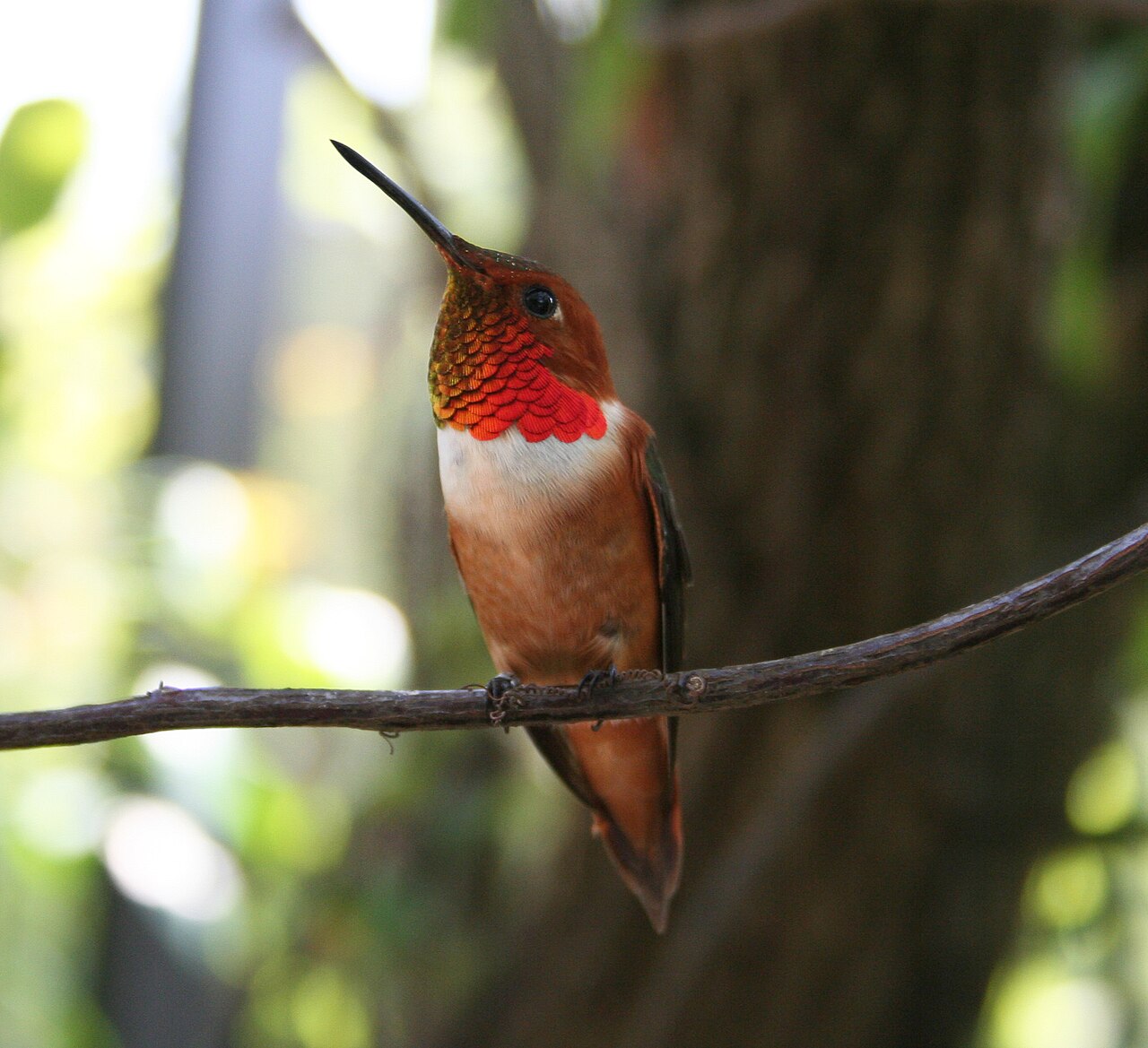
The Rufous Hummingbird is rust red rather than green, and of all hummingbirds it covers the longest road: from southeast Alaska to the mountains of southern Mexico, over four thousand kilometres, on a body of three and a half grams. The male carries a throat patch that turns from gold-orange to fire red as soon as the light falls on it properly. At a feeder it drives off every other hummingbird, including species twice its weight.
Voice
It has no song in the ordinary sense. In flight the male's wings produce a high, shrill whine, which at the lowest point of the display dive ends in a dry pop. The call is a hard chip that speeds up in chases into a rattling chip-chip-chip with a pinched zee-chuppity-chup through it. At a feeder you hear the fighting before you hear the bird.
Recording: Peter Ward and Ken Hall — CC BY-NC-SA 4.0 · Campbell Valley Regional Park, British Columbia, Canada · xeno-canto
Identification
The male is rust red above and on the flanks, with a white breast band and a throat patch flaring from gold-orange to scarlet; a proportion of males have a green back, which causes doubt in the field. The female is green above, with rufous flanks, a rufous tail base and white tail tips, and usually a few red feathers in the centre of the throat. The juvenile resembles the female but has no red on the throat yet. The bill is straight, black and fairly short; the bird is compact and short-tailed, the wingtips at rest reaching almost to the end of the tail. While hovering it holds the tail still or spreads it briefly, without pumping.
Confusion species
Ruby-throated Hummingbird of the east is green above and has no rufous on flanks or tail; only the females and juveniles of the two are alike, and then the rufous tail base of this species settles it. Allen's Hummingbird (Selasphorus sasin) of the California coast is barely separable as a female or juvenile; the male always has a green back, and the remaining difference lies in the width of the outer tail feathers, which is rarely visible in the field. Broad-tailed Hummingbird (Selasphorus platycercus) of the Rocky Mountains is larger and green-backed, with a rose-red throat and a wing sound like a ringing bell. At a feeder in the southeastern states in winter, almost every hummingbird is a Rufous Hummingbird.
Habitat
Breeds in the conifer forest of the west coast and the mountains, but not inside the closed stands: it looks for edges, clearcuts, young plantations, thickets and riverside scrub where flowers stand in the sun. On autumn migration it follows the flowering upward, through alpine and subalpine meadows to above the treeline. In winter it is in Mexican pine-oak forest from two thousand metres up, and in the southeastern states in gardens with a feeder and late flowers. What it needs is nectar inside a small, defensible patch of ground, wherever that is.
Where the bird is most often found, arranged by the USNVC — the vegetation classification of the United States and Canada — and CMECS for sea and coast.





Range and movements
Breeds from southeast and south-central Alaska through Yukon, British Columbia and western Alberta to Washington, Oregon, Idaho, western Montana and the extreme northwest of California — further north than any hummingbird anywhere in the world. Migration runs as a loop: north up the Pacific coast in spring, south through the Rocky Mountains and the Sierra Madre in late summer. It winters in the highlands of central and southern Mexico, from Jalisco to Oaxaca. Since the 1970s more birds have wintered each year along the Gulf Coast and in the southeastern United States, where it was not expected before; at the same time breeding numbers in the northwest have fallen by roughly two per cent a year.
- Resident
- Breeding (summer)
- Winter
- Passage
- dark = core range, pale = thinly spread
Where and when to look
Look for it in July and August in a mountain meadow with red flowers, between two thousand and three thousand metres: that is when it is moving south and the meadows are in flower. Stand by a patch of flowers and wait — it keeps a fixed perch above its own plot and returns to it again and again. If you live in the southeastern states, leave the feeder out through November and December; the hummingbird that comes to it then is almost never the summer species.
Conservation
The Red List rates it Near Threatened (NT). Numbers have been falling for decades, and winter counts and breeding surveys point the same way: together they amount to a halving since 1970. The causes are spread along a long route — loss of scrub and young plantation in the breeding range, a shift in the timing of flowering relative to its arrival, and forest loss in the Mexican highlands.
Scientific name
Selasphorus rufus | (Gmelin, 1788)
Johann Friedrich Gmelin described the species in 1788 as Trochilus rufus, in the genus that then held all hummingbirds; because it was later moved, author and year stand in parentheses. He worked from a description by Latham of a bird collected on Cook's third voyage at Nootka Sound on Vancouver Island — the type locality. The genus Selasphorus was introduced by Swainson in 1832, from Greek selas, 'flame' or 'brightness', and -phoros, 'bearing'. rufus is Latin for 'reddish brown', after the colour of the back and flanks.