All species › Loons › Loons › Arctic Loon
Arctic Loon | Gavia arctica
Parelduiker | Colimbo ártico
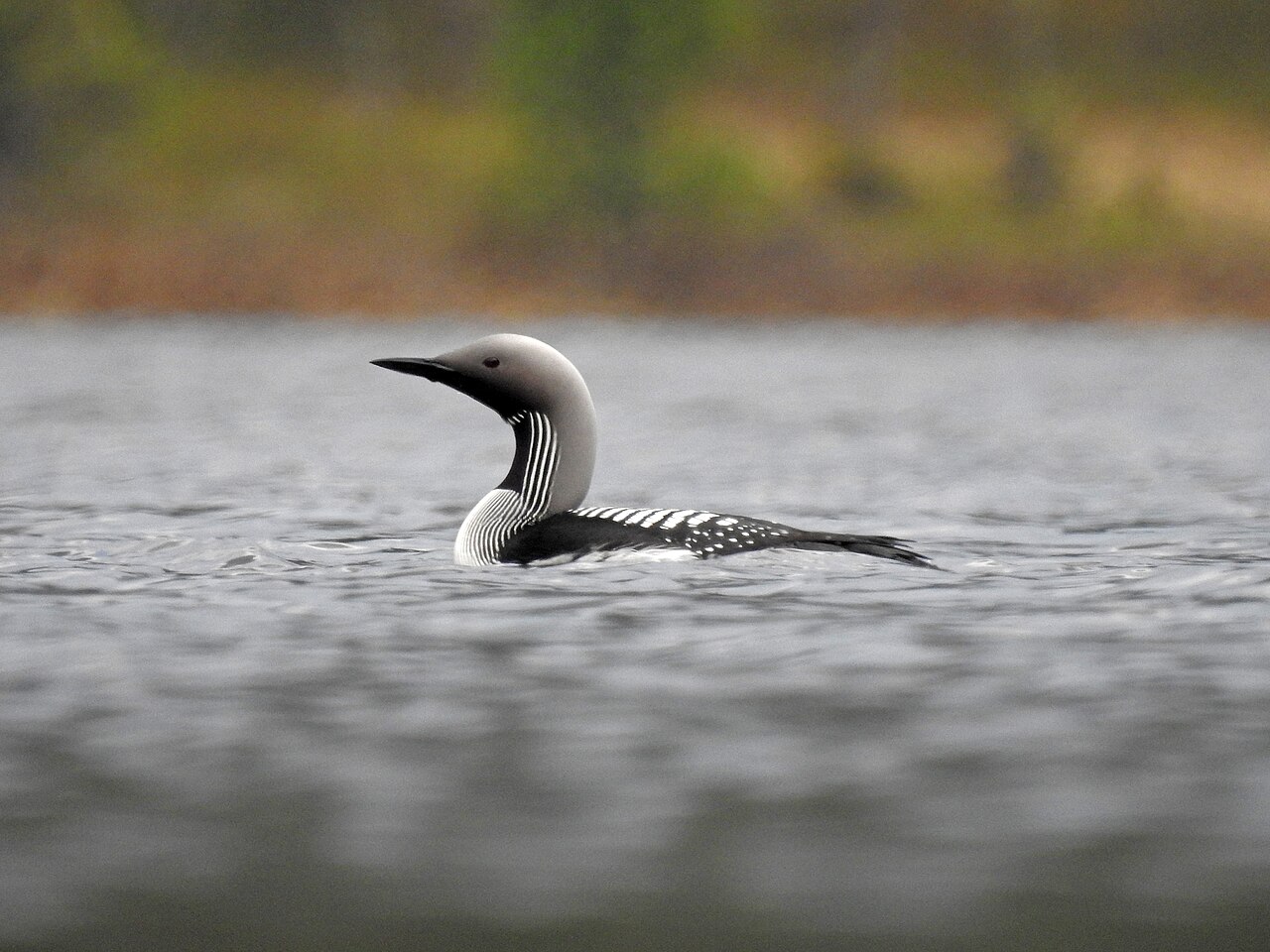
Arctic Loon is a common breeder across Europe and Asia, but in North America it reaches only a small corner of western Alaska. It is heavier-built than its close relative Pacific Loon, with a thicker bill and, in breeding plumage, a green rather than purple throat patch.
Voice
The song is a short, soft introductory note followed by a long, loud, rising wail, repeated in series — the same hoarse yodel familiar from other loons. It also gives a short, hoarse croak and a drawn-out, mournful call. On its Alaskan breeding grounds the species is heard far less often than the much more numerous Pacific Loon, simply because there are so few of it.
No freely licensed recording has been found for this species yet; what to listen for is described below.
Identification
In breeding plumage Arctic Loon has a plain, dark grey crown and nape, a black throat with a metallic sheen that is green rather than purple in the Alaskan subspecies, and broad white stripes down the sides of the neck. The back shows a sharp black-and-white checkerboard pattern, and a striking white hip patch is visible on swimming birds. In winter it is dark grey-brown above and white below, with a knife-sharp line dividing the two on the flank. Juveniles resemble winter adults with a slightly less crisp pattern. The bill is thicker than Pacific Loon's and is often held at a slight upward angle.
Confusion species
Pacific Loon is almost identical but smaller and more slender, with a thinner bill and, in breeding plumage, a paler crown and narrower neck stripes; outside the breeding season the two are barely separable, and identification often rests on the white hip patch, which shows more clearly on Arctic Loon. Common Loon is considerably larger with a heavier, straight bill.
Habitat
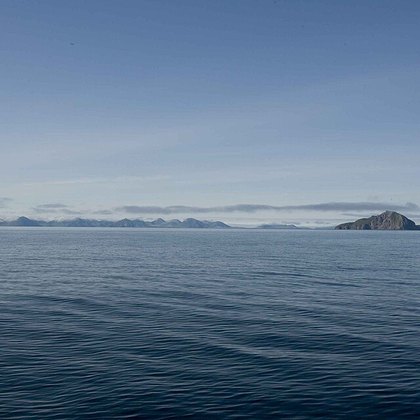
In Alaska it breeds on shallow tundra lakes with grassy shores, close to the Bering Sea coast. Elsewhere in its range it also uses large lakes in boreal forest. Outside the breeding season it lives at sea, in shallow coastal waters where it dives for fish.
Where the bird is most often found, arranged by the USNVC — the vegetation classification of the United States and Canada — and CMECS for sea and coast.


Range and movements
Its North American breeding range is confined to the Seward Peninsula and a small adjoining part of western Alaska; the rest of the world population breeds from Scandinavia to eastern Siberia. The Alaskan birds move through the Bering Sea to winter off the coasts of East Asia, and are seen farther south along the American Pacific coast only as a rare exception.
- Breeding (summer)
- Winter
- Passage
- dark = core range, pale = thinly spread
Where and when to look
Look for it in June and July on the shallow tundra lakes around Wales and Teller on the Seward Peninsula, where it sits among far more numerous Pacific Loons; the green throat sheen and broader neck stripes are the best marks to separate it there.
Conservation
Globally the species is not threatened, with a large population across Eurasia. Its Alaskan breeding population is small and poorly counted, however, and disturbance of the tundra around the breeding lakes and oil and gas development on the Seward Peninsula are the main risks there.
Scientific name
Gavia arctica | (Linnaeus, 1758)
Linnaeus described the species in 1758 as Colymbus arcticus; it has since been placed in the genus Gavia, hence the parentheses around author and year. The type locality originally covered Europe and North America together, but was restricted by Linnaeus himself to Sweden in 1761. The species name arcticus refers to its northern breeding range.