All species › Loons › Loons › Pacific Loon
Pacific Loon | Gavia pacifica
Pacifische parelduiker | Colimbo del Pacífico
Pacific Loon is the most numerous loon on the west coast of North America and, after Red-throated Loon, the smallest, with a slender, pointed bill and a silvery-grey crown that gleams like brushed metal in breeding plumage. In autumn and spring it migrates along the coast in dense, strung-out lines, sometimes thousands passing a single point in an hour.

Voice
On the breeding lakes it gives a long, wailing yodel, oo-loo-lee, which like that of other loons carries far across the water. It also produces a range of croaking, raven-like calls and soft squealing, purring and cackling sounds around the nest. Outside the breeding season it is largely silent; in mixed flocks at sea a short, sharp ark is occasionally heard.
Recording: Logan McLeod — CC BY-NC-SA 4.0 · Yukon, Unorganized (near Beaver Creek), Yukon, Yukon Territory, Canada · xeno-canto
Identification
In breeding plumage Pacific Loon has a smooth, silvery-grey crown and nape, a black throat finely striped down the sides, and a back marked with crisp white lines. In winter it is dark grey-brown above with little pale feather edging and white below, often with a dark line across the throat like a necklace. The bill is straight and pointed, slimmer than Common Loon's. Juveniles resemble winter adults but show a more scaly-patterned back.
Confusion species
Arctic Loon is almost identical but slightly heavier-built, with a thicker bill and, in breeding plumage, a darker grey crown and broader white neck stripes; outside the breeding season the two are barely separable in the field. Common Loon is considerably larger with a heavier, straighter bill. Red-throated Loon is smaller and slimmer, with a thin, slightly upturned bill, and often holds its head and bill tilted upward.
Habitat
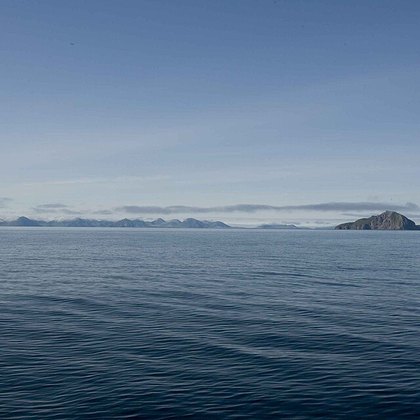
It breeds on tundra and taiga lakes large enough for take-off, usually with low, open shores. Outside the breeding season it seeks shallow coastal waters, bays and straits with a sandy rather than rocky bottom, where it chases schools of small fish. Large river mouths and sheltered straits serve as important staging areas on migration.
Where the bird is most often found, arranged by the USNVC — the vegetation classification of the United States and Canada — and CMECS for sea and coast.



Range and movements
It breeds from the coast of eastern Siberia across northern North America, east through Canada's north to Baffin Island and James Bay. In winter almost the entire population moves to the Pacific, from Alaska south to southern Baja California. The spring and autumn migration along the west coast is one of the continent's great bird spectacles, with thousands passing fixed headlands in a single day.
- Resident
- Breeding (summer)
- Winter
- Passage
- dark = core range, pale = thinly spread
Where and when to look
Head to a prominent Pacific headland such as Point Reyes or Cape Flattery in October or November and count the strings of loons moving south just above the water; on a good day thousands pass in an hour. In winter, watch for the dark throat line to separate it from other loons of similar size.
Conservation
The world population is estimated at over eight hundred thousand birds and the species is listed as Least Concern (LC). It declined noticeably between 1979 and 1996, but the trend since then has not been well tracked. Entanglement in gillnets and oil and gas development on the tundra are the main risks it faces.
Scientific name
Gavia pacifica | (Lawrence, 1858)
American ornithologist George Newbold Lawrence described the species in 1858 as Colymbus pacificus; it has since been placed in the genus Gavia, hence the parentheses around author and year. The species name pacificus refers to the Pacific Ocean, where the type locality lies: San Diego, California, later fixed to that city by Grinnell in 1932.