All species › Passerines › New World blackbirds, troupials and allies › Audubon's Oriole
Audubon's Oriole | Icterus graduacauda
Zwartkoptroepiaal | Turpial amarillento
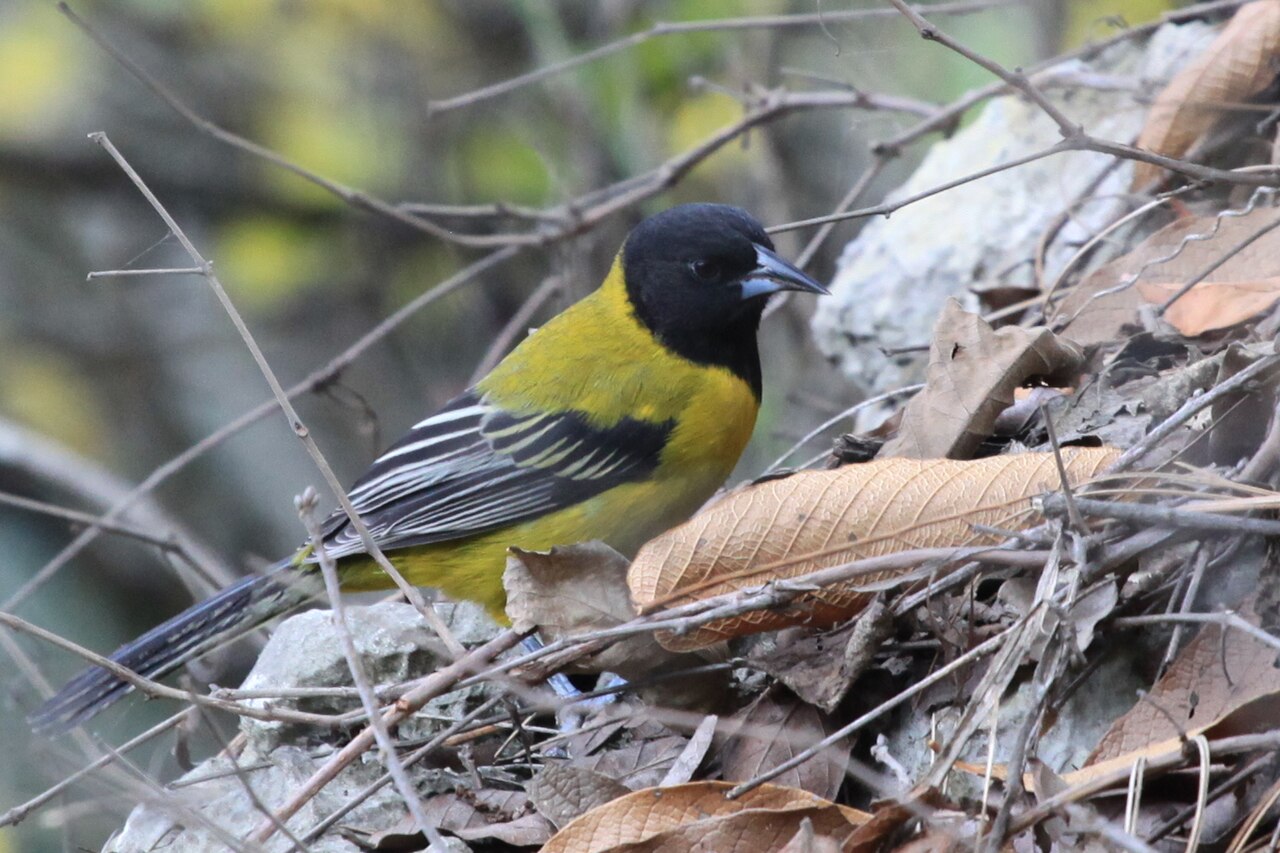
Audubon's Oriole is the only oriole in North America with an entirely black hood on a yellow body. It lives unobtrusively in dense thicket and riparian woodland in Mexico and in the Rio Grande valley of South Texas, where it is heard more often than seen.
Voice
The song consists of slow, hesitant whistles that slide up and down in pitch, with a pause between the notes; the whole sounds lower and slower than in the other orioles. Male and female sing the same song and answer one another, outside the breeding season as well. Calls include a nasal nyeh and a short high whistle with which the pair keeps contact in dense cover.
Recording: Matthew L. Brady — CC BY-NC-SA 4.0 · Omiltemi village hydro project forest, Omiltemi, Chilpancingo de los Bravo, Guerrero, Mexico · xeno-canto
Identification
Head, throat and nape are wholly black, ending in a sharp edge on the upper breast; the rest of the body is yellow with an olive wash on back and rump. Wings and tail are black, with white edges to some secondaries and a yellow shoulder. The bill is long, thick at the base and sharply pointed. Females are slightly duller and more olive on nape and back than males, otherwise alike. Young birds have dull brown wings and an olive-yellow head without the black hood.
Confusion species
No other oriole in the guide area combines a black hood with a yellow body: Hooded Oriole has black only on face and throat, with a yellow or orange crown, and on Altamira Oriole the black does not extend over the crown. Scott's Oriole, in the west, also has a black head and yellow belly, but black extends over the back and breast well onto the body, and the two barely overlap in range. Young Audubon's Orioles without the hood are told by size, the heavy bill and the yellow-and-olive plumage.
Habitat
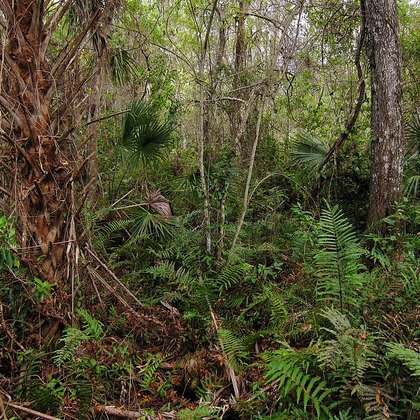
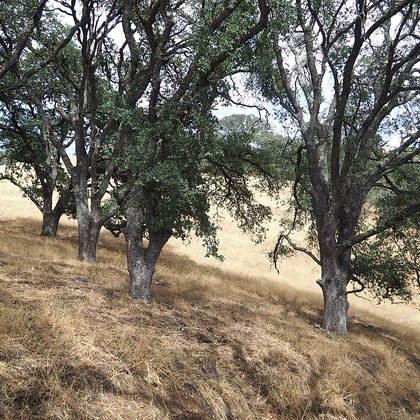
Dense evergreen thicket and woodland along water: mesquite woodland, ebony thicket and riparian forest in South Texas, and in Mexico also montane forest, cloud forest and shaded coffee plantations up to several thousand metres. It forages lower and more hidden than other orioles, down to the ground, prying the bill into rolled leaves and bark crevices to expose insect larvae. The nest is a shallow hanging cup one and a half to five metres up, in dense cover.
Where the bird is most often found, arranged by the USNVC — the vegetation classification of the United States and Canada — and CMECS for sea and coast.



Range and movements
Resident; pairs often stay together year-round. The range falls into two separate parts. The eastern part runs from the Rio Grande valley of South Texas south through Tamaulipas, Nuevo León, San Luis Potosí, Querétaro, Hidalgo and Veracruz; the western part lies along the Pacific slope, from Nayarit and Jalisco south through Colima, Michoacán and Guerrero to southern Oaxaca. Fewer than five thousand birds breed in the United States, in the counties along the river and in the South Texas brush country.
- Resident
- Breeding (summer)
- Winter
- Passage
- dark = core range, pale = thinly spread
Where and when to look
In Texas go by sound: the slow, sliding whistles carry far through dense brush, while the bird itself rarely perches in the open. Santa Ana, Salineño and the thickets of South Texas ranches are the best-known places. In winter it comes to feeding stations, and a long wait at a table set with orange is often the surest way to see it.
Conservation
Partners in Flight puts the world population at about 3.5 million birds, fewer than five thousand of them in the United States; globally the species is listed as Least Concern (LC). In Texas numbers have fallen since the 1920s and it has disappeared from part of the large refuges in the Rio Grande valley, linked to the loss and fragmentation of riparian woodland. Nests are heavily parasitised by Brown-headed Cowbird, which lowers breeding success further in small, fragmented patches.
Scientific name
Icterus graduacauda | Lesson, 1839
Lesson described the species in 1839 as Icterus graduacauda; because it has stayed in that same genus, author and year stand without parentheses. The genus Icterus comes from Greek ikteros, the name of a yellow bird. The species name combines Latin gradus 'step' and cauda 'tail' and means 'with the graduated tail', after the tail feathers increasing in length from outside inwards. The English name honours John James Audubon; the Dutch name refers to the black hood and the Spanish to the yellow body colour. The specimen described came from Mexico, with no closer locality.