All species › Passerines › New World blackbirds, troupials and allies › Altamira Oriole
Altamira Oriole | Icterus gularis
Altamiratroepiaal | Turpial de Altamira
The Altamira Oriole is the largest oriole in North America, with a heavy bill, an orange shoulder patch and a hanging nest that can exceed sixty centimetres. It is resident along the Gulf slope of Mexico and Central America and reaches the United States only in the Rio Grande valley of South Texas, where it has been established since 1939.

Voice
The song is a slow series of clear, full whistles with long pauses between them, usually no more than four to six notes in a row; it sounds slower and lower than the songs of the other orioles of the area. Calls include a hard, nasal ike or nyek, often in short series, and a rasping chatter when disturbed. Both sexes sing, in winter as well, and a pair keeps contact by call while foraging together through the canopy.
Recording: Isaí López — CC BY-NC-SA 4.0 · Marcala, Departamento de La Paz, Honduras, Honduras · xeno-canto
Identification
Large and heavy-bodied, with a thick, straight bill whose lower mandible is blue-grey at the base. Head, breast and belly are orange, the throat black and sharply edged, as is a black mask around bill and eye. Back, wing and long tail are black. The shoulder carries a clear orange patch, visible on a perched bird; the wing also has white edges to the secondaries and white spots on the primary coverts. Male and female look alike. Young birds are olive-yellow with a dull brown wing and a yellow rather than orange shoulder.
Confusion species
Hooded Oriole is considerably smaller and slimmer, with a thin, slightly curved bill and two narrow white wing bars instead of an orange shoulder. Baltimore Oriole, which passes through South Texas on migration, is smaller, has a wholly black head with no orange cheek, and orange in the outer tail feathers. Orchard Oriole is much smaller and chestnut in the male. On a perched bird the combination of size, orange shoulder and heavy bill settles it.
Habitat
Lightly wooded lowland: thorn forest with mesquite (a thorny pod-bearing shrub of the Southwest that forms dense thickets) and ebony, riparian woodland along rivers and resacas with Mexican ash and cypress, ranchland with scattered trees, and wooded parks and village edges. In Mexico and Central America it occurs up to about 1500 metres, into gardens and along roadsides. The nest is built at the end of a high drooping branch, sometimes on a telephone wire, and pairs often choose the site near a nest of Great Kiskadee or Tropical Kingbird.
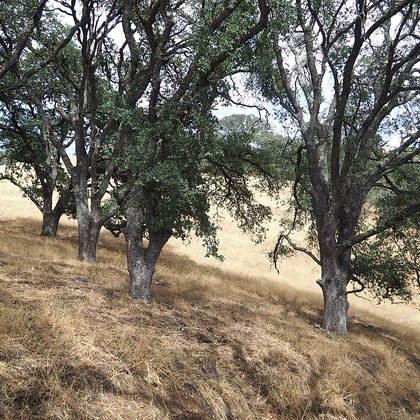
Where the bird is most often found, arranged by the USNVC — the vegetation classification of the United States and Canada — and CMECS for sea and coast.





Range and movements
Resident, with no seasonal migration. The range runs from South Texas — Starr, Hidalgo, Cameron and Willacy counties in the Rio Grande valley — through Tamaulipas, Nuevo León and San Luis Potosí south along the Gulf slope over Veracruz, Tabasco and the Yucatán Peninsula to Chiapas, Belize, Guatemala, Honduras and Nicaragua; on the Pacific slope it is present from the Isthmus of Tehuantepec southward. In Texas it was first recorded in 1939 and bred from 1951; a few hundred birds breed there, concentrated in the refuges along the river and in a few town parks.
- Resident
- Winter
- Passage
- dark = core range, pale = thinly spread
Where and when to look
In Texas, Bentsen-Rio Grande Valley State Park, Santa Ana and Salineño offer the best chance, year-round, though in winter the birds are seen mostly at feeding stations with orange and peanut butter. Look for the nest first: a hanging pouch of thirty to sixty centimetres at the end of a high branch is visible from a distance and marks the same territory year after year.
Conservation
Worldwide the species is listed as Least Concern (LC) and the range is large. In Texas it is listed as threatened by the state: the breeding population there is put at no more than five hundred birds, and the riparian woodland of the Rio Grande valley has largely been converted to farmland and housing. Replanting of native thorn forest in the river refuges has increased the available breeding habitat. In the Mexican part of the range the species is numerous and tolerates a lightly modified landscape.
Scientific name
Icterus gularis | (Wagler, 1829)
Wagler described the species in 1829 as Psarocolius gularis; the later move to Icterus puts author and year in parentheses. The genus Icterus comes from Greek ikteros, the name of a yellow bird. The species name gularis is Latin for 'of the throat', from gula 'throat', after the black throat patch. The Dutch, English and Spanish names refer to Altamira, a town in southern Tamaulipas, Mexico. The specimen described came from Tehuantepec in Oaxaca.