All species › Waders, gulls and terns › Sandpipers and allies › Baird's Sandpiper
Baird's Sandpiper | Calidris bairdii
Bairds strandloper | Correlimos de Baird
Baird's Sandpiper is the long-winged one among the small sandpipers: at rest the wingtips project clearly beyond the tail. It breeds on the driest tundra of the far north and winters in the Andes and on the plains of southern South America, a journey of well over ten thousand kilometres each way.

Voice
On the breeding grounds the male sings in a high, slow display flight: a purring trill, then rising twoo-wee notes, and a rattling phrase to close. On migration it is much quieter; the usual call is a low, harsh, grating kreep, like that of Pectoral Sandpiper. In a party along a shoreline there is also soft trilling. Anyone hearing a single kreep out of the air over the prairie should look up: the bird often travels high and alone.
Recording: Alvaro Rivera Rojas — CC BY-NC-SA 4.0 · Galindo, San Juan del Río Municipality, Querétaro, Querétaro, Mexico · xeno-canto
Identification
A small, elongated sandpiper with black legs, a short, straight, fine dark bill and the longest wings of all the small sandpipers — at rest the tips reach beyond the tip of the tail. The upperparts are dark brown with black markings, the underparts white, with a buff, finely streaked breast that fades gradually into the white. Juveniles have broad pale buff feather edges that give the back a neat scaled pattern; that is the plumage in which most birds are seen in the south. The tail has a dark centre with white sides. In flight the white wingbar is narrow and the bird looks slim and drawn out.
Confusion species
White-rumped Sandpiper (Calidris fuscicollis) also has wingtips beyond the tail, but shows a wholly white rump in flight, is greyer, and has streaking far onto the flanks. Pectoral Sandpiper (C. melanotos) is bigger, has yellow legs, and a breast band that breaks off sharply against the white belly instead of fading out. Semipalmated Sandpiper (C. pusilla) and Western Sandpiper (C. mauri) are shorter-winged — the tips do not pass the tail. Juveniles are sometimes taken for Sanderling, which is paler, thicker-billed and lacks the buff wash across the breast.
Compare sandpipers, snipes and allies: bill, legs, wing bar and rump
Habitat
On migration a bird of drier ground than most sandpipers: shortgrass prairie, bare fields, sod farms, and above all the drying mud margins of prairie pools and reservoirs. It avoids deep water and broad marine mudflats; it would rather walk through low vegetation than through surf. It breeds on dry, sparsely vegetated high-arctic tundra, on slopes and gravel ridges often far from the sea. In the Andes it winters above four thousand metres, on bare plains and along shrinking salt lakes.
Where the bird is most often found, arranged by the USNVC — the vegetation classification of the United States and Canada — and CMECS for sea and coast.

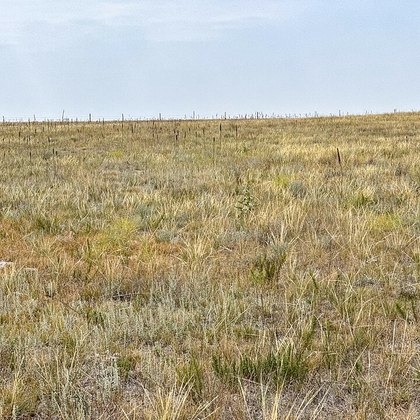



Range and movements
Breeds from Wrangel Island and eastern Chukotka through northern and central Alaska, across the arctic islands of Canada to northwestern Greenland. It winters in the mountains and along the coast from southern Peru through Chile to Tierra del Fuego. Migration runs largely through the interior: in spring almost entirely over the Great Plains, in autumn in a broader fan, with juveniles in particular turning up on both coasts. In western Europe it is a rare but almost annual vagrant, usually a juvenile in September.
- Breeding (summer)
- Passage
- dark = core range, pale = thinly spread
Where and when to look
Look for it in August and September on the bare, dried-out margin of a prairie pool or reservoir, or on a freshly cut sod field — not at the waterline but ten metres above it. Watch the posture at rest: a sandpiper whose wingtips pass the tail is, in North America, almost always this species or White-rumped Sandpiper. Both look a notch longer and flatter than the small sandpipers beside them.
Conservation
Partners in Flight puts the world population at about 300,000 breeding birds and rates the species as not threatened (LC). The trend is unknown, because both the breeding and the wintering grounds are remote and hardly any run of counts exists. The greatest uncertainty is climate: dry high-arctic tundra and the high Andean lakes are both sensitive to change.
Scientific name
Calidris bairdii | (Coues, 1861)
Coues described the species in 1861 as Actodromas bairdii; because it was later moved to another genus, author and year stand in parentheses. The genus Calidris goes back to Greek kalidris, in Aristotle the name of a grey bird of the waterside. The specific name honours Spencer Fullerton Baird, the leading figure of the Smithsonian Institution and Coues's mentor. The described specimen came from Fort Resolution on Great Slave Lake, in what is now the Northwest Territories.