All species › Waders, gulls and terns › Sandpipers and allies › Pectoral Sandpiper
Pectoral Sandpiper | Calidris melanotos
Gestreepte strandloper | Correlimos pectoral
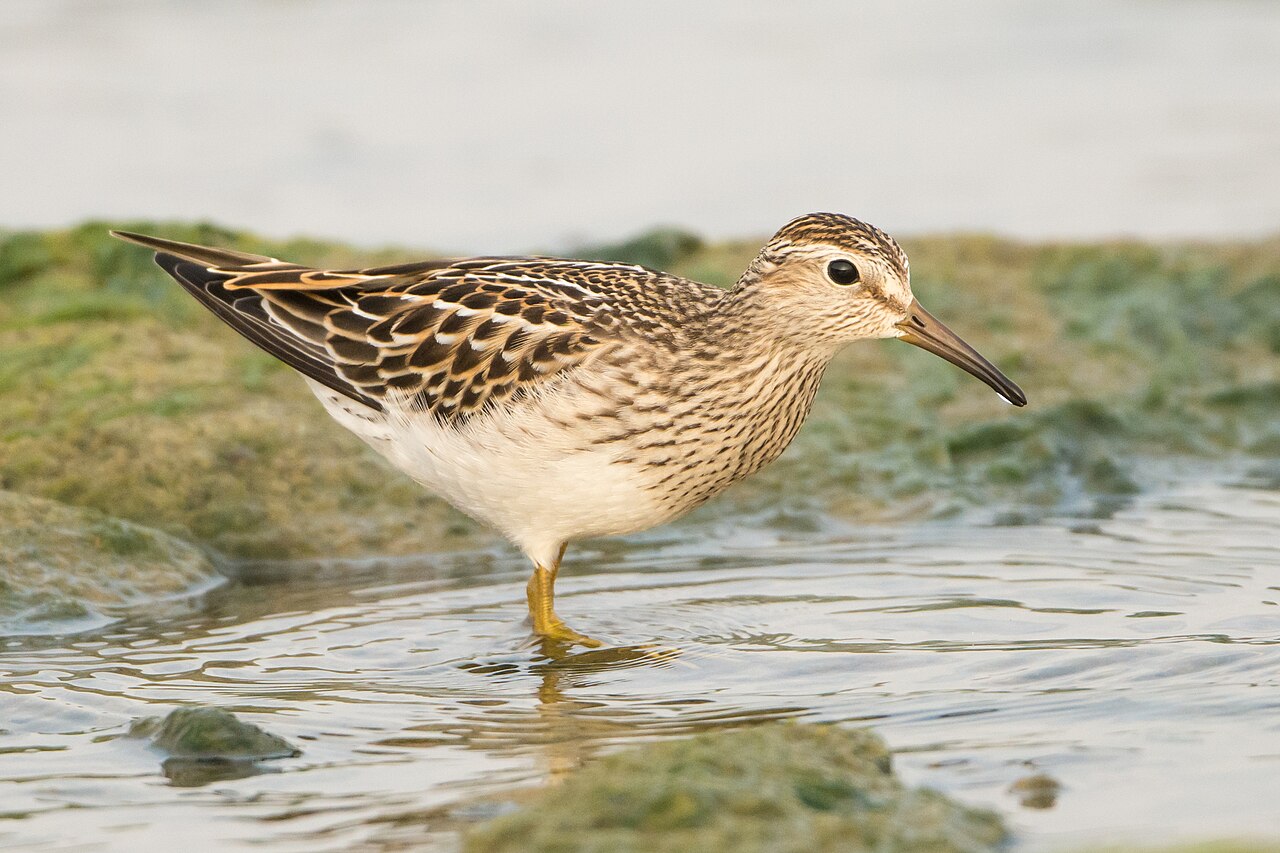
The Pectoral Sandpiper wears its field mark on the breast: a densely streaked band that stops against the white belly as abruptly as a bib. Males are up to half as heavy again as females, and in the display flight they inflate an air sac in the throat with which they deliver a hollow lowing over the tundra.
Voice
The flight call is a low, harsh, dry krrp, usually heard at the moment the bird springs out of the grass. In display the male uses his inflated throat sac to produce a series of hollow, throbbing hoots, skimming low over the female in the half-dark of the arctic summer night. On the ground he approaches her with the chest puffed out, wings drooping and tail raised. Away from the breeding grounds there is no more than a soft grunting in a party.
Recording: JAYRSON ARAUJO DE OLIVEIRA — CC BY-NC-SA 4.0 · Embrapa Arroz-Feijão, Goianira, Goiás, Brazil · xeno-canto
Identification
A sturdy, medium-sized sandpiper with yellowish legs and a fairly long, thick-based, slightly curved bill with a pale base. Patterned brown, gold and black above, white below, with the sharply bounded streaked breast band as the decisive mark. Juveniles have rusty feather edges, white mantle lines and a more finely streaked breast, but the same hard border. Males are markedly larger than females — side by side they can look like two species. In flight it shows almost no wingbar and looks long-bodied with a small head.
Confusion species
Sharp-tailed Sandpiper (Calidris acuminata), an annual visitor to Alaska and the west coast, has as a juvenile a rufous crown, a broad white supercilium and an unstreaked orange breast with no hard lower edge. Baird's Sandpiper (C. bairdii) is smaller, has black legs and a breast that fades gradually into the white. Least Sandpiper (C. minutilla) also has yellow legs and a streaked breast and is confused with it constantly, but is barely half the weight. A bulky bird with a small head and long legs may also be a Ruff, which lacks the sharp breast border entirely.
Compare sandpipers, snipes and allies: bill, legs, wing bar and rump
Habitat
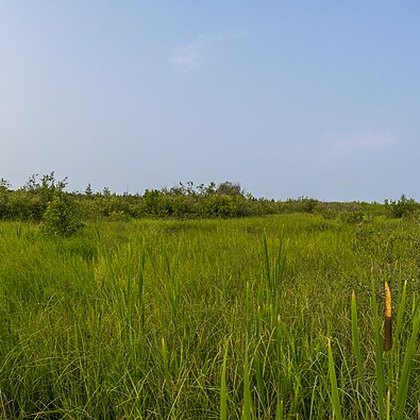
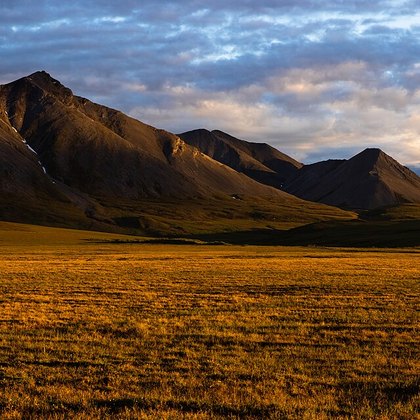
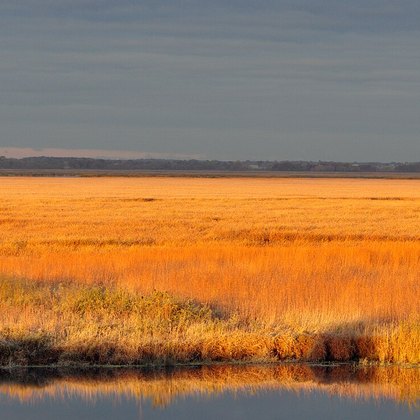
Wet, grassy ground rather than open mud: sedge marshes, wet meadows, flooded fields, rice fields, sod farms and the vegetated edges of pools and settling ponds. Where a party of sandpipers stands in the grass instead of out on the flat, this is often the species. It breeds on wet, grassy coastal tundra, the nest set on a slightly higher and drier ridge from which the bird can see out. It makes little use of bare marine mudflats and sandy beaches.
Where the bird is most often found, arranged by the USNVC — the vegetation classification of the United States and Canada — and CMECS for sea and coast.


Range and movements
Breeds from the Yamal Peninsula eastward to Chukotka, and from western and northern Alaska through northern Canada into the arctic islands. Almost the whole population travels to South America, as far as Argentina and Tierra del Fuego; a few Siberian birds reach Australia and New Zealand. The northward journey in spring runs mainly through the interior and the Mississippi valley, the return broader and later, with adults in August and juveniles in September and October. Of all American sandpipers it is the best-known vagrant in western Europe: annual in Britain and Ireland, and in the autumn of 2003 nearly two hundred birds arrived at once.
- Resident
- Breeding (summer)
- Winter
- Passage
- dark = core range, pale = thinly spread
Where and when to look
In September walk the grassy edge of a flooded pasture or a settling pond and watch what flushes out of the grass: this species often sits hidden and gives itself away with its harsh krrp. Once it is standing, look at the lower edge of the streaking — it should end against the white as if ruled with a straightedge. Two birds of different size beside one another are not two species here but a male and a female.
Conservation
The world population is put at about 1.6 million breeding birds, the IUCN rates the species as Least Concern (LC), but more than half has disappeared over fifty years. What lies behind the decline is unclear; loss of wet grassland along the flyway and on the wintering grounds is most often named. Because outside the breeding season it spreads over many small, scattered sites, it is hard to count and a decline is noticed late.
Scientific name
Calidris melanotos | (Vieillot, 1819)
Vieillot described the species in 1819 as Tringa melanotos; because it was later moved to another genus, author and year stand in parentheses. The genus Calidris goes back to Greek kalidris, in Aristotle the name of a grey bird of the waterside. melanotos is built from Greek melas, 'black', and nōtos, 'backed'. Vieillot knew the bird not from the north but from Azara's account of the birds of Paraguay: the type locality therefore lies in the wintering range, thousands of kilometres from the tundra on which it breeds.