All species › Waders, gulls and terns › Sandpipers and allies › Semipalmated Sandpiper
Semipalmated Sandpiper | Calidris pusilla
Grijze strandloper | Correlimos semipalmeado
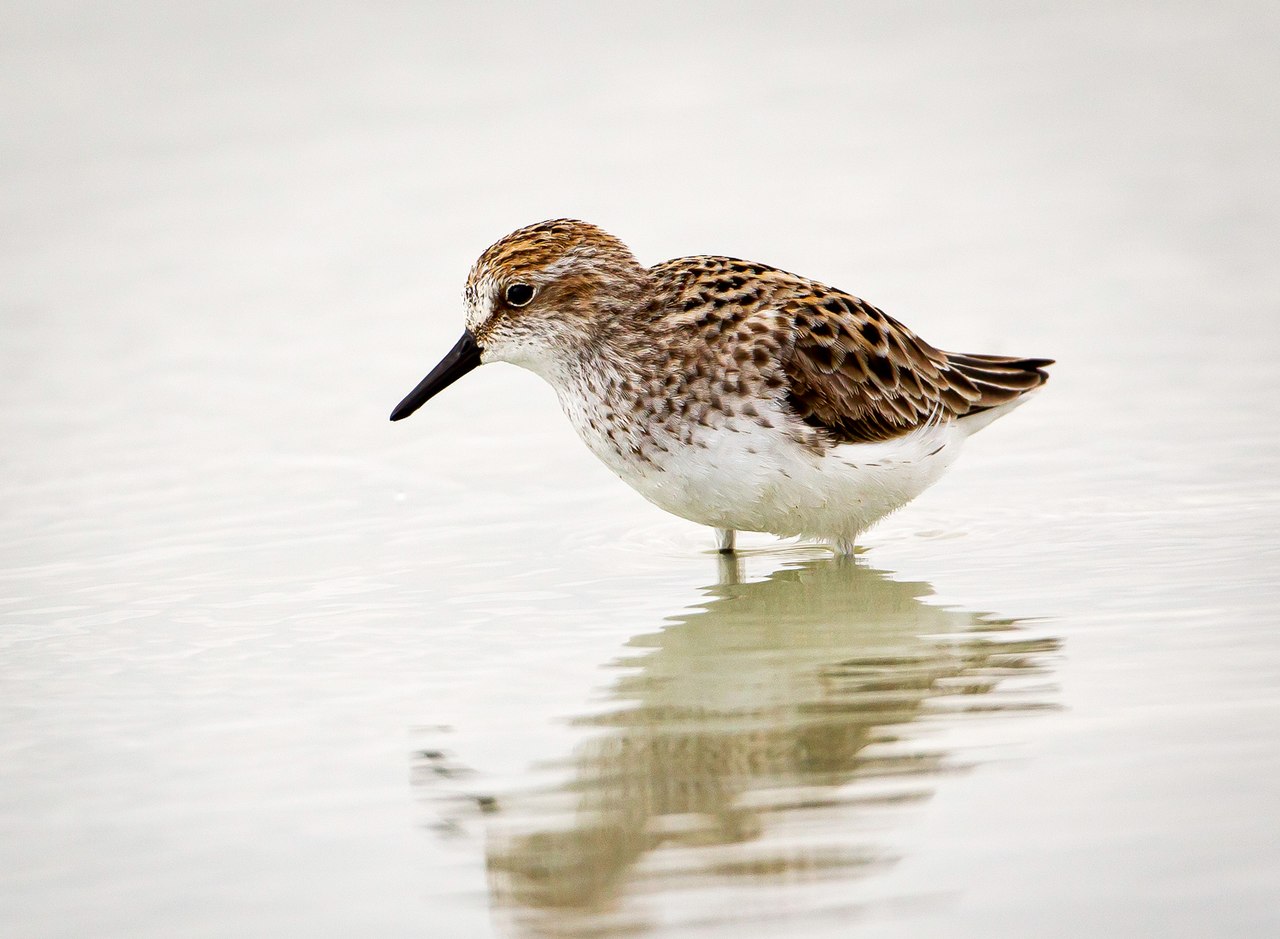
The Semipalmated Sandpiper is the commonest small sandpiper of eastern North America: a short, straight bill, black legs, and between the toes the half-webs that give the bird its English and its Spanish name. In the Bay of Fundy hundreds of thousands gather in autumn to leave in a single push across the Atlantic.
Voice
The usual call is a short, low chert or chirrup, sometimes doubled; in a large flock it becomes a continuous rushing sound hanging over the flat. Squabbling birds give a nasal, scolding jer-jer-jer-jer. On the breeding grounds the male sings in a hovering flight a pulsating vurra-vurra-vurra, likened to an outboard motor, followed by sped-up call notes. Courting birds also give a trilling yu-yu-yu.
Recording: AUDEVARD Aurélien — CC BY-NC-SA 4.0 · Utqiagvik, North Slope, Barrow, Alaska, United States · xeno-canto
Identification
A small sandpiper with black legs and a short, straight dark bill slightly thickened at the tip. In breeding plumage it is brown, black, gold and lightly rusty above, with streaking on head, neck and breast and a white belly; in winter plumage plain grey-brown with a faint pale supercilium. Juveniles resemble the winter bird but have white feather edges that give a neat scaled pattern, and a darker cap. The wingtips reach about to the tail tip and no further. Between the toes are small webs, visible only at close range or in a photograph.
Confusion species
Western Sandpiper (Calidris mauri) is the most similar species: it has a longer bill drooping at the tip, rusty scapulars in breeding plumage and arrow marks running onto the flanks, and a colder grey back in winter. Least Sandpiper (C. minutilla) is smaller still, browner, finer-billed and yellow-legged. Sanderling is paler and larger and shows a broad white wingbar in flight. Bill length is the most usable mark outside the breeding season, but it overlaps: eastern birds and females are distinctly longer-billed than western birds and males.
Compare sandpipers, snipes and allies: bill, legs, wing bar and rump
Habitat
Mudflats, sandflats and the muddy edges of estuaries, lagoons, salt pans and settling ponds; on migration also ploughed and flooded fields and the margins of rivers and reservoirs. It walks slowly and pecks and probes ceaselessly in the top few centimetres, in water that barely covers its toes. On the breeding grounds it chooses low tundra close to pools and small marshes, with sedges, mosses, dwarf willow and birch. It avoids rocky shores and deep water.
Where the bird is most often found, arranged by the USNVC — the vegetation classification of the United States and Canada — and CMECS for sea and coast.




Range and movements
Breeds from eastern Chukotka through northern Alaska and northern Canada to northern Labrador. It winters on the coasts of the Caribbean and from southern Mexico south to northern Chile and northeastern Brazil; virtually none stay in the United States in winter. Migration runs mainly through the east and the centre of the continent; on the Pacific it is much scarcer. In the Bay of Fundy a large part of the world population gathers in July and August, nearly doubling its body weight there before flying non-stop to South America in three to four days.
- Resident
- Breeding (summer)
- Winter
- Passage
- dark = core range, pale = thinly spread
Where and when to look
In August, look on a mudflat for the party that walks fastest and packs closest together: that is usually this species. Compare bills within one group rather than between groups — a short, straight bill with a blunt tip against the longer, drooping bill of Western Sandpiper. In the Bay of Fundy the spectacle is at its best on a rising tide, when clouds of birds shift from the flat to the high-tide roost.
Conservation
Partners in Flight puts the world population at about 2.3 million breeding birds, but more than half has disappeared over fifty years and the IUCN treats the species as Near Threatened (NT). The chief causes are hunting at the staging grounds in the Guianas and Suriname, loss and pollution of mudflats, and dependence on a handful of sites. That concentration is the weakness: a single oil spill or one disturbed high-tide roost hits a large share of the birds in a short time.
Scientific name
Calidris pusilla | (Linnaeus, 1766)
Linnaeus described the species in 1766 as Tringa pusilla; because it was later moved to another genus, author and year stand in parentheses. The genus Calidris goes back to Greek kalidris, in Aristotle the name of a grey bird of the waterside. pusilla is Latin for 'very small'. The type locality is Santo Domingo on Hispaniola: as with the Pectoral Sandpiper, the species was therefore described from a bird on the wintering grounds, long before anyone knew the nest.