All species › Passerines › New World sparrows › Baird's Sparrow
Baird's Sparrow | Centronyx bairdii
Bairdgors | Chingolo de Baird
Baird's Sparrow is a bird of unploughed mixed-grass prairie on the northern Great Plains, with a broad ochre central crown stripe and a narrow necklace of fine streaks across the breast. It breeds in a band from Alberta, Saskatchewan and Manitoba to Montana and the Dakotas and winters in the desert grasslands of the Chihuahuan plateau.
Voice
The song is two to four clear, slightly rising tsip notes running into a thin, tinkling trill: tsip tsip tsip tr-r-r-r-ee. It sounds higher and more musical than the insect-like buzz of Grasshopper Sparrow. The male sings from a grass stem, a thistle or a fence post, often well into the evening. The call is a sharp, high tsip, usually the only sound it makes in winter.
Recording: Jacob Saucier — CC BY-NC-SA 4.0 · Wards Dam, Valley County, Montana, United States · xeno-canto
Identification
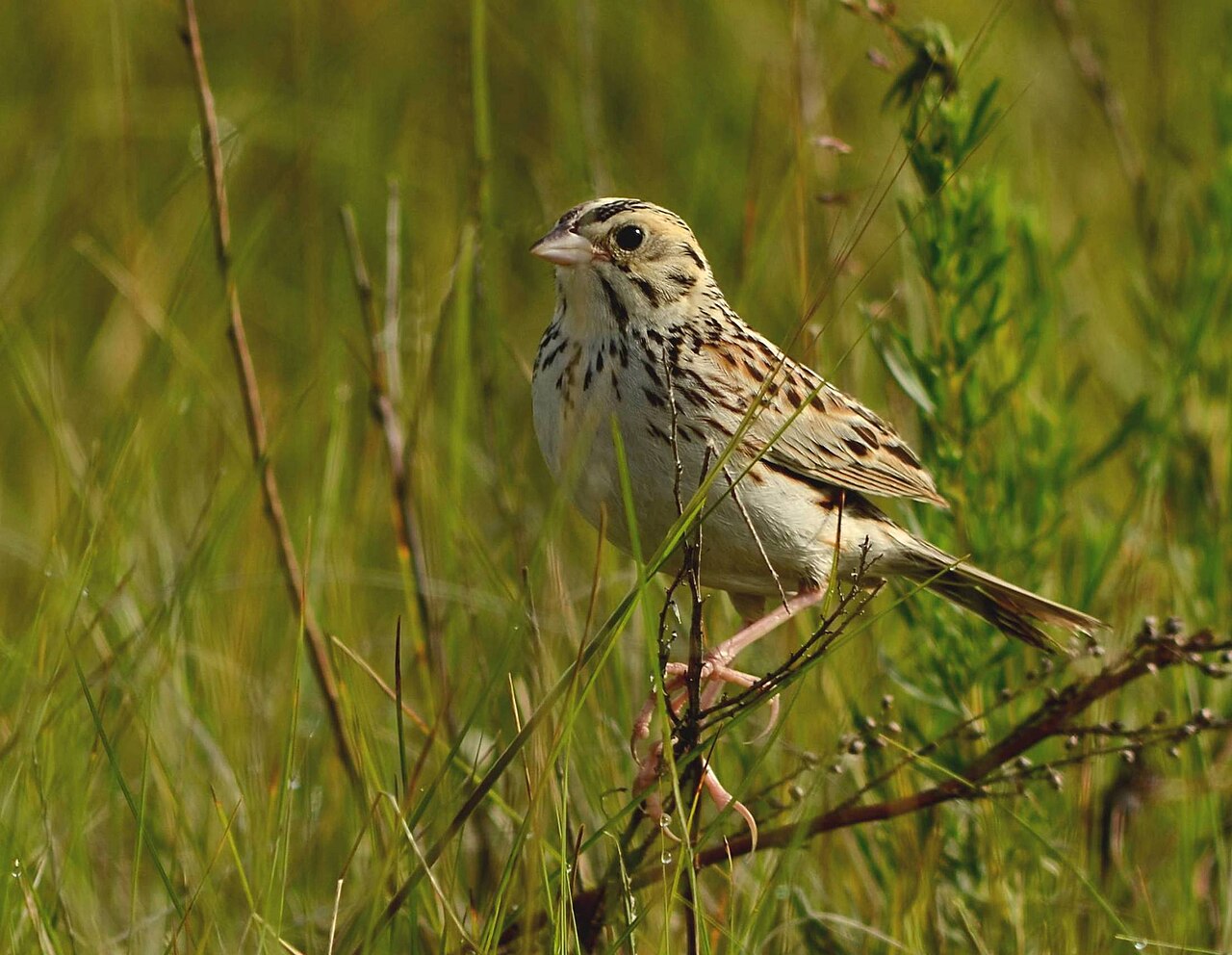
A small, short-tailed sparrow, sandy brown above and broken up by black and chestnut streaks. The head is the key: the crown is dark with a broad ochre-yellow central stripe, and the whole face carries a warm buffy-yellow wash with a fine black line behind the cheek. The underparts are white with a narrow band of thin black streaks across the breast that does not continue onto the belly. The flanks are lightly streaked, the legs flesh-coloured, and the hind claw is noticeably long.
Confusion species
Grasshopper Sparrow has a plain unstreaked breast, a flatter forehead and a heavier bill. On Savannah Sparrow the breast streaking is broader and carries down onto the flanks, there is usually yellow above the eye, and the broad ochre crown stripe is missing. LeConte's Sparrow is more orange-buff on head and breast, shows a grey nape pattern and keeps to wetter sedge. Watch above all for the combination of ochre crown stripe, ochre face and a sharply bounded necklace of fine breast streaks.
Habitat
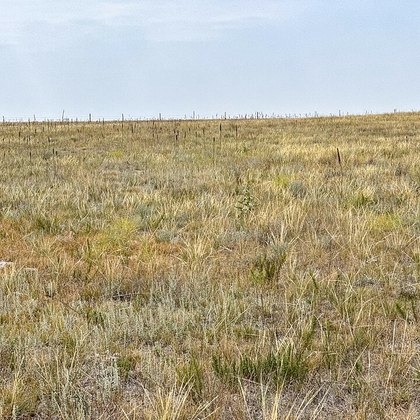
Extensive, never-ploughed mixed-grass and tallgrass prairie with a dense sward, few shrubs and a shallow litter layer. It avoids cropland and restored fields dominated by grasses such as quackgrass; lightly to moderately grazed pasture with native grass is used. In winter it occupies the grasslands of the Chihuahuan Desert, with grama (a tufted prairie grass), three-awn and lovegrass, shrub cover under twenty per cent and a grass height of ten to thirty centimetres.
Where the bird is most often found, arranged by the USNVC — the vegetation classification of the United States and Canada — and CMECS for sea and coast.



Range and movements
The breeding range lies in southern Alberta, Saskatchewan and Manitoba and in Montana, North Dakota and northern South Dakota. Migration passes over the southern Great Plains to the winter range in southeastern Arizona, southern New Mexico, West Texas and above all the northern Mexican plateau in Chihuahua and Durango, with outliers in bordering states. The range is narrower than it was: the eastern edge in Minnesota and Iowa is virtually empty.
- Breeding (summer)
- Winter
- Passage
- dark = core range, pale = thinly spread
Where and when to look
Walk a stretch of native prairie at sunrise in June and listen for the tinkling trill at the end of the song — the bird itself often sits so low that you see it only when it flushes. In winter it is nearly silent and can be found only by walking a band of Chihuahuan grassland until a bird flushes, flies a few metres and drops out of sight again.
Conservation
The species is listed as Least Concern (LC), but breeding bird surveys show a loss of about 65 per cent since 1967, more than two per cent a year, and the State of the Birds treats it as a tipping-point species at the highest alert level. The cause is conversion of native prairie to cropland, compounded on the wintering grounds by shrub encroachment following fire suppression and by spreading exotic grasses. Restored fields sown with non-native grass are barely occupied.
Scientific name
Centronyx bairdii | (Audubon, 1844)
Audubon described the species in 1844 as Emberiza bairdii; because it was later moved to another genus, author and year stand in parentheses. The specimen came from the wet portions of the prairies of the upper Missouri, at Fort Union in present-day North Dakota. The species name honours Spencer Fullerton Baird, then in his early twenties and later head of the Smithsonian Institution. The genus Centronyx was introduced by Baird himself in 1858, from Greek kentron 'spine' and onux 'claw', after the long claw of the hind toe.