All species › Waders, gulls and terns › Sandpipers and allies › Bar-tailed Godwit
Bar-tailed Godwit | Limosa lapponica
Rosse Grutto | Aguja colipinta
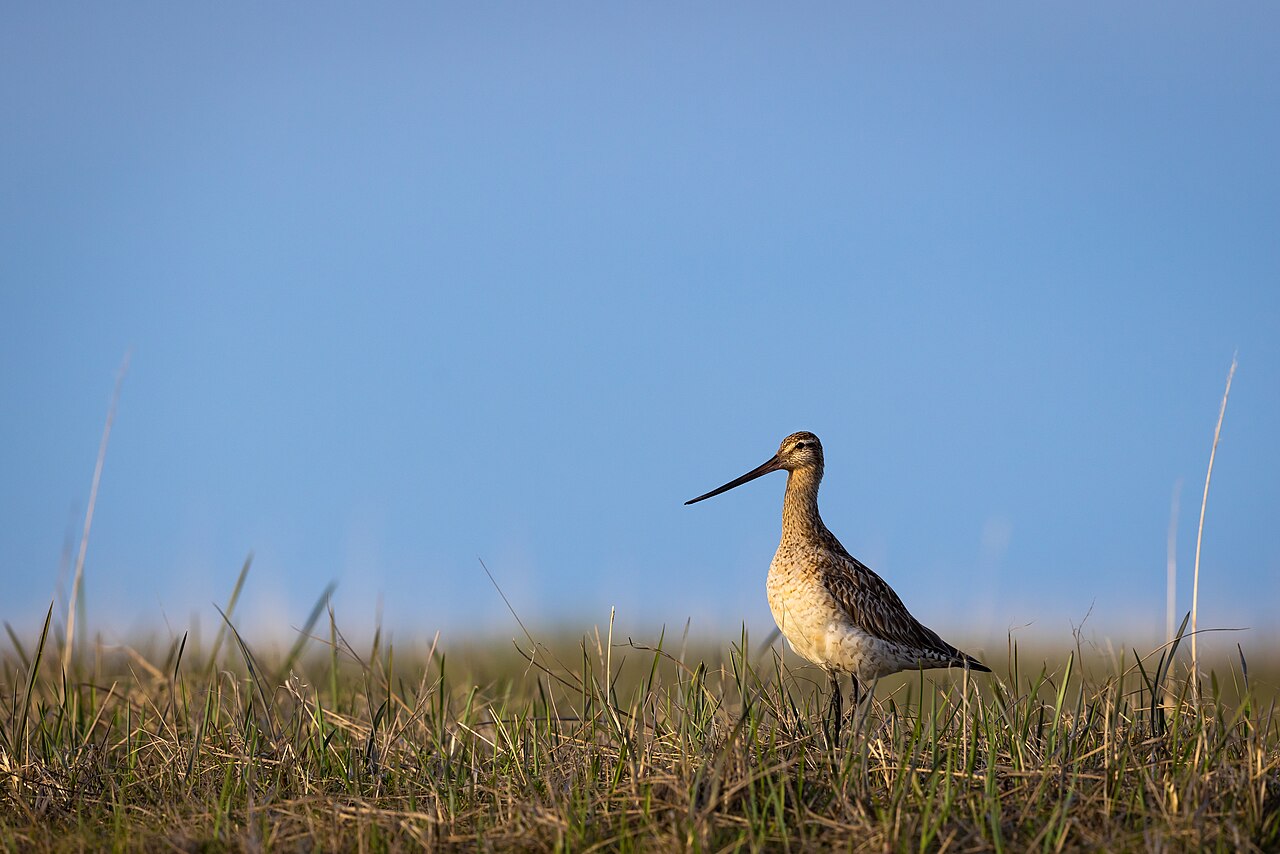
The Bar-tailed Godwit of Alaska makes the longest unbroken flight of any bird: from the coast of western Alaska straight across the Pacific to New Zealand or Australia. In October 2022 a young bird covered 13,560 kilometres that way in eleven days, without once coming down. In breeding plumage the male is brick red from face to undertail.
Voice
The usual call is a hard, nasal kew-kew or ke-wee, mostly of two or three syllables and without the clear ring of the Black-tailed Godwit. Large flocks taking off give a dull murmur of the same notes. Over the tundra the male performs a high display flight with a sustained, yodelling a-wik a-wik a-wik audible at a great distance. On the late-summer mudflats the species is largely silent; what you hear then is a short low kuk between bouts of feeding.
Recording: Lionel Triboulin — CC0 · Moulin des Prés (near Le Mesnil-Esnard), Seine-Maritime, Normandie, France · xeno-canto
Identification
A medium-sized godwit with short legs and a long, slightly upturned bill, pink at the base and black at the tip outside the breeding season. In breeding plumage the male is plain brick red from face to undertail coverts, with dark-mottled upperparts; the female is clearly larger and longer-billed and stays pale buff, with a whitish, finely barred belly. Outside the breeding season both are grey-brown, with dark shaft streaks above that give a streaked look, and white below. The tail is finely barred and there is no white stripe across the wing. Alaskan birds have a barred rump and a brown, barred underwing; the European form has white in those places, and for a vagrant on the east coast that is the difference that counts.
Confusion species
Hudsonian Godwit (Limosa haemastica) is the same size but has a black tail with a white base, a narrow white wingbar and a black underwing; in flight there is no doubt. Marbled Godwit (L. fedoa) is larger and warm cinnamon in every plumage, with cinnamon underwings. Black-tailed Godwit (L. limosa) has a dead straight bill, longer legs, a broad white wingbar and a sharply cut black tail band. On a perched bird the finely barred tail and the absence of a clear wingbar are what to go on.
Compare sandpipers, snipes and allies: bill, legs, wing bar and rump
Habitat
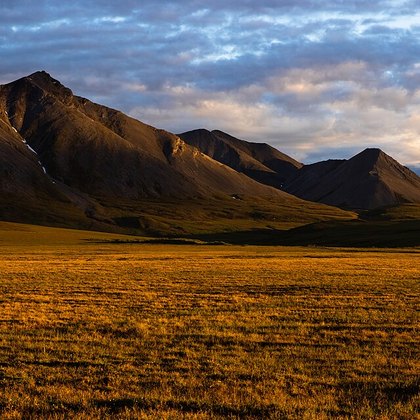
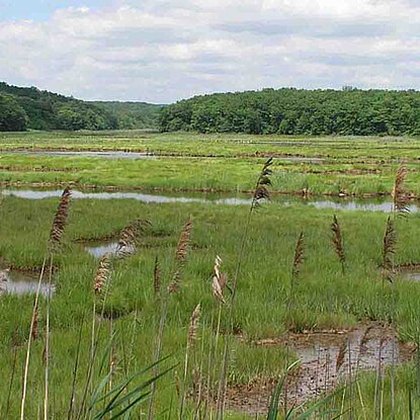
It breeds on low-lying tundra just behind the coast: wet sedge hollows, peaty flats and rolling hills with dwarf birch and dwarf willow, usually within a few tens of kilometres of the sea. As soon as the young can fly the birds move to the mudflats and sandbars of the river mouths, where they gather in thousands in late summer to lay on fat. On passage and in winter the picture is the same everywhere: wide, bare mud and sand flats that fall dry at low water, with a high-tide roost on a beach or salt marsh beside them. Rocky coasts, inland waters and wooded country it does not use.
Where the bird is most often found, arranged by the USNVC — the vegetation classification of the United States and Canada — and CMECS for sea and coast.



Range and movements
It breeds from northern Scandinavia east through Siberia and, on this continent, in western and northern Alaska: from the delta of the Yukon and the Kuskokwim to the Seward Peninsula and the North Slope. The Alaskan birds gather in August and September on the flats of that delta and of the Alaska Peninsula, and leave from there in a single flight across the Pacific to New Zealand and eastern Australia. The return in spring does not cross the open sea but follows the Yellow Sea, so that the annual journey becomes a great loop over the ocean. Outside Alaska the species is scarce in North America: a few birds a year on the Pacific coast and, mostly in late summer, on the Atlantic coast.
- Resident
- Breeding (summer)
- Winter
- Passage
- dark = core range, pale = thinly spread
Where and when to look
To see the red breeding plumage, go to the tundra near Nome or Utqiaġvik in the first half of June: males sit calling on a tussock and can be seen from far off. For numbers, late August on the flats of the Yukon-Kuskokwim Delta is the moment, when the birds have eaten themselves so heavy that they take off with difficulty. If a godwit turns up on a mudflat outside Alaska, look at the tail and the underwing: a finely barred tail without a broad white wingbar points this way, and a brown barred underwing belongs to the birds of Alaska and Siberia, a white one to those of Europe.
Conservation
The species is listed as Near Threatened (NT) on the Red List; the world population is put at about 1.1 million birds and has fallen by more than half in fifty years, though recent years have been fairly stable. The Alaskan birds hang on two links: the tidal flats of the Yukon-Kuskokwim Delta where they build their fat, and the shores of the Yellow Sea where they refuel on the way back. It is those last that reclamation has largely removed, and that accounts for most of the decline. On the breeding grounds themselves drying and the rapid change of the tundra play their part.
Scientific name
Limosa lapponica | (Linnaeus, 1758)
Linnaeus described the species in 1758 as Scolopax lapponica, among the snipes; because it was later moved to another genus, author and year stand in parentheses. The genus Limosa was introduced by Brisson in 1760 and comes from Latin limus 'mud': the muddy flat is the habitat of the whole group. lapponica means 'of Lapland', which is also the type locality Linnaeus gave. The Alaskan birds are placed in the form baueri, named by Naumann in 1836.