All species › Waders, gulls and terns › Sandpipers and allies › Far Eastern Curlew
Far Eastern Curlew | Numenius madagascariensis
Siberische wulp | Zarapito de Siberia
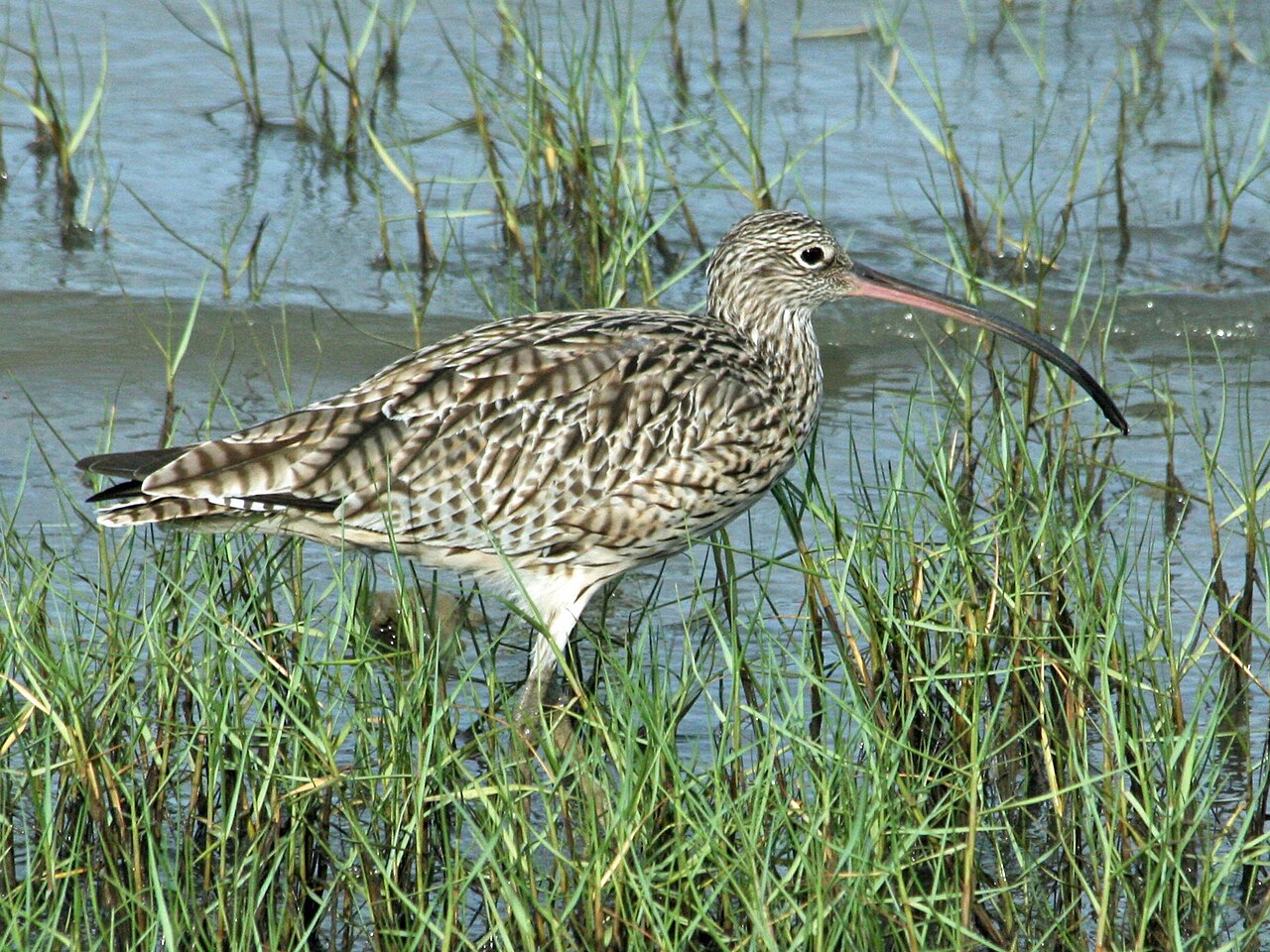
The Far Eastern Curlew is the largest curlew in the world: a uniformly dark brown bird with a bill that reaches twenty centimetres in the female, longer than in any other shorebird. It breeds in eastern Siberia and winters in Australia, and on that journey it now and then ends up on the wrong side of the Bering Sea. North America has barely more than a handful of records, almost all of them in spring in the outer Aleutians.
Voice
The call is a loud, clear two-syllable whistle, coo-ree, stressed on the second syllable and usually repeated a few times; it carries across a whole tidal flat. When disturbed this turns into a faster, higher kir-kir-kir. Over the breeding ground it gives a long, plaintive song flight that rises and falls and can be confused with that of other large curlews. A vagrant in Alaska is usually silent; to hear one call is luck.
Recording: He Wenjin/文进 — CC BY-NC-SA 4.0 · Dan Dong, Liao-Ning, China, China · xeno-canto
Identification
A large, long-legged curlew with a long, evenly decurved bill: more than thirteen centimetres in the male, up to twenty in an old female. The plumage is streaked and barred in one dark brown tone from head to tail, without the pale belly that other large curlews have. Crown, neck and breast are closely streaked dark; the flanks and undertail coverts are barred, not white. In flight there is no white anywhere: back, rump and tail are as brown as the rest, and the underwing too is brown with dense barring. Male and female are coloured alike, but the female is larger and longer-billed, and juveniles have a shorter bill and neatly fringed coverts.
Confusion species
Long-billed Curlew (Numenius americanus) is the only species it can really be confused with in North America: as large and as long-billed, but warm cinnamon instead of cool brown, with a plain unstreaked belly and strongly cinnamon underwings. Hudsonian Whimbrel (N. hudsonicus) is considerably smaller, much shorter-billed, and carries dark bands across the crown. From Eurasian Curlew (N. arquata), which does not reach this continent, it differs in lacking the white wedge on the back and the white belly. For every report the rule is the same: photograph the bird as it flies, because everything hangs on back and underwing.
Habitat
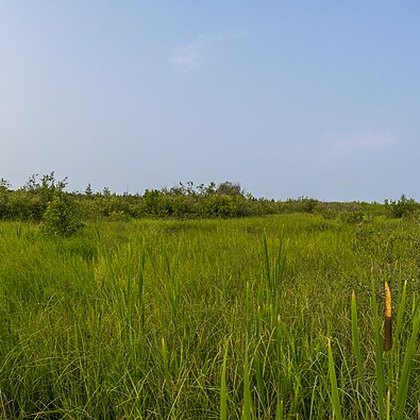
In winter and on passage it is a bird of wide tidal flats, river mouths, mangrove fringes and salt marsh, where it drives the long bill deep into the mud for crabs and shrimps. On the breeding grounds in Siberia it uses open wet hollows at the edge of the taiga: sedge marsh, bog-moss flats and lake shores, with short vegetation and much standing water. The little that is known of it here fits that picture: the birds in Alaska and Canada stood on tidal flats and in wet, short tundra just behind the shore. Deep water, dense vegetation and dry inland country it does not use.
Where the bird is most often found, arranged by the USNVC — the vegetation classification of the United States and Canada — and CMECS for sea and coast.




Range and movements
It breeds in eastern Siberia, from Transbaikalia to Kamchatka and the Amur, and winters almost entirely in Australia, with smaller numbers in Indonesia, the Philippines and New Zealand. The whole population passes along the shores of the Yellow Sea, where the birds refuel for weeks in spring and autumn. In North America it is a very rare vagrant: a few spring records in the western and central Aleutians, a handful on St. Paul and elsewhere in western Alaska, one bird at Lake Laberge in Yukon on 31 May and 1 June 2017, and one in British Columbia, at Boundary Bay near Delta on 24 September 1984. Now that the species is declining fast, new records are becoming less likely rather than more.
Where and when to look
To find one you must be on Attu, Shemya or Adak in the last week of May and check every large curlew on the salt marsh; outside the outer Aleutians the chance is negligible. Look at the belly first: if it is closely streaked and neither white nor plain cinnamon, keep looking. Then wait for the flight and watch the underwing; a brown, barred underwing on a giant curlew leaves only one species.
Conservation
The species is listed as Endangered (EN) on the Red List, with an estimated 20,000 to 35,000 mature birds and a rapid decline. The cause is known and lies on the Yellow Sea: reclamation and land-making have removed more than sixty-five per cent of the tidal flats on which the whole population depends during migration. In Australia, where almost all the birds winter, it counts as critically endangered, and on the breeding grounds too the wet hollows are shrinking through drainage and fire.
Scientific name
Numenius madagascariensis | (Linnaeus, 1766)
Linnaeus described the species in 1766 as Scolopax madagascariensis, among the snipes; because it was later moved to another genus, author and year stand in parentheses. The genus Numenius was introduced by Brisson in 1760 and is formed from Greek neos 'new' and mene 'moon', after the sickle shape of the bill. The species name means 'from Madagascar', and rests on a mistake: the bird does not occur there. The specimen described turned out to come from Macassar on Celebes, and the type locality was later restricted to that place; the name itself may no longer be changed under the rules.