All species › Waders, gulls and terns › Sandpipers and allies › Black-tailed Godwit
Black-tailed Godwit | Limosa limosa
Grutto | Aguja colinegra
In North America the Black-tailed Godwit is not a breeding bird but a visitor from overseas: a slender, long-legged godwit with a dead straight bill, showing a broad white wingbar and a sharply cut black tail band in flight. In spring a small number of Asian birds passes almost annually through the Aleutians; on the Atlantic coast an Icelandic bird turns up now and then. It is the rarest of the four godwits of this continent.
Voice
The call is a loud, nasal weeka-weeka-weeka, stressed on the first syllable, given above all on take-off and in alarm. There is also a shorter, higher kwee-kwee as a contact call within a flock. Over the breeding grounds, which lie outside this continent, the male sings a sustained grut-to grut-to in a rocking display flight; that sound gave the bird its Dutch name. A vagrant is usually silent and rarely betrays itself by voice.
Recording: Jens Schöller — CC BY-NC-SA 4.0 · Cham, Upper Palatinate, Bavaria, Germany · xeno-canto
Identification
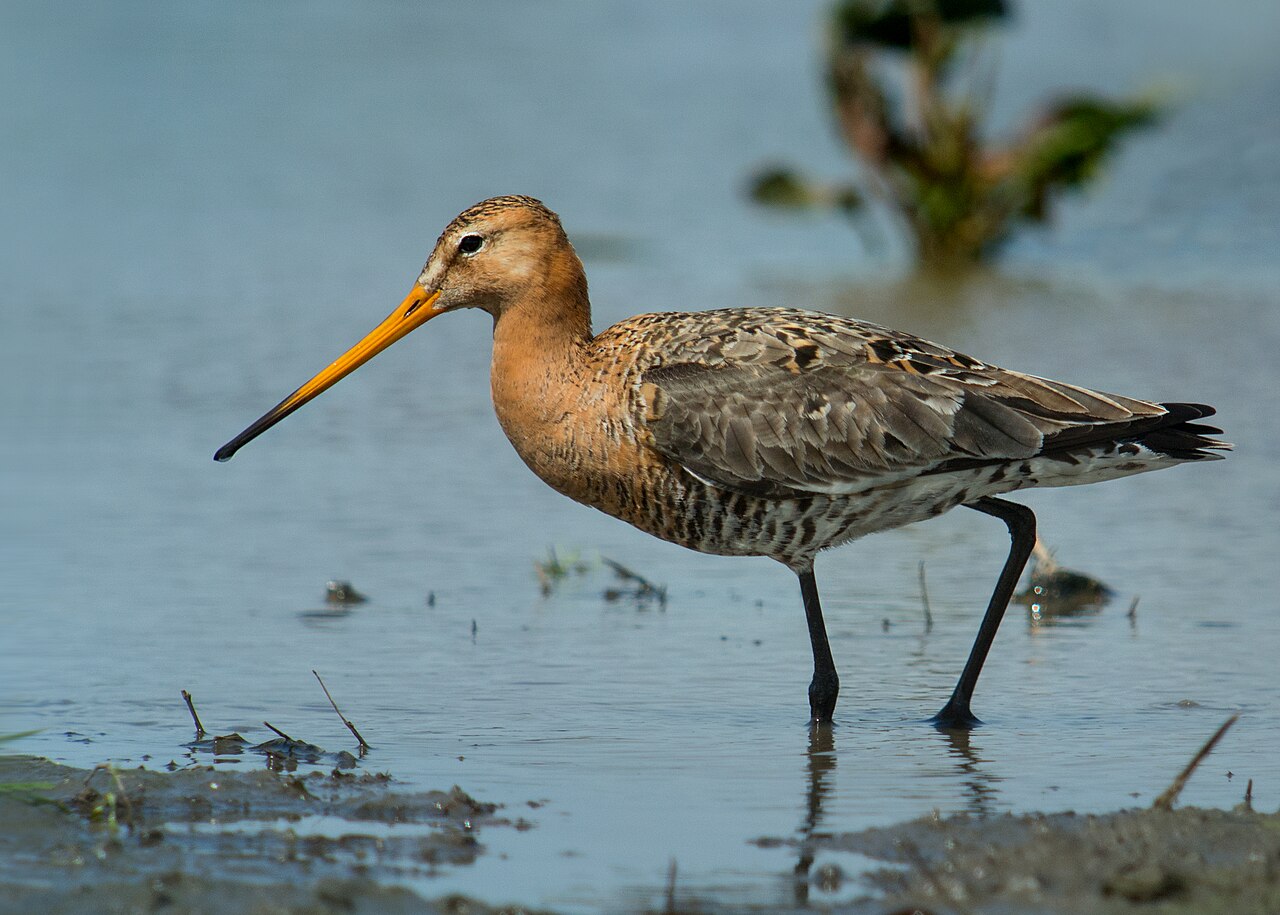
A large, slender godwit with long legs, a long neck and a dead straight bill, pink at the base and black at the tip. In breeding plumage head, neck and breast are warm orange-brown, with black bars across the flanks and a white belly; the male is brighter and smaller, the female paler, larger and longer-billed. Outside the breeding season the bird is plain grey-brown above and pale below, without streaking — that even grey separates it at once from the Bar-tailed Godwit. In flight it is distinctive: a broad white stripe along the whole wing, a white rump, a sharply cut black tail band and feet projecting well beyond the tail. Juveniles have a warm orange wash over neck and breast and neatly fringed coverts.
Confusion species
Bar-tailed Godwit (Limosa lapponica) has a slightly upturned bill, shorter legs, no white wingbar and a finely barred tail, and outside the breeding season is streaked above rather than plain. Hudsonian Godwit (L. haemastica), the species that breeds on this continent, has a narrower white wingbar and a black underwing, where this bird's is white. Marbled Godwit (L. fedoa) is warm cinnamon in every plumage, with cinnamon underwings, and lacks the black and white in wing and tail. On a perched bird the plain grey upperparts are the quickest mark; once it flies, the broad white wingbar decides.
Habitat
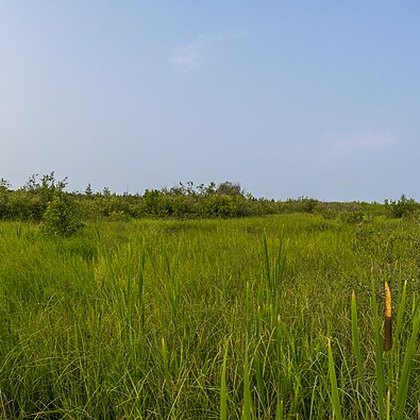
On passage and in winter a bird of shallow fresh and brackish water: flooded pasture, rice fields, clay pits, the edges of lagoons and the upper margin of tidal flats. It wades deeper than most shorebirds and drives the bill into the mud up to the eyes, sometimes with the whole head under water. On the breeding grounds in Eurasia it belongs in wet, herb-rich hay meadows and sedge marsh, and it is precisely those that have largely gone from western Europe. The birds that appear in North America usually stand on a salt marsh or a flooded field among other shorebirds.
Where the bird is most often found, arranged by the USNVC — the vegetation classification of the United States and Canada — and CMECS for sea and coast.




Range and movements
It breeds from Iceland and western Europe east through Central Asia to Mongolia and the Russian Far East, and winters in West Africa, around the Mediterranean, in southern Asia and in Australia. It does not breed in North America: the birds that reach here are visitors from overseas. In spring a small number of Asian birds passes almost annually through the Aleutians, and that is the only place on the continent where it is seen with any regularity. On the Atlantic coast there are scattered records from Newfoundland to Florida, and in rare cases also on the Gulf Coast and inland. The picture has not changed materially in recent decades, although birds are found faster now that more people are looking.
Where and when to look
To see one in North America you must be on Attu or Adak in the second half of May and work through the flooded fields and salt marshes; that is the only place where it is found in almost every year. Elsewhere the rule is: in a flock of godwits, look for the bird with the dead straight bill and the plain grey back, and wait for it to fly. A broad white wingbar with a black tail band belongs to no other godwit of this continent.
Conservation
The world population is estimated at 450,000 to 585,000 mature birds and is falling; over three generations the loss is about a quarter, enough for Near Threatened (NT) on the Red List. The cause lies in Europe: draining, levelling and early mowing of wet hay meadows leave too few chicks to reach the wing. To that comes hunting, which in France alone costs six to eight thousand birds a year. For the picture in North America that makes little difference; here it is a matter of a few birds a year.
Scientific name
Limosa limosa | (Linnaeus, 1758)
Linnaeus described the species in 1758 as Scolopax Limosa, among the snipes; because it was later moved to another genus, author and year stand in parentheses. The genus Limosa was introduced by Brisson in 1760 and comes from Latin limus 'mud'; the species name is the same word in adjective form and means 'muddy'. The name therefore says the same thing twice: the bird of the mud. Linnaeus gave the origin as Europe; the type locality was later restricted to Sweden.