All species › Waders, gulls and terns › Sandpipers and allies › Marbled Godwit
Marbled Godwit | Limosa fedoa
Marmergrutto | Aguja Canela
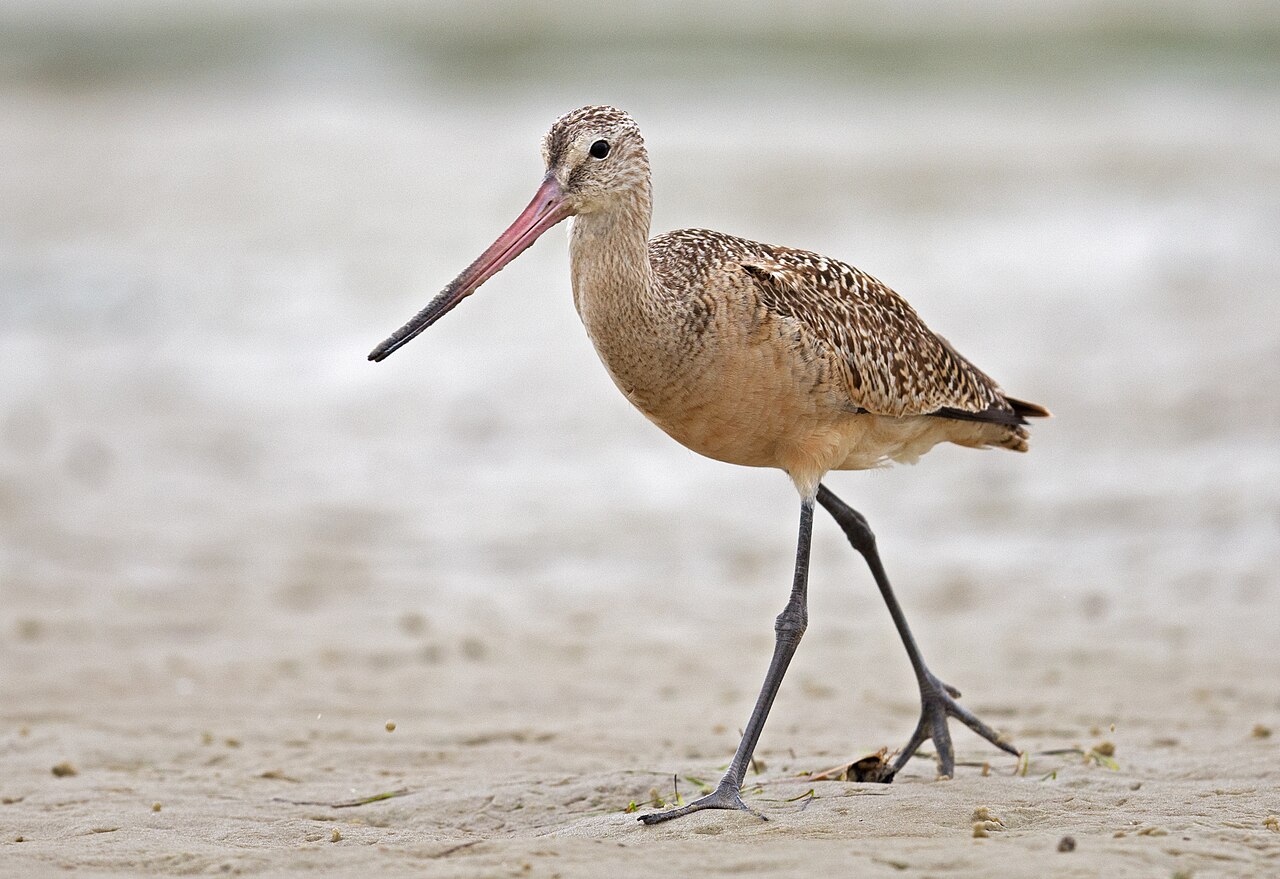
The largest godwit of the continent: a cinnamon wader with a long, slightly upturned bill that begins pink and ends black. It breeds on the shortgrass prairie of the northern Great Plains, far from salt water, and spends the winter on the tidal flats of both coasts. In flight the underwing glows warm cinnamon — the mark that gives it away at a distance.
Voice
Over the prairie the male circles wide and repeats a loud, nasal ra-di-ca ra-di-ca that carries far across the grass. At the nest, and at an approaching person, there is a hard stuttering kek-kek-kek, kept up in short bursts as long as the intruder stays. The ordinary call, heard outside the breeding season too, is a loud nasal kerr-wit in which the English name of the group can be heard. A flock on the flats is otherwise silent; it is the birds lifting off that call.
Recording: Nancy Salem — CC BY-NC-SA 4.0 · Golden Shore Preserve, Long Beach, Los Angeles County, California, United States · xeno-canto
Identification
A large wader with a small round head, a long neck and a bill nearly twice the length of the head that curves slightly upward; the base is pink to orange, the last part black. In breeding plumage the whole plumage is closely barred in brown, black and cinnamon, breast and flanks included. In winter plumage that barring drops from the underside and what is left is a plain cinnamon-buff bird with finely mottled upperparts. In flight there is no wingbar and no white rump; what shows is the warm cinnamon underwing and the cinnamon base to the primaries. The female is larger than the male and has a noticeably longer bill. The legs project beyond the tail in flight.
Confusion species
Long-billed Curlew (Numenius americanus) is as large and as cinnamon but has a long, strongly decurved bill. Hudsonian Godwit (Limosa haemastica) is smaller, has a black underwing, and in flight shows a white rump with a broad black tail band. Bar-tailed Godwit (L. lapponica) carries a white wedge up the back and a finely barred tail, and lacks the cinnamon underwing. Willet is shorter-billed and greyer, and on taking off shows a bold black-and-white wing pattern that Marbled Godwit does not have.
Compare sandpipers, snipes and allies: bill, legs, wing bar and rump
Habitat
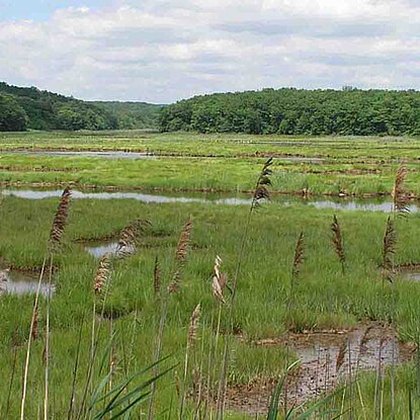
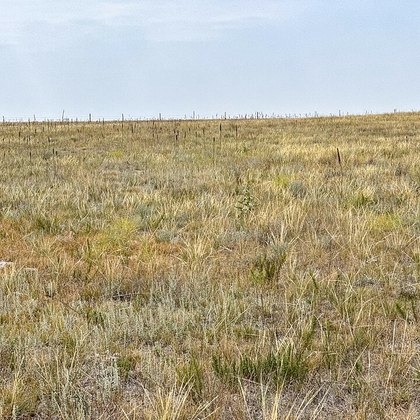
In the breeding season shortgrass prairie of blue grama and needle grass, with shallow pools or prairie marshes nearby, though the nest often lies hundreds of metres from water. Tall dense grass it avoids; what it needs is a clear view. Outside the breeding season it is a bird of mud and salt water: tidal flats in estuaries and bays, salt pans, lagoons and the edge of the saltmarsh, and sandy beach only where mud lies beside it. It feeds wading in water up to its belly and regularly puts its whole head under.
Where the bird is most often found, arranged by the USNVC — the vegetation classification of the United States and Canada — and CMECS for sea and coast.



Range and movements
The bulk of the breeding birds lies on the northern Great Plains: Montana, both Dakotas, western Minnesota, Alberta, Saskatchewan and Manitoba. Beyond that two small and entirely separate groups breed, one on the tundra at James Bay in Ontario and one on the Alaska Peninsula. In winter most birds are on the Pacific from Washington to Baja California and western Mexico, with a second concentration on the Gulf of Mexico and on the Atlantic coast from the Carolinas to Florida; a small share goes further than Panama. The range shrank through the nineteenth and twentieth centuries as the prairie went under the plough: as a breeding bird it has gone from Iowa and from the southern Great Lakes.
- Resident
- Breeding (summer)
- Winter
- Passage
- dark = core range, pale = thinly spread
Where and when to look
Stand at the edge of a tidal flat on a rising tide in winter: the Marbled Godwit is the big warm-brown bird among the willets and the curlews, and it keeps probing when the water is already round its belly. Wait until the flock lifts — the cinnamon underwing is then visible at hundreds of metres and settles the species at once. On the prairie May is the month: the male then circles high above the grass.
Conservation
The Red List holds the species as Vulnerable (VU). The breeding population is put at about 170,000 birds and the weakness lies in the small size of the range: two of the three breeding groups are small and isolated, and in winter a large share of all the birds sits on a handful of estuaries. Turning native prairie into cropland has cut the breeding ground. On the coast the area of mud has fallen: that of San Francisco Bay went from just over 8,000 to nearly 5,000 hectares between 1800 and 2000.
Scientific name
Limosa fedoa | (Linnaeus, 1758)
Linnaeus described the species in 1758 as Scolopax Fedoa, among the snipes; because it was later placed in the genus Limosa, author and year stand in parentheses. That genus was introduced by Brisson in 1760 and goes back to the Latin limosus, 'muddy', after the ground the bird feeds in. fedoa is an old English book-name for a godwit, already used by Turner in 1544; where the word itself comes from is not known. The described specimen came from North America, and the type locality was later fixed on Hudson Bay, after the plate in Edwards on which Linnaeus drew.