All species › Passerines › Thrushes and allies › Bicknell's Thrush
Bicknell's Thrush | Catharus bicknelli
Bicknells dwerglijster | Zorzal de Bicknell
Bicknell's Thrush breeds in the wind- and ice-battered spruce forest on the summits of the mountains of northeastern America and winters almost entirely on Hispaniola. Of all songbirds breeding regularly in North America it has one of the smallest ranges; only in 1995 was it separated as a species from Gray-cheeked Thrush.
Voice
The song consists of four phrases of fluting, slightly nasal notes; the last phrase holds its pitch or rises, whereas that of Gray-cheeked Thrush falls — in the field this is the most reliable distinction. Song comes mainly at sunrise and in the last hour before dark, often from several males at once. The calls are a descending whistle, a growling alarm and a nasal flight note.
Recording: Doug Hynes — CC BY-SA 4.0 · St. Paul Island, Nova Scotia, Canada · xeno-canto
Identification
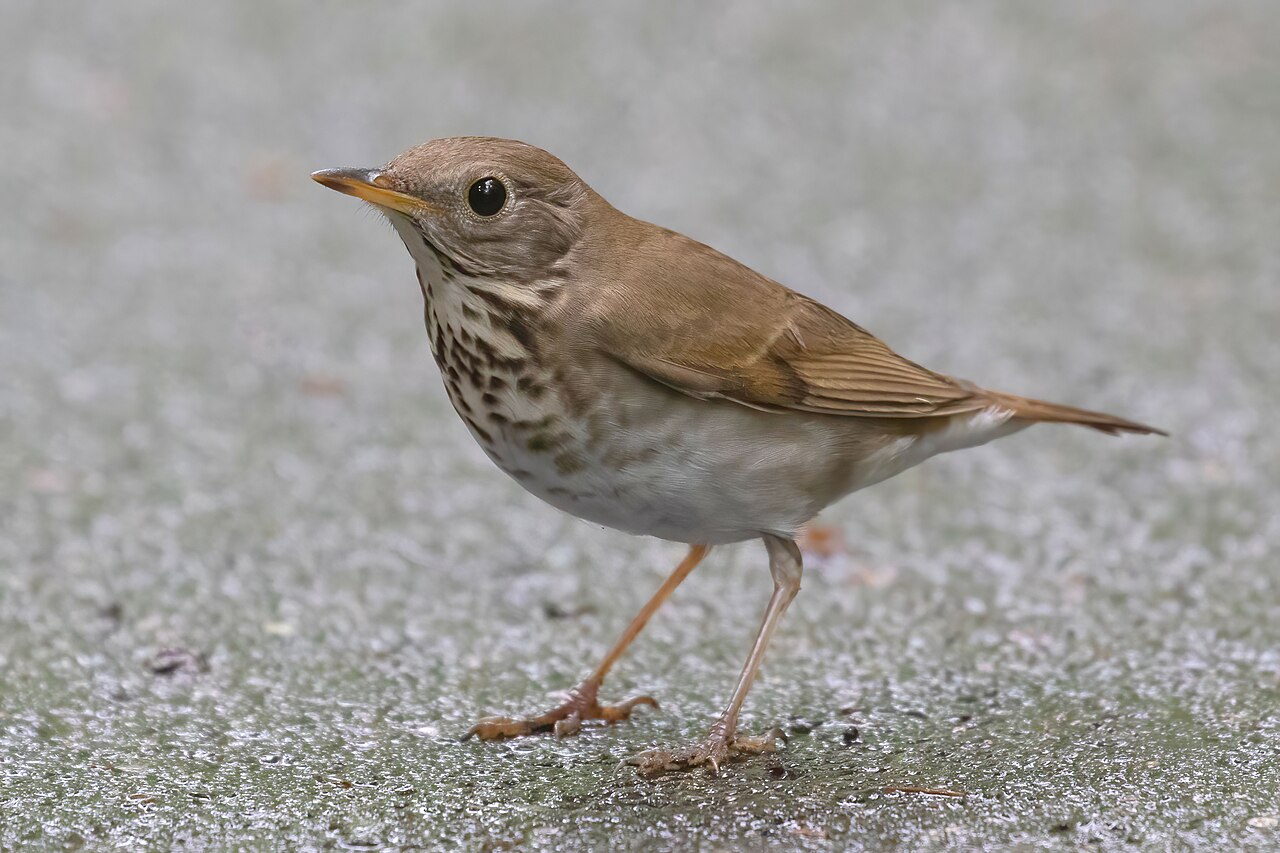
A small, compact Catharus with olive-brown to chestnut-tinged upperparts and a tail slightly more rufous than the back. The underparts are off-white with dull black spots on the upper breast and grey flanks. The eyering is narrow, grey and often incomplete, the cheek grey. The bill is distinctive: the lower two-thirds of the lower mandible is yellow, only the tip black. The legs are pink.
Confusion species
Gray-cheeked Thrush is the main confusion species and cannot be separated reliably on colour; it averages larger and greyer above, with less rufous in the tail and on average less yellow on the lower mandible, but the song decides: a falling final phrase in Gray-cheeked, level or rising in Bicknell's. Swainson's Thrush has a full buff eyering and buff cheeks. Veery is a warmer rufous with faint spots. Outside the song period a silent bird usually cannot be identified in the field.
Habitat
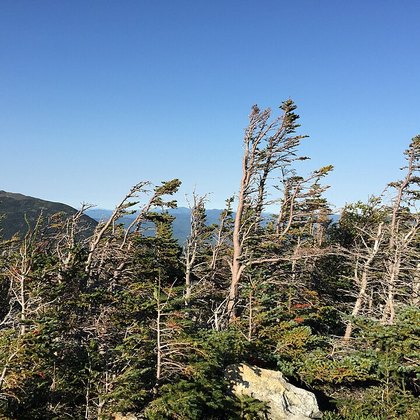
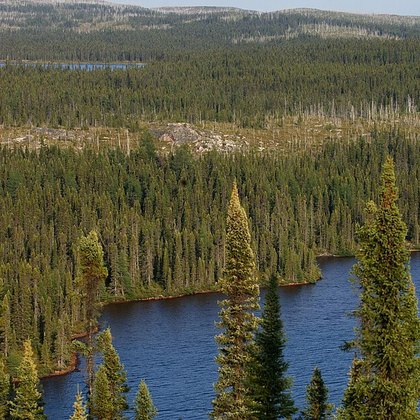
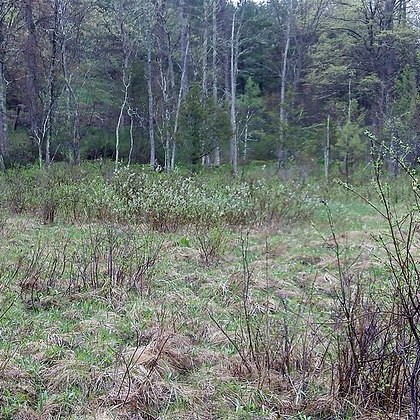
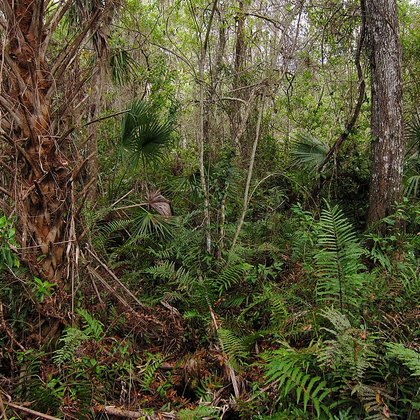
Dense, low and heavily deformed spruce and balsam fir forest on mountain summits, almost always above about 900 metres, where wind and ice keep the trees stunted — on the coast of Nova Scotia and the Gulf of St Lawrence that drops to near sea level. Young, dense forest after logging or storm is used too, provided the understorey is closed. In winter it occupies moist broadleaf montane forest on Hispaniola, from the lowlands to above a thousand metres, favouring undisturbed forest.
Where the bird is most often found, arranged by the USNVC — the vegetation classification of the United States and Canada — and CMECS for sea and coast.
Range and movements
The breeding range covers eastern Quebec, New Brunswick and Nova Scotia and the highest summits of New England and New York: the Adirondacks, the Catskills, the Green Mountains, the White Mountains and the mountains of Maine. Migration follows the east coast and crosses the Bahamas to the Greater Antilles. About ninety percent winters on Hispaniola, mainly in the Dominican Republic; smaller numbers are in eastern Cuba, eastern Jamaica and Puerto Rico.
- Breeding (summer)
- Winter
- Passage
- dark = core range, pale = thinly spread
Where and when to look
The best chance is a summit with stunted spruce in Vermont, New Hampshire or the Adirondacks, in the second half of June, in the half hour around sunrise or just before dark — by day the species is almost entirely silent. Go by the final phrase of the song rather than by appearance; in case of doubt, leave without an identification rather than name a silent bird on colour.
Conservation
The IUCN treats the species as Vulnerable, and in Canada it has been listed as Threatened since December 2022. The world population is put at under 120,000 birds, roughly 70,000 in the United States and 40,000 to 50,000 in Canada. On the breeding grounds the high-elevation spruce forest is shrinking and fragmenting through ski areas, communication towers, wind farms and a rising treeline under a warming climate; on Hispaniola the loss of broadleaf montane forest to logging, charcoal production and agriculture is the main pressure, and those two small areas leave the species exposed at both ends of the flyway.
Scientific name
Catharus bicknelli | (Ridgway, 1882)
Ridgway described the bird in 1882 as Hylocichla aliciae bicknelli, as a subspecies of Gray-cheeked Thrush, from a specimen taken near the summit of Slide Mountain in Ulster County, New York; because it was later moved to another genus, author and year stand in parentheses. The species name honours Eugene Pintard Bicknell, the amateur ornithologist who collected the bird there. The genus Catharus comes from Greek katharos 'pure, clean'. The American Ornithologists' Union recognised it as a full species in 1995.