All species › Passerines › Tanagers and allies › Black-faced Grassquit
Black-faced Grassquit | Melanospiza bicolor
Maskergrondvink | Semillero bicolor
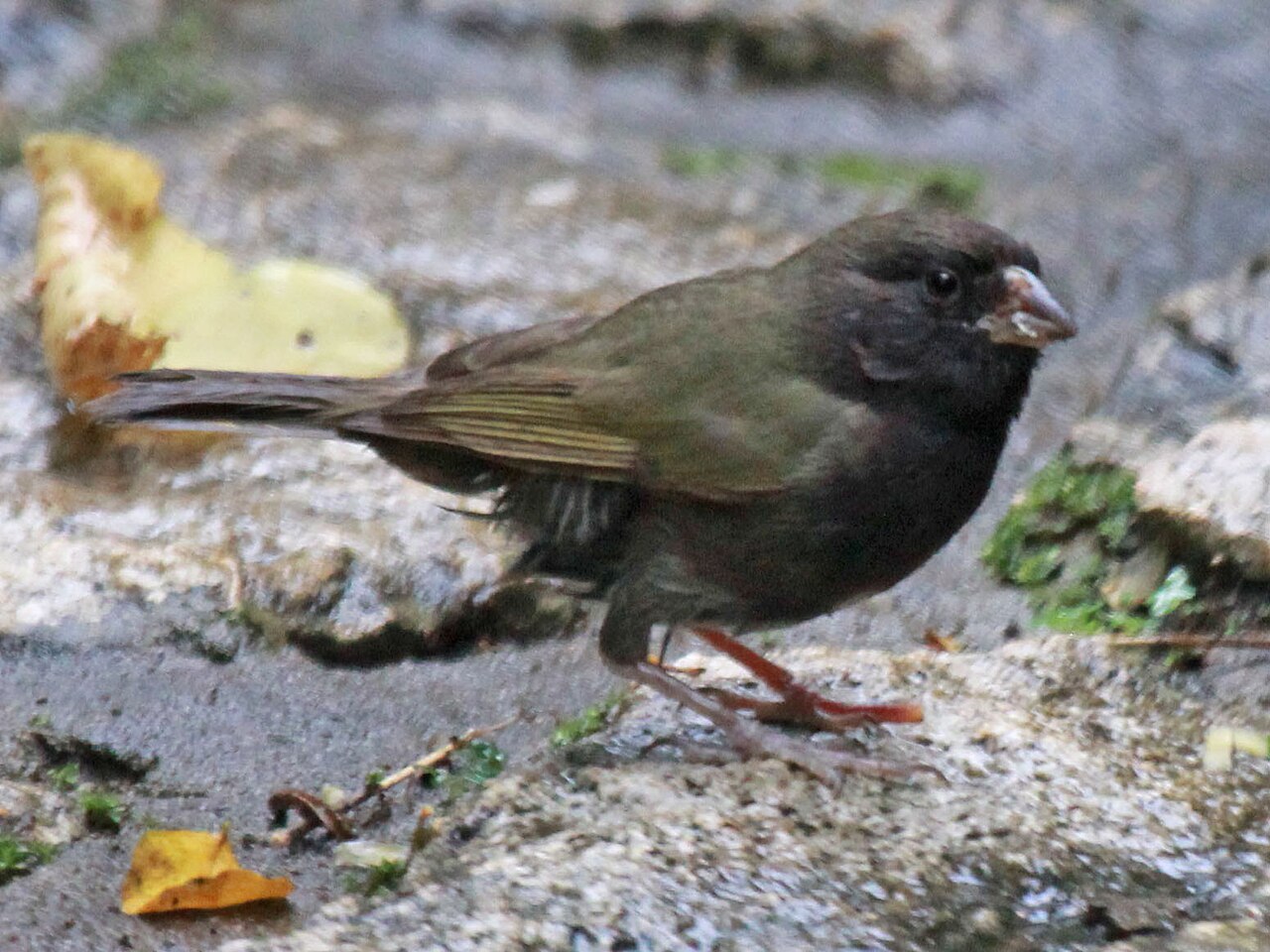
The Black-faced Grassquit is a small seedeater of dry scrub and coastal thicket across the West Indies. The male has a black head, throat and breast against an olive-green back and wings; the female is plain dull green without markings. The species is absent from Cuba and from mainland Central America, and reaches the United States only as a vagrant in southern Florida.
Voice
The song is a short, emphatic buzz, often followed by a second, louder buzz at a slightly different pitch — a dry bzz… bzzzzt that sounds more like an insect than a bird. The length and pitch of the syllables vary from island to island. A soft, musical tsip serves as a contact call. The male sings from the top of a bush or a wire, vibrating his wings as he does so.
Recording: Francisco contreras — CC BY-NC-SA 4.0 · CIEZA UNEFM, Miranda, Falcón, Venezuela · xeno-canto
Identification
Small, 10 to 11 centimetres and 7 to 13 grams, with a short conical bill. The male of the nominate form has a black head, throat and underparts, with olive-green back, wings and tail and dark green rear flanks. The female and the young bird are uniform dull olive-green, somewhat browner or greyer below, without streaking or wingbar. The iris is dark, the legs dusky pink. Subspecies differ in how far the black extends over the underparts.
Confusion species
The male Yellow-faced Grassquit has a yellow throat, yellow eyebrow and yellow spot below the eye against the black face; the Black-faced is entirely black there. The females are closely similar: a female Black-faced is plainer and greyer-brown below, with no yellow wash. On the islands where both occur — Jamaica, Hispaniola, the Cayman Islands — that is the only distinction in the field. In Florida an immature Indigo Bunting is the likeliest confusion: it is larger, warmer brown, finely streaked on the breast and heavier-billed.
Habitat
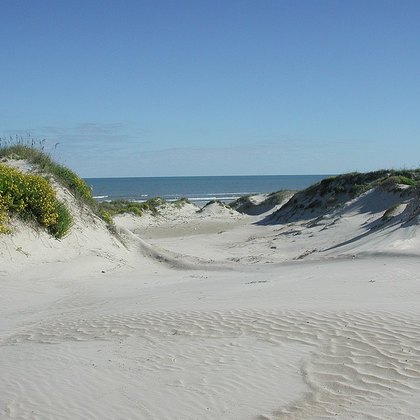
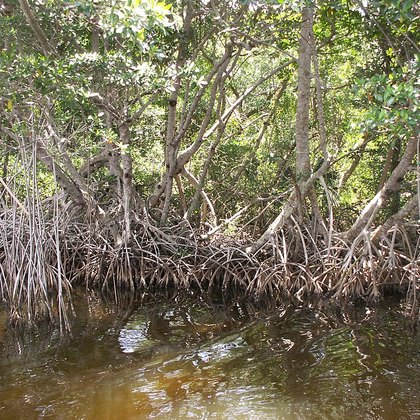
Dry to semi-dry open ground: thorn scrub, cactus scrub, grassy woodland edges, forest clearings, coastal dune and sand flats with low growth, plantations and gardens. On the Leeward Antilles it also occurs in mangrove. The upper limit lies around 1300 metres. Grass and herb seed forms the main food, taken while walking or while clinging to the stem; small insects are also caught in the breeding season. The nest is a domed ball with a side entrance, low in a shrub or cactus.
Where the bird is most often found, arranged by the USNVC — the vegetation classification of the United States and Canada — and CMECS for sea and coast.



Range and movements
Resident, with no migration. The nominate form occupies the Bahamas, the Turks and Caicos and the islets north of Cuba; other subspecies occur on Jamaica, Hispaniola, Puerto Rico, the Cayman Islands and through the Lesser Antilles, and along the north coast of Colombia and Venezuela with their offshore islands. Cuba itself is missing from the range, as is the Central American mainland. A few records are known from southern Florida, nearly all of birds presumed to have come from the Bahamas.
- Resident
- Breeding (summer)
- Winter
- Passage
- dark = core range, pale = thinly spread
Where and when to look
Work a dry coastal road or a track through thorn scrub and listen for the short buzz; it betrays the bird sooner than the eye does. The male sings from an exposed twig and then shows against the sky as a small, dark silhouette. Females often cannot be settled without the voice or without a male alongside.
Conservation
The species is listed as Least Concern (LC). Population size has not been established, but the range is large and numbers are rising rather than falling, as clearance and grazing produce open, grassy scrub. No pressures acting in the short term have been identified. On the smallest islands a hurricane can set the local population back for a time.
Scientific name
Melanospiza bicolor | (Linnaeus, 1766)
Linnaeus described the species in 1766 as Fringilla bicolor, from a specimen from the Bahamas; because it was later moved to another genus, author and year stand in parentheses. The genus Melanospiza was introduced in 1897 by Robert Ridgway, from Greek melas 'black' and spiza 'finch'. The species name bicolor is Latin for 'two-coloured', after the black and green plumage of the male. The English and Dutch names refer to the male's black face.