All species › Passerines › Tanagers and allies › Yellow-faced Grassquit
Yellow-faced Grassquit | Tiaris olivaceus
Grote Cubavink | Semillero tomeguín
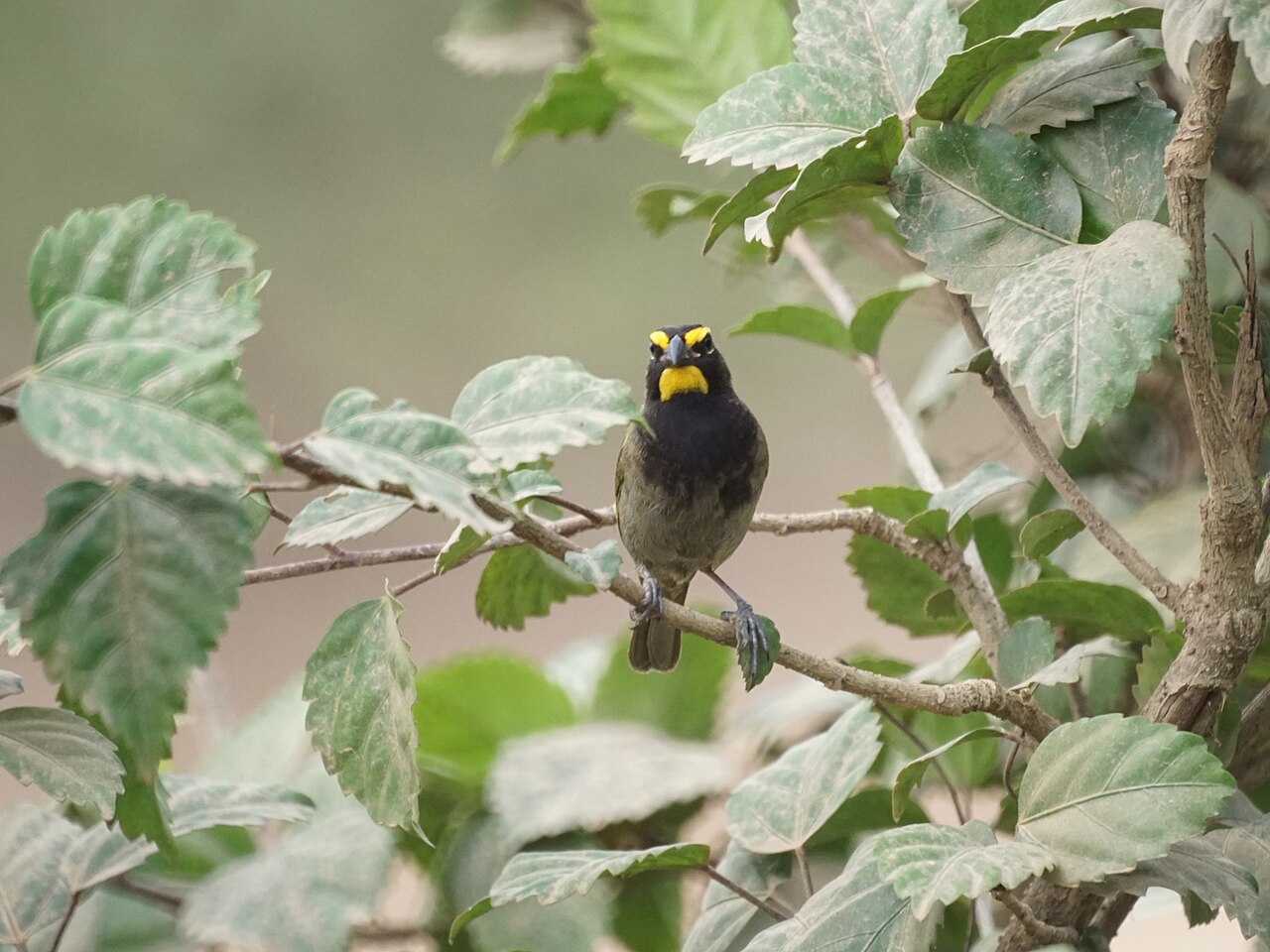
The Yellow-faced Grassquit is a small olive-green seedeater with a short conical bill. The male has a black face and black breast set against a bright orange-yellow throat, eyebrow and spot below the eye; the female shows almost none of that pattern. The species belongs to grassy roadsides, pastures and weedy fields from central Mexico to Nicaragua and in the Greater Antilles, and has been introduced on Oʻahu.
Voice
The song is a series of high, thin, rapid trills, insect-like in quality and so quiet that it is often audible only at close range; it runs on without a clear start or finish. The call is a weak buzzing ttttt-tee, usually given from cover or on taking flight. Males sing from a grass stem, a barbed-wire fence or the top of a low bush, often at length from the same spot.
Recording: FREDERIC Lionel — CC BY-NC-SA 4.0 · Soroa, Candelaria, Pinar del Rio, Cuba · xeno-canto
Identification
Small and compact, with a short, pointed conical bill and a short tail. The male is olive-green above, with a black face and black breast against which the orange-yellow throat, the yellow eyebrow and a yellow spot below the eye stand out sharply; the rest of the underparts are greyish olive. The female is dull olive-green above and pale greyish below, with at most a faint yellowish wash on the eyebrow and throat. Outside the breeding season it gathers in small parties in tall grass.
Confusion species
The male Black-faced Grassquit is black on head, throat and breast with no yellow at all, and greener on the flanks and back. The females of the two differ least: a female Yellow-faced is greener with a hint of yellow on eyebrow or throat, a female Black-faced duller and greyer-brown below; their ranges also barely overlap, as the Black-faced is absent from Cuba and from mainland Central America. The Cuban Grassquit of Cuba and the Bahamas has a broad yellow band enclosing the black face. Seedeaters of the genus Sporophila have a thicker, more swollen bill.
Habitat
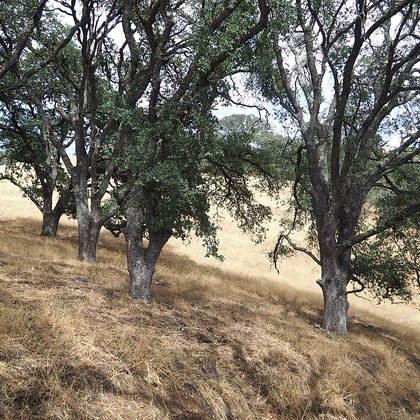
Semi-open grassland and weedy vegetation: roadsides, grazed plots, fallow fields, low scrub, rank growth along forest edges and coffee plantations with grassy undergrowth. It occurs from the lowlands to about 2300 metres and avoids closed forest as well as bare, closely grazed ground. Sown and wild grass seed makes up nearly the whole diet; small berries and insects are also taken, chiefly in the breeding season. The domed nest is placed low in a grass tussock or a low shrub.
Where the bird is most often found, arranged by the USNVC — the vegetation classification of the United States and Canada — and CMECS for sea and coast.




Range and movements
Resident throughout its range. Within the guide area it breeds from central Mexico southward on both slopes — the northern limit lying around San Luis Potosí and southern Tamaulipas on the Atlantic side and around Nayarit and Jalisco on the Pacific side — through Belize, Guatemala, El Salvador, Honduras and Nicaragua; further south the range continues beyond this window to Ecuador and Venezuela. In the Greater Antilles it occurs on Cuba, Jamaica, Hispaniola and the Cayman Islands. On Oʻahu it is introduced and established. A few records exist from southern Texas and Florida.
- Resident
- Breeding (summer)
- Winter
- Passage
- dark = core range, pale = thinly spread
Where and when to look
Walk a grassy verge or a pasture fence early in the morning and listen for the thin trill; it betrays the bird sooner than the eye does. Wait until a singing male climbs a grass stem: only then is the yellow throat pattern against the black clearly visible.
Conservation
The species is listed as Least Concern (LC) and is common over much of its range. Numbers are rising rather than falling, because clearance and grazing produce the grassy, semi-open ground the bird belongs in; the range has locally shifted northward over the twentieth century as a result. The introduced population on Oʻahu is limited in size.
Scientific name
Tiaris olivaceus | (Linnaeus, 1766)
Linnaeus described the species in 1766 as Emberiza olivacea, from a specimen from Hispaniola; because it was later moved to another genus, author and year stand in parentheses. The genus Tiaris was introduced in 1827 by William Swainson, from Greek tiaras 'headdress, tiara', after the head pattern. The species name olivaceus is Neo-Latin for 'olive-green'. The Dutch name refers to Cuba, where the species is common; the English name to the yellow face pattern and seed-eating in grassland; the Spanish name combines 'seed-eater' with the Cuban vernacular name tomeguín.