All species › Passerines › Tanagers and allies › Bananaquit
Bananaquit | Coereba flaveola
Suikerdiefje | Platanero
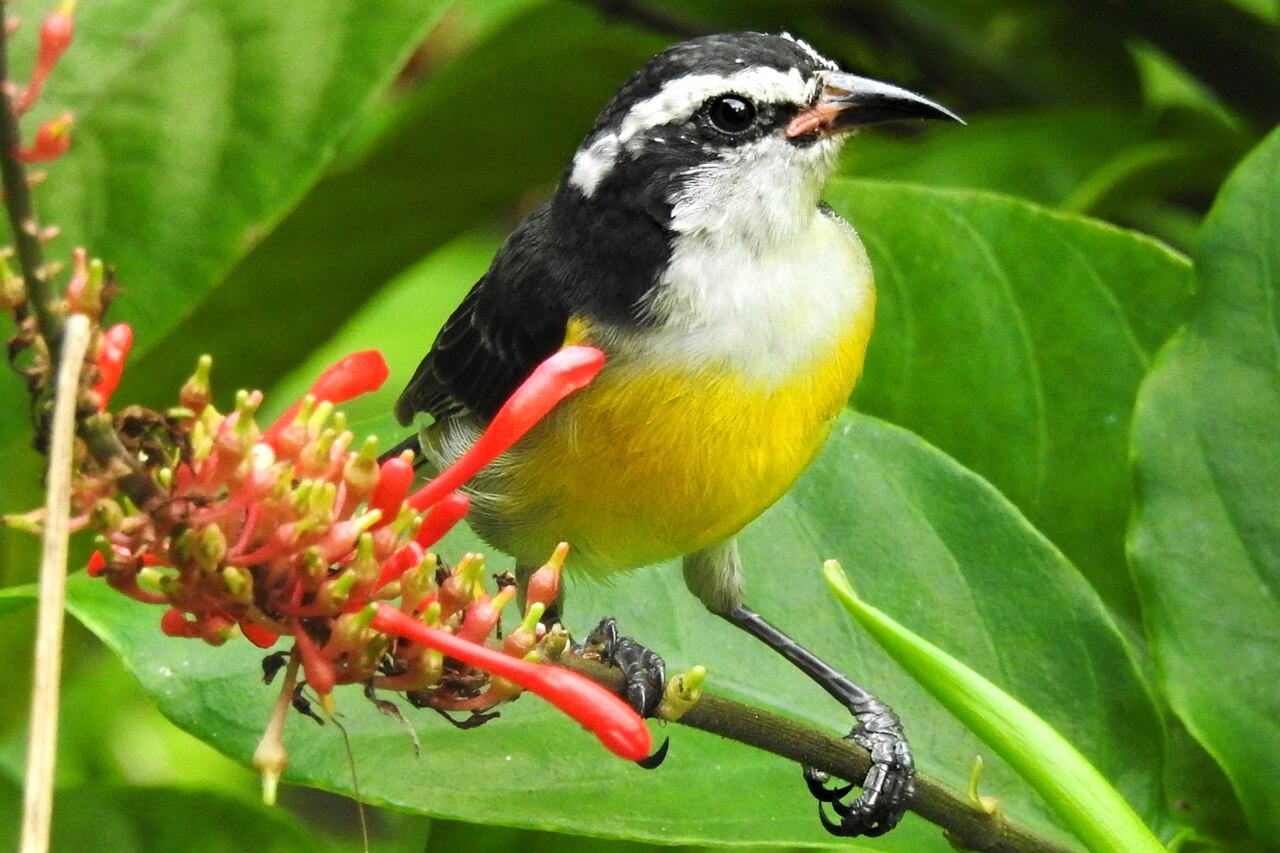
The Bananaquit is a small nectar feeder with a thin, decurved bill, a white eyebrow over a black crown and a yellow breast, belly and rump. Within the guide area it is a bird of the Caribbean and the tropical Atlantic coast: resident in the Bahamas, Jamaica, Hispaniola, Puerto Rico and the Lesser Antilles, and along the Caribbean coast from Mexico to Nicaragua. It is absent from Cuba, and reaches the mainland United States only as a vagrant in southern Florida.
Voice
The song is a high, thin series of hissing notes and dry rattles, roughly see-see-tzrrrr-see, insect-like in quality and given through much of the year. It does not carry far and is lost quickly against traffic or surf. A sharp, short tsit serves as a contact call, often repeated as the bird moves from flower to flower. Males sing from an exposed twig or a wire, usually from first light.
Recording: José María Loaiza B. — CC BY-NC-SA 4.0 · Distrito Metropolitano de Quito, Pichincha, Parroquia Nanegalito, Nueva Granada, Hacienda Los Yumbos, Ecuador · xeno-canto
Identification
Small, short-tailed and almost never still. Most subspecies are dark grey above with a black crown and black sides to the head, a broad white eyebrow, a grey throat and a yellow breast, belly and rump; a small white patch shows at the base of the primaries. The bill is thin, sharp and clearly decurved, with a pink gape. Subspecies differ widely: the Bahamian birds have a pale throat and less yellow, and on a few Lesser Antillean islands entirely black birds occur.
Confusion species
No other species in the region combines a curved bill with a white eyebrow and yellow underparts. Wood-warblers with yellow underparts have a straight, fine bill and lack the black crown with its white stripe; they also glean among leaves rather than working the base of a flower. Hummingbirds have a far longer bill, hover in place and do not perch on the bloom. The pale Bahamian form comes closest to a warbler at a distance, but the bill shape remains decisive.
Habitat
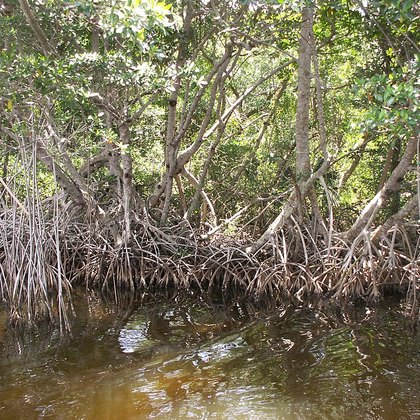
Open to semi-open ground wherever plants are in flower: gardens, parks, hotel grounds, forest edges, scrub, coffee and fruit plantations and mangrove. It avoids closed forest, as well as desert and highland above about 2000 metres. It depends on nectar and sweet liquid and pierces the base of a corolla from the side when the flower is too long for its bill; it also takes small fruit and insects. Sugar bowls on terraces and hummingbird feeders are visited daily.
Where the bird is most often found, arranged by the USNVC — the vegetation classification of the United States and Canada — and CMECS for sea and coast.




Range and movements
Resident, with no migration. Within the guide area it breeds in the Bahamas and the Turks and Caicos, on Jamaica, Hispaniola, Puerto Rico and the Cayman Islands, on Aruba, Curaçao and Bonaire, and on the mainland from Quintana Roo and Cozumel south through Belize, Guatemala, Honduras and Nicaragua; further south the range continues into South America. Cuba is a marked gap in the distribution. Birds from the Bahamas cross to southern Florida now and then, with records concentrated in the winter half of the year.
- Resident
- Breeding (summer)
- Winter
- Passage
- dark = core range, pale = thinly spread
Where and when to look
Look for it early in the morning at a flowering shrub or a sugar-water feeder in a garden or hotel grounds: at such a spot it returns every few minutes. Watch the behaviour — it clings to the side of a flower instead of hovering in front of it. The curved bill and the white eyebrow show even against the light.
Conservation
The species is listed as Least Concern (LC). The range is large and numbers are stable to increasing, helped by gardens, parks and plantations providing suitable ground. The island subspecies each hold a small range and are therefore more exposed to hurricanes and to the loss of flowering vegetation; for the species as a whole this is not a pressure.
Scientific name
Coereba flaveola | (Linnaeus, 1758)
Linnaeus described the species in 1758 as Certhia flaveola, from a specimen from Jamaica; because it was later moved to another genus, author and year stand in parentheses. The genus Coereba was introduced in 1809 by Vieillot and goes back to a Tupi name for small black and yellow birds. The species name flaveola is a diminutive of Latin flavus 'golden yellow'. The English and Dutch names refer to its visits to sugar bowls and bananas on terraces; the Spanish name Platanero means 'banana bird'.