All species › Passerines › Tanagers and allies › Morelet's Seedeater
Morelet's Seedeater | Sporophila morelleti
Morelets dikbekje | Semillero cuelliblanco
Morelet's Seedeater is one of the smallest songbirds in North America: a seed-eater of barely eleven centimetres with a short, thick, strongly curved little bill. Within the United States it holds a single narrow strip, the reedbeds along the Rio Grande in South Texas; most of the range lies in eastern Mexico and Central America. Until recently the species was treated together with Cinnamon-rumped Seedeater as one species.
Voice
The song is a series of clear rising whistles that after four or five notes drops into a lower, rapid rattling ending; it is given from a reed plume, a grass stem or a low shrub and repeated at short intervals. The call is a high, somewhat plaintive chee or cheew, given continuously in a feeding party and often the only sign of the birds. Males sing mainly from March to July.
Recording: Bobby Wilcox — CC BY-NC-SA 4.0 · Reserva Natural Estatal Arroyo Moreno, Mexico · xeno-canto
Identification
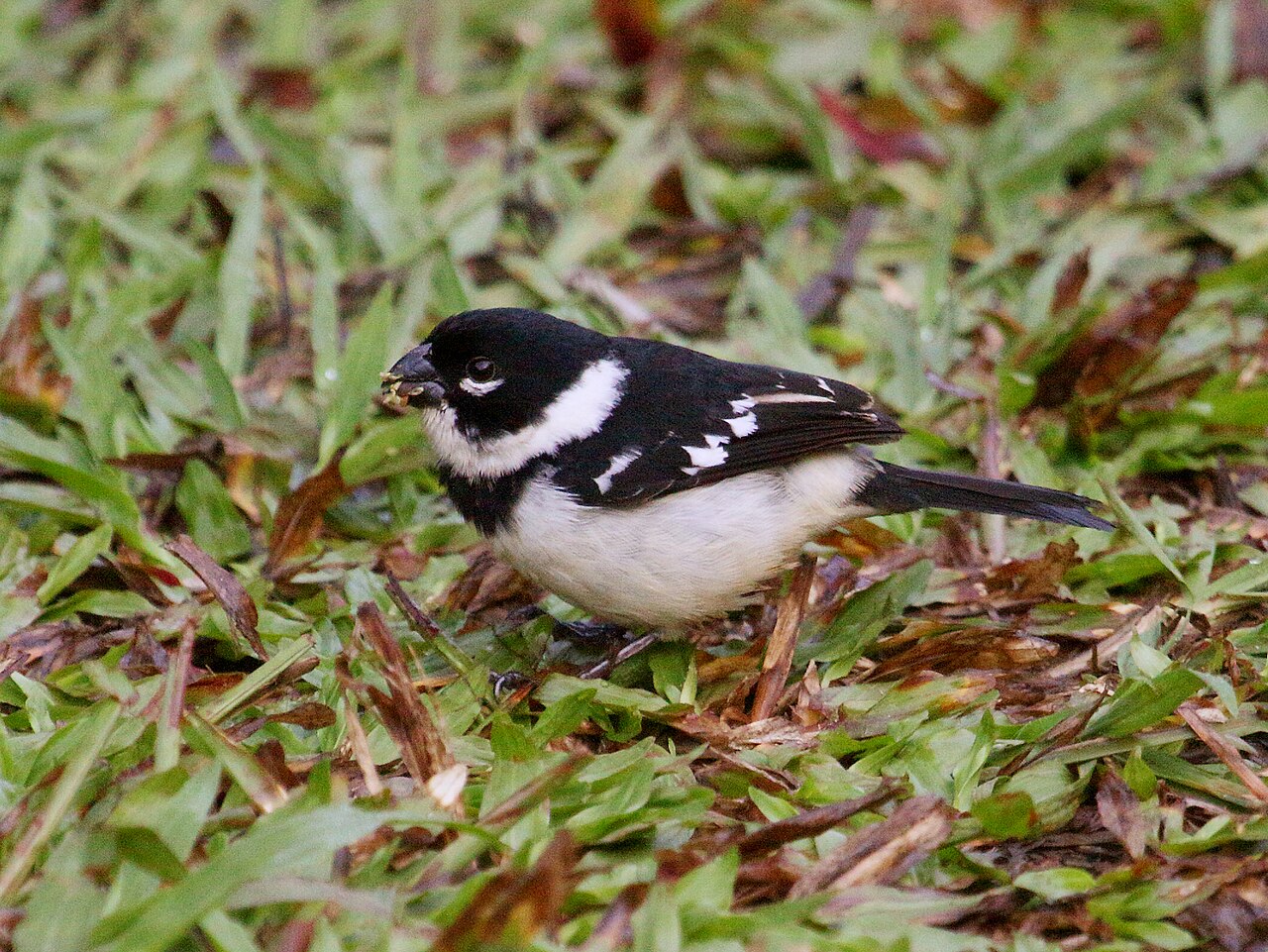
The adult male has a black crown and black sides to the head, a white throat and a white collar running onto the side of the neck, a black back and black wings with two white wingbars and a white wing patch; a broken black band crosses the breast, and the underparts are white, or in some birds buff. The female is olive-brown above and warm buff below, without head or breast markings, but with the same two pale wingbars on dark grey wings. In both sexes the bill is short and deep with a clearly curved culmen, used to strip seed from grass heads.
Confusion species
Cinnamon-rumped Seedeater, which holds the Pacific slope of Mexico and does not occur alongside this species, has a cinnamon rump and cinnamon underparts in the male. Females and juveniles are taken at a distance for young Indigo Buntings or female Lesser Goldfinches; the curved, deep little bill, the small size and the plain buff unstreaked underparts separate them. A female House Sparrow is larger, more coarsely streaked on the back and has a straight bill. With a bird in reeds or tall grass along the Rio Grande, the combination of size and bill shape is decisive.
Habitat
Reeds, tall grass, sugar cane and weedy rank growth in damp hollows, above all in river floodplains and along banks, ditches and irrigation canals. Also pasture, fallow land, field edges and rank roadside ground up to about 1500 metres. Closed forest is avoided; where the canopy opens through felling or storm damage the species does appear. In Texas it is almost entirely a matter of the giant cane and the weedy bank along the Rio Grande itself.
Where the bird is most often found, arranged by the USNVC — the vegetation classification of the United States and Canada — and CMECS for sea and coast.






Range and movements
The range runs from South Texas along the Gulf slope of Mexico — Tamaulipas, San Luis Potosí, Veracruz, Oaxaca, Tabasco, Chiapas and the Yucatán Peninsula — through Belize, Guatemala, El Salvador, Honduras and Nicaragua and on south to Panama, outside the guide area. In Texas the species was widespread from Laredo to Corpus Christi until about 1946; a steep decline followed, and since the 1960s breeding has been confined almost entirely to Zapata County near San Ygnacio, with scattered records in the neighbouring counties of Webb, Starr and Cameron. In the mid-1990s some seven to nine breeding pairs were present.
- Resident
- Breeding (summer)
- Winter
- Passage
- dark = core range, pale = thinly spread
Where and when to look
Look for it from April to July along the Rio Grande at San Ygnacio or in the riverside parks of Laredo, early in the morning, and go by the song: the rising whistle with rattling ending carries farther than the bird can be seen. Watch the tops of the reed plumes and grass heads — it climbs up there to strip seed, and otherwise stays deep in the vegetation.
Conservation
Across the range as a whole the species is common and listed as Least Concern (LC). In Texas the picture is different: Christmas Bird Counts record the decline — two counts in 1949 together produced 107 birds, while six counts from 1965 onwards yielded a single one. The loss of weedy bank vegetation along the Rio Grande through herbicides, grazing and clearing of the river channel is regarded as the main cause; work on the border barrier affects the same strips. Whether the Texas population holds depends on the survival of reeds and rank growth immediately along the river.
Scientific name
Sporophila morelleti | (Bonaparte, 1850)
Charles Lucien Bonaparte described the species in 1850 as Spermophila morelleti, from a specimen from Petén in Guatemala; because it was later moved to Sporophila, author and year stand in parentheses. The genus name Sporophila comes from Greek sporos 'seed' and philos 'loving'. The species name honours the French naturalist Pierre Marie Arthur Morelet, who collected in Central America; the double l in morelleti is a slip by Bonaparte that the rules of nomenclature keep in place. The species was formerly called White-collared Seedeater, together with Cinnamon-rumped Seedeater.