All species › Passerines › Tanagers and allies › Saffron Finch
Saffron Finch | Sicalis flaveola
Gewone saffraangors | Chirigüe azafranado
The Saffron Finch is a yellow seed-eater from South America that has been spread around the world as a cage bird and has established populations in Hawaii, Puerto Rico and Jamaica. Within this guide's window it is therefore an introduced species everywhere; its natural range lies south of the Amazon basin and along the north coast of South America.

Voice
The song is a short, rapid series of clear twittering notes repeated over and over with little variation, often for several minutes from a roof edge, wire or post. The call is a short sharp chip, given continuously in a feeding flock. Males sing throughout the year, most of all in the weeks before breeding.
Recording: Jacob Wijpkema — CC BY-NC-SA 4.0 · Puerto Suarez (near Buyú), Provincia de Germán Busch, Departamento de Santa Cruz, Bolivia · xeno-canto
Identification
The adult male is yellow over the whole body, deeper on the underparts, with an orange wash on forehead and crown and an olive tinge on the back; the wings are dark with yellow edges. The bill is conical, short and grey with a pale base. Females of the northern subspecies resemble a duller male, while females of the southern subspecies are olive-brown with dark streaks on breast and back. Juveniles are grey-brown and streaked with a yellow band across the breast; they reach full yellow plumage only in their second year.
Confusion species
In Hawaii the main confusion species is Yellow-fronted Canary: it is smaller, green above, with a yellow-and-grey patterned head, streaked flanks and no orange on the crown, while a male Saffron Finch is wholly yellow over head and underparts with an orange forehead. Streaked juvenile Saffron Finches resemble female sparrows and buntings; look then for the yellow wash on the breast and the absence of head and throat markings. A conical bill without a hooked tip separates the species from the equally yellow but much larger and differently patterned orioles.
Habitat
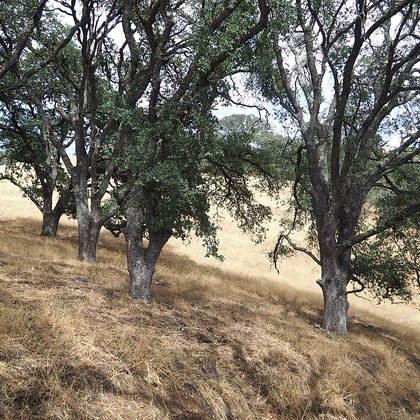
Open and semi-open lowland with short vegetation: pasture, field edges, road verges, golf courses, parks, farmyards and villages. It nests in cavities — abandoned nests of other species, hollow palm stumps, hollow bamboo stems, holes in walls and spaces under roof tiles — and builds no domed nest of its own. It avoids closed forest and high mountains; in Hawaii it keeps mainly to the dry leeward lowlands, up to about 1500 metres.
Where the bird is most often found, arranged by the USNVC — the vegetation classification of the United States and Canada — and CMECS for sea and coast.




Range and movements
The original range lies in South America in two separate parts: the north coast of Colombia, Venezuela and the Guianas, and a large area from eastern Brazil and Bolivia to Paraguay, Uruguay and northern Argentina. Within this guide's window only introduced populations are involved: in Hawaii since the 1960s, with the largest numbers on the island of Hawaii and on Oʻahu; in Puerto Rico and in Jamaica likewise from escaped or released cage birds. Records in Florida and elsewhere in the United States concern escapes without an established population.
- Resident
- Passage
- dark = core range, pale = thinly spread
Where and when to look
In Hawaii look for it along the dry coastal roads and on the lawns of resorts and golf courses, where parties feed on the ground and fly up together to a wire or roof edge when disturbed. In built-up areas the twittering song from a roof edge is often the first sign.
Conservation
In its native range the species is common and the trend is assessed as stable; the IUCN places it in the Least Concern (LC) category. Trapping for the cage-bird trade is regionally substantial. The introduced populations in Hawaii, Puerto Rico and Jamaica are expanding and are under no restriction; their effect on native seed-eaters has not been studied, but they occupy mainly man-made lowland rather than native forest.
Scientific name
Sicalis flaveola | (Linnaeus, 1766)
Linnaeus described the species in 1766 as Fringilla flaveola, without a locality; Surinam was later designated as the type locality. Because it now stands in Sicalis, author and year go in parentheses. The genus name Sicalis comes from Greek sikalis, a name used by classical authors for a small bird. The species name flaveola is a Latin diminutive of flavus 'yellow' and so means 'yellowish'. The English name follows the saffron-yellow colour, as does Spanish azafranado.