All species › Passerines › New World warblers › Blue-winged Warbler
Blue-winged Warbler | Vermivora cyanoptera
Blauwvleugelzanger | Reinita aliazul
The Blue-winged Warbler is a yellow warbler of rank old fields and woodland edges in the eastern United States, with blue-grey wings and a black line through the eye. Over a century and a half it spread northward as abandoned farmland grew up into scrub, and in doing so came into contact with the Golden-winged Warbler.
Voice
The song is two buzzes, a higher one followed by a lower, usually rendered bee-bzzz. The whole phrase lasts under a second and sounds more like an insect than a bird. There is also a second song type, a longer series of trilled notes, heard mainly at territory boundaries. The call is a sharp, dry chip; in flight a fine tsee.
Recording: Stephen Tyndel — CC BY-NC-SA 4.0 · Middlefork Fish and Wildlife Area, United States · xeno-canto
Identification
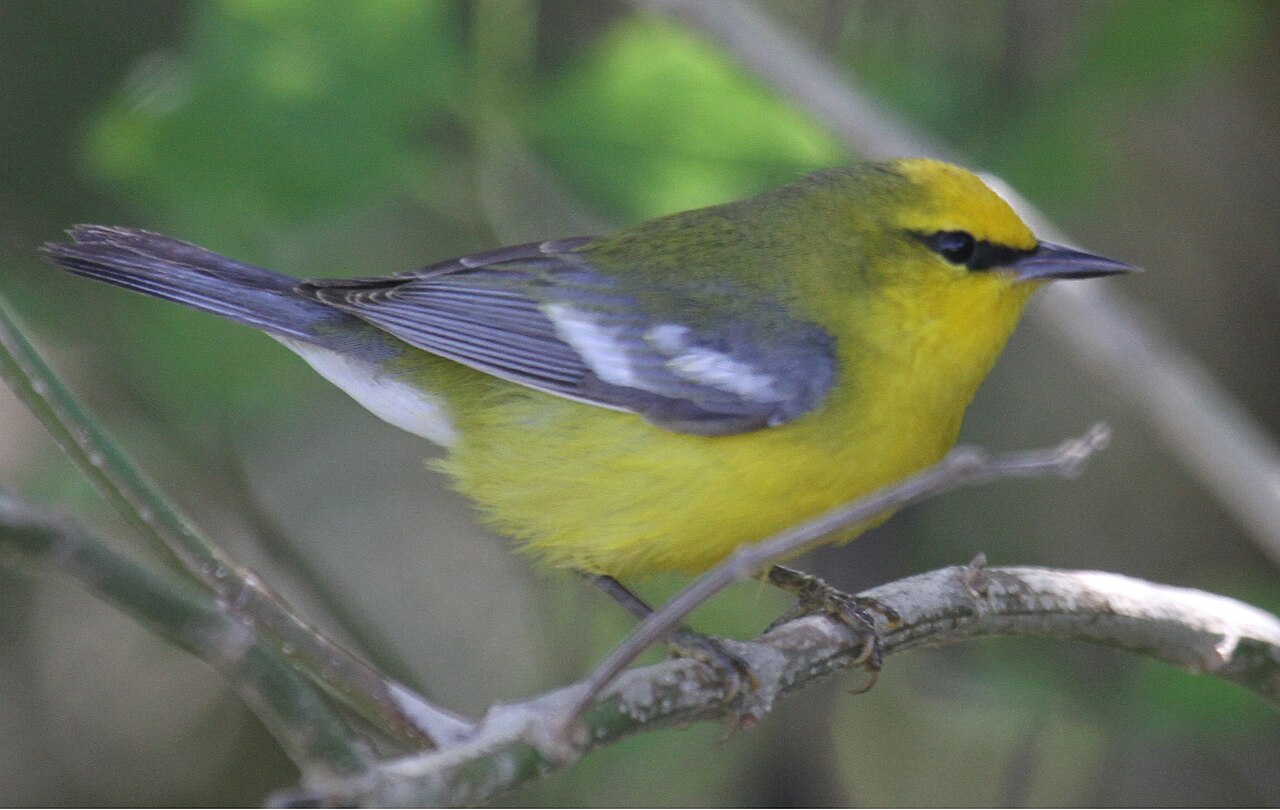
Head, breast and belly are yellow, with a narrow black eye-line cutting the yellow head in two. The wings are blue-grey with two white bars; back and rump are olive-green. The female is duller yellow with a greyer eye-line, but the pattern is the same. Young birds are olive-green with barely visible wing bars. It forages low, often hanging from dead, curled leaves and prising them open with the pointed bill.
Confusion species
Golden-winged Warbler has grey rather than yellow as its ground colour and a black (male) or grey (female) throat and mask; the wing panel is yellow rather than white. Hybrids between the two are regular: the brewsteri type combines a grey body with white wing bars and no black throat, while the rarer lawrencei type is yellow like a Blue-winged but carries the black throat and mask of a Golden-winged. Prothonotary Warbler is bulkier, deeper orange-yellow and has unbarred blue-grey wings; Yellow Warbler has neither eye-line nor white wing bars.
Habitat
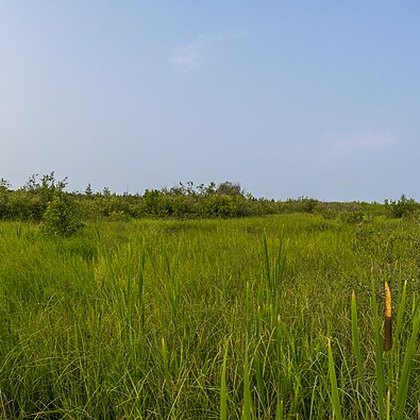
Rank old fields, coppiced hedgerows, wide woodland edges and young regrowth of bramble, hawthorn and alder, often on damp ground along streams. The nest is on or just above the ground among dense herbage. Unlike Golden-winged Warbler it persists in somewhat older, denser regrowth and in woodland edges near houses, which has helped its northward spread. In winter it uses open woodland, forest edge, gardens and parks.
Where the bird is most often found, arranged by the USNVC — the vegetation classification of the United States and Canada — and CMECS for sea and coast.




Range and movements
Breeds in the eastern United States, roughly from eastern Nebraska, Iowa and Missouri east to New England and north to southern Ontario, with a southern limit in Arkansas, Tennessee and the mountains of North Carolina. The range shifted steadily north through the nineteenth and twentieth centuries, following abandoned farmland. Migration runs by way of the Gulf coast; the winter is spent from southeastern Mexico to Panama, of which Belize, Guatemala and Honduras fall inside the guide area.
- Breeding (summer)
- Winter
- Passage
- dark = core range, pale = thinly spread
Where and when to look
Walk a rank old field or a wide woodland edge in May and listen for the short bee-bzzz; the bird sings from a projecting twig or a dead treetop and is then in clear view. Look at the plumage pattern of every singing bird as well: where Golden-winged Warbler also occurs, hybrids often sing the song of one species in the plumage of the other, so only the appearance settles the identification.
Conservation
Partners in Flight puts the breeding population at about 680,000 birds. Between 1966 and 2019 numbers fell by about 0.7 per cent a year, some 30 per cent in total; the species scores 13 out of 20 on the Continental Concern Score. It disappears locally where scrub is built over or grows into closed forest. For conservation the interaction with Golden-winged Warbler matters most: the northward spread brings the two together ever more often, bringing competition and hybridisation into the shrinking range of the rarer species.
Scientific name
Vermivora cyanoptera | Olson; Reveal, 2009
Olson and Reveal introduced the name Vermivora cyanoptera in 2009 to replace the older Vermivora pinus, whose type material proved not to be assignable unambiguously to this species; because the species was described in Vermivora from the start, author and year stand without parentheses. The genus Vermivora is from Latin vermis 'worm' and vorare 'to devour'. The species name cyanoptera is Greek for 'blue wing', from kyanos 'dark blue' and pteron 'wing', after the blue-grey wings — the same feature behind the English, Spanish and Dutch names.