All species › Passerines › New World warblers › Golden-winged Warbler
Golden-winged Warbler | Vermivora chrysoptera
Geelvleugelzanger | Reinita alidorada
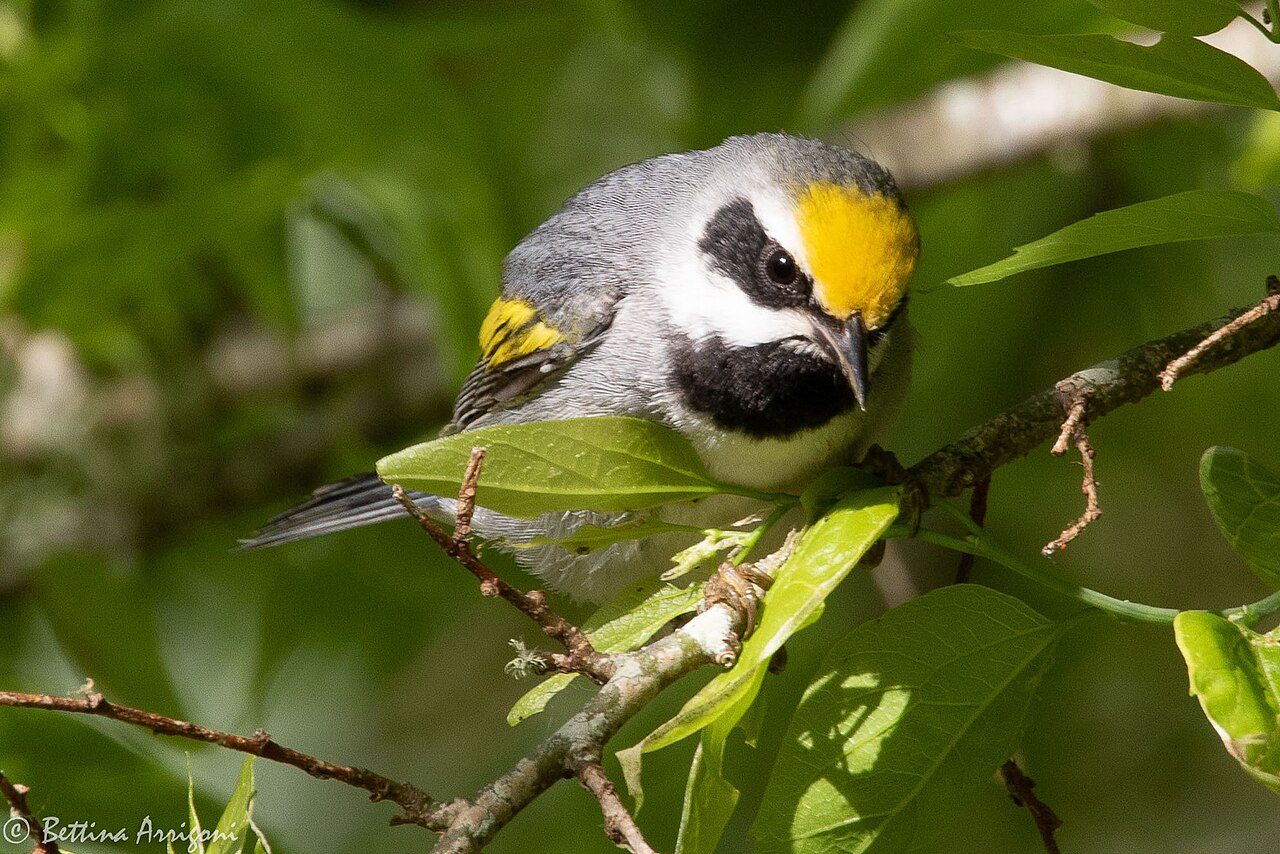
The Golden-winged Warbler is a small warbler of young, scrubby regrowth in eastern North America, grey above with a yellow crown and a yellow wing patch. It belongs to a stage of the landscape that lasts only a few years: the shrub layer between clearcut and closed forest. Over the past half century its range has contracted to two cores, around the Great Lakes and in the Appalachians.
Voice
The song is a series of thin, insect-like buzzes: one drawn-out bzzzzz followed by three shorter bzz bzz bzz, on one pitch and with little carrying power. At any distance it is hard to separate from a grasshopper. Males also sing a second, faster series of buzzes, heard mainly in disputes at the territory boundary. The call is a dry, sharp chip or zip.
Recording: Valerie Heemstra — CC BY-NC-SA 4.0 · Ford River Township (near Bark River), Delta County, Michigan, United States · xeno-canto
Identification
The male is plain blue-grey above and white below, with a yellow crown and a large yellow wing patch that in some birds breaks into two bars. The black throat patch with a black eye mask above it, both bordered in white, is the key mark. The female has the same pattern, but throat and mask are grey rather than black and the yellow is paler. The tail shows white in the outer feathers as the bird flies up. The bill is thin and pointed, suited to probing rolled leaves for caterpillars.
Confusion species
Blue-winged Warbler has a yellow body with a black line through the eye and two white wing bars — close to the reverse pattern. Where the two occur together they hybridise: the brewsteri type looks like a Golden-winged with a yellow wash and no black throat, the rarer lawrencei type like a Blue-winged with a black throat and mask. Such intermediates cannot be named without recording the whole pattern. Black-capped Chickadee shows a similar grey, black and white pattern, but has an all-black cap without yellow, a short thick bill and a longer tail.
Habitat
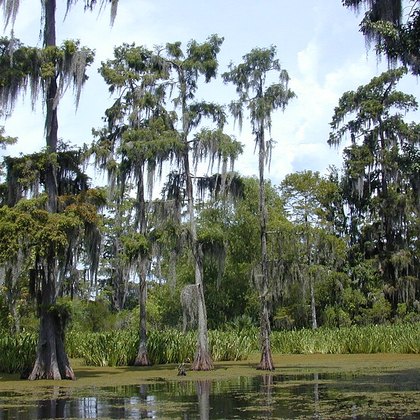
Shrubland in an early stage of regrowth: clearcuts five to fifteen years old, wet alder and willow thickets, tamarack bog at the edge of swamp forest, and rank old fields with scattered trees. The species needs standing trees as song posts and a dense herb layer for the nest, which is placed on the ground. Where the regrowth closes into forest it disappears within a few years. In winter it uses open woodland and shade-grown coffee plantations.
Where the bird is most often found, arranged by the USNVC — the vegetation classification of the United States and Canada — and CMECS for sea and coast.




Range and movements
Two separate breeding cores: the first around the Great Lakes, centred on Minnesota, Wisconsin, Michigan, Manitoba and Ontario; the second in the Appalachians from New York and Pennsylvania south to the mountains of North Carolina and Tennessee. Great Lakes birds winter in Central America and southern Mexico, Appalachian birds almost entirely in northern South America; that difference is linked to a genetic difference on the Z chromosome. Spring migration runs through Texas and the Gulf coast, autumn migration across the eastern half of the continent.
- Breeding (summer)
- Winter
- Passage
- dark = core range, pale = thinly spread
Where and when to look
Look for it in May and June by sound, in young clearcuts and wet regrowth: the buzzing bzzzzz bzz bzz bzz is the most reliable way in, since the bird often sits still on a bare twig above the shrubs. The best chances are the managed shrubland tracts of northern Minnesota and the high pastures of the Appalachians; note for every bird whether throat and mask are black or grey, and whether there is yellow on the breast, so that hybrids stay recognisable.
Conservation
The species is listed as Near Threatened (NT). Partners in Flight puts the population at about 390,000 birds, roughly half of them breeding in Minnesota. Between 1966 and 2023 numbers fell by about 52 per cent; the Appalachian population declined by some 98 per cent, while the Great Lakes core held up better. The causes are the loss of young shrubland as forest closes or is built over, and brood parasitism by Brown-headed Cowbird. Genetic work has shown Golden-winged and Blue-winged Warbler to be 99.97 per cent alike and to have hybridised for thousands of years, so hybridisation plays a smaller part than was long assumed. Management focuses on repeatedly creating shrub patches within a forested landscape.
Scientific name
Vermivora chrysoptera | (Linnaeus, 1766)
Linnaeus described the species in 1766 as Motacilla chrysoptera; because it was later moved to another genus, author and year stand in parentheses. The genus Vermivora comes from Latin vermis 'worm' and vorare 'to devour', thus 'worm-eater', after its search for caterpillars. The species name chrysoptera is Greek for 'golden wing', from chrysos 'gold' and pteron 'wing', after the yellow wing patch — the same feature that gives the English and Dutch names. The type came from Pennsylvania, later restricted to the neighbourhood of Philadelphia.