All species › Passerines › New World warblers › Tennessee Warbler
Tennessee Warbler | Leiothlypis peregrina
Tennesseezanger | Reinita verdillo
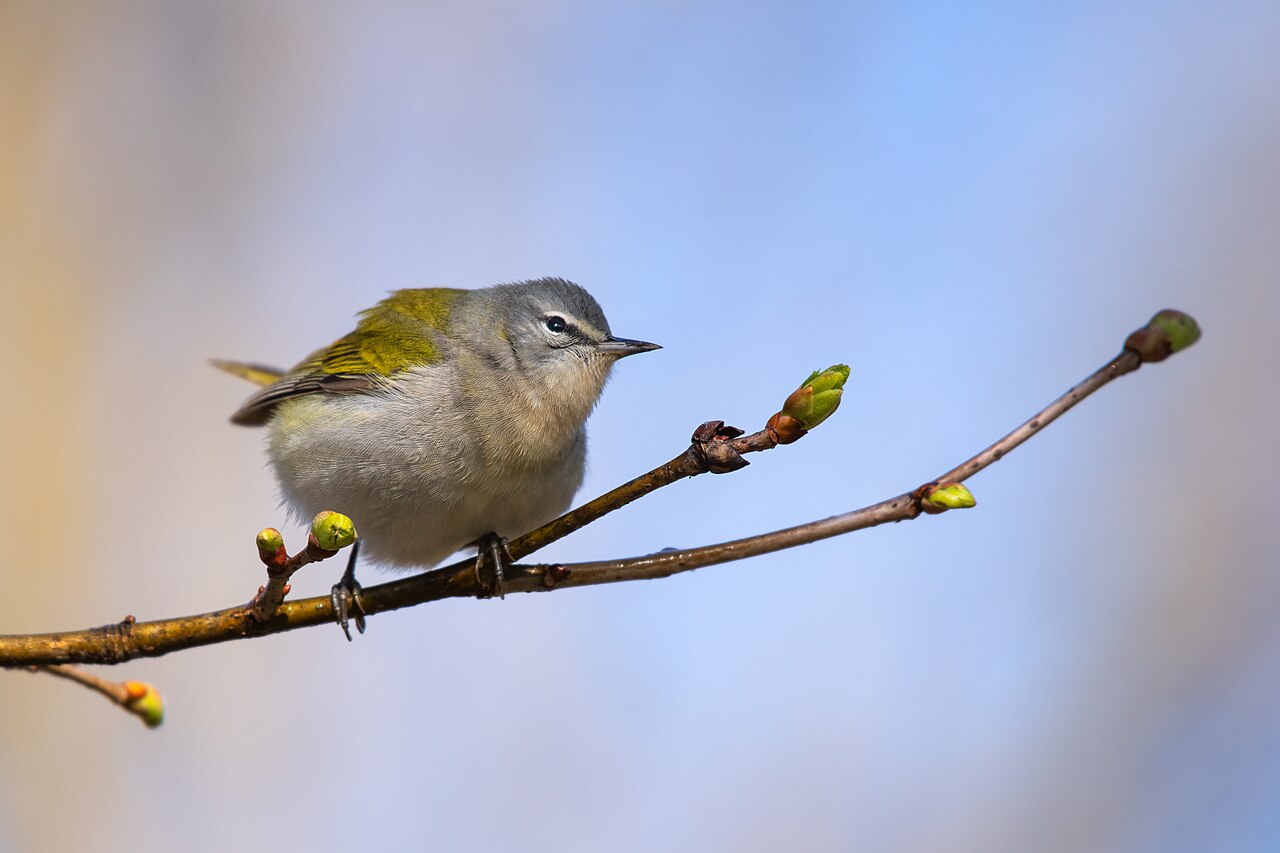
The Tennessee Warbler is an unstreaked warbler without wing bars, grey-headed and green-backed, breeding in the boreal forest of Canada and Alaska. Its numbers rise and fall with outbreaks of spruce budworm. The name points to where Alexander Wilson collected the type — a migrant on the Cumberland River in Tennessee, far from the breeding range.
Voice
The song is a loud, penetrating series in three parts, each faster and sharper than the last: chip chip chip — chewee chewee — tit-tit-tit-tit-tit, ending in a staccato rattle. It carries far for so small a bird and is sung from a high perch in the upper two thirds of a tree. The call is a thin, high tsip; on nocturnal migration a fine zeet.
Recording: Jimmy Enfru — CC BY-NC-SA 4.0 · Parc national de l'Île-Bonaventure-et-du-Rocher-Percé, Percé, Québec, Canada · xeno-canto
Identification
The breeding male has a slate-grey head and neck, a clear white eyebrow with a dark line below it, an olive-green back and wings, and white underparts without streaking and without wing bars. The female is duller and greener on the head, with a yellow wash on throat and breast. In autumn plumage both sexes closely resemble other species: olive-green above, yellowish below. What stays constant is the white undertail coverts, which with the thin, pointed bill are the most usable marks.
Confusion species
Orange-crowned Warbler is yellower on the undertail coverts in every plumage, has faint streaking on the breast and a broken eye-ring rather than a crisp eyebrow. Warbling Vireo and Red-eyed Vireo have a heavier bill with a hooked tip and move far more slowly. Philadelphia Vireo has a yellow throat. A Tennessee Warbler stands out by its quick movements high in the canopy and by the fine, pointed bill, which it also pushes into flowers.
Habitat
Boreal conifer and mixed forest of spruce, black spruce and birch, especially in regenerating stands and along the edges of bog, muskeg (boggy spruce peatland typical of boreal Canada) and streams; the nest is on the ground in moss or a sedge tussock. On migration it uses almost any woodland, scrub and even city parks. In winter it keeps to forest edge and shade-grown coffee plantations, where it drinks nectar from flowering trees.
Where the bird is most often found, arranged by the USNVC — the vegetation classification of the United States and Canada — and CMECS for sea and coast.





Range and movements
Breeds across the boreal belt from southeastern Alaska and Yukon east to Newfoundland and the Maritimes, with a southern limit in northern Minnesota, Michigan, New York and New England. The whole population migrates through central and eastern North America and across the Gulf of Mexico to southern Central America, the Caribbean and northern Colombia and Venezuela. Within the guide area it winters mainly in Guatemala, Honduras and Nicaragua; further north it is a passage migrant.
- Resident
- Breeding (summer)
- Winter
- Passage
- dark = core range, pale = thinly spread
Where and when to look
The best chance in the south of the continent is in early May, when passage peaks: listen for the three-part song coming out of the canopy of street trees and city parks. On the breeding grounds it is most numerous in years of a spruce budworm outbreak. With any plain green warbler in autumn, look first at the undertail coverts: white points to this species.
Conservation
The species is listed as Least Concern (LC). Partners in Flight puts the population at about 110 million birds. Between 1966 and 2015 numbers were stable or slightly declining according to the North American Breeding Bird Survey, but the breeding range lies so far north that trends are hard to measure. Numbers swing strongly with spruce budworm outbreaks, which last several years and then fade; caterpillars can make up as much as ninety per cent of the food brought to nestlings in summer. Logging of boreal forest and the loss of shade coffee in the winter range are the points of attention.
Scientific name
Leiothlypis peregrina | (Wilson, 1811)
Alexander Wilson described the species in 1811 as Sylvia peregrina; because it was later moved to another genus, author and year stand in parentheses. The genus Leiothlypis, split from Vermivora in 2010, is from Greek leios 'smooth, plain' and thlypis, a name for a small bird, after the unmarked plumage. The species name peregrina is Latin for 'wandering, foreign'. Wilson collected the type on the bank of the Cumberland River in Tennessee, where the bird occurs only on migration; the state thus named a species that does not breed there.