All species › Passerines › New World warblers › Orange-crowned Warbler
Orange-crowned Warbler | Leiothlypis celata
Groene zanger | Reinita coroninaranja
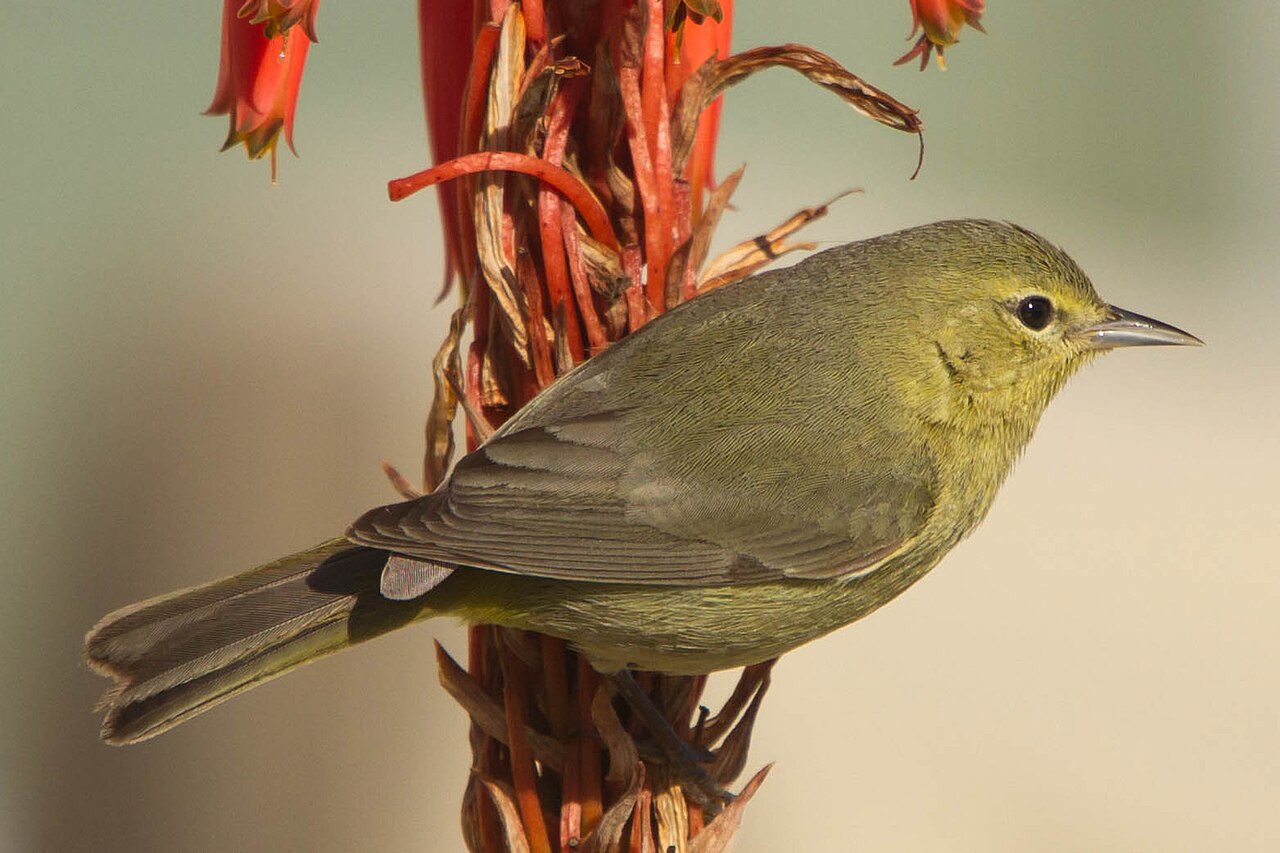
The Orange-crowned Warbler is the warbler without marks: olive-green to grey-green, without wing bars, without tail spots, and with at most faint streaking on the breast. The orange crown patch behind its scientific and English name stays hidden under the crown feathers almost all the time. Of all the American wood-warblers it winters furthest north.
Voice
The song is a short, high trill that changes pitch and volume halfway: usually a series of fast notes on one pitch, then a lower and softer tail. Some birds run the trill upward instead. The sound resembles that of Pine Warbler and Dark-eyed Junco, but is thinner and less musical. The call is a sharp, hard chik, often the first sign of its presence in dense scrub.
Recording: Ed Pandolfino — CC BY-NC-SA 4.0 · Alder Springs, Glenn County, California, United States · xeno-canto
Identification
A slim, plain warbler with a thin, pointed bill, olive-green to grey above and yellow-green below. What is telling is what is missing: no wing bars, no white tail spots, no bold eyebrow. There is a thin dark line through the eye and a broken, pale eye-ring. The undertail coverts are always yellow. The breast carries faint, blurred streaking. The orange crown patch shows only when the bird raises the crown feathers, usually in disputes. Western birds are yellower, eastern birds greyer and duller.
Confusion species
Tennessee Warbler has white undertail coverts, a crisper white eyebrow and no breast streaking. Yellow Warbler is yellow throughout, with yellow tail spots. Nashville Warbler has a grey head with a complete white eye-ring and a sharply set-off yellow throat. Warbling Vireo moves more slowly and has a thicker, hook-tipped bill. The combination of yellow undertail coverts, faint breast streaking and absent wing bars is decisive.
Habitat
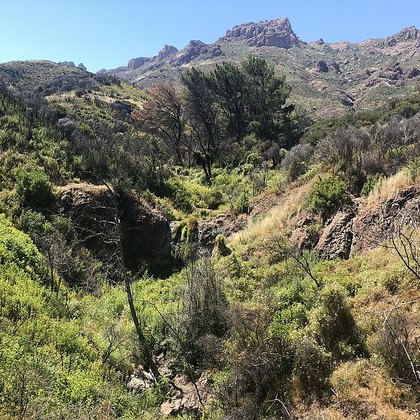
Scrub and low regrowth in almost any landscape: alder and willow thickets along streams, regrowth in logged forest, chaparral (dense, hard-leaved scrub of the Californian Mediterranean climate) on dry slopes, aspen and spruce woodland with dense understorey, and in the north the edges of coastal rainforest. In Arizona it breeds up to just over 2,200 metres. The nest is on the ground or low in a shrub. In winter it is in forest edge, gardens, wet thickets and mangrove, and then also comes to suet and peanut butter.
Where the bird is most often found, arranged by the USNVC — the vegetation classification of the United States and Canada — and CMECS for sea and coast.





Range and movements
Breeds from Alaska and Yukon across Canada to Newfoundland and south through the western United States to New Mexico. The subspecies sordida is resident on the Channel Islands and the coast of southern California and Baja California. It winters in the southern United States, from California and Arizona through Texas to Florida and the Gulf Coast, and on through almost all of Mexico to Guatemala. Through the east of the continent it passes in small numbers, mainly late in autumn.
- Resident
- Breeding (summer)
- Winter
- Passage
- dark = core range, pale = thinly spread
Where and when to look
In the east it is still present late in October, when most other warblers are already further south: a plain, unmarked green warbler in November is in many states almost certainly this species. Listen for the sharp chik from dense scrub and then look for the yellow undertail coverts. In the west it sings from April onward out of the chaparral, often from a projecting twig.
Conservation
The species is listed as Least Concern (LC) and is numerous across its range. The North American Breeding Bird Survey nevertheless shows a decline of about 28 per cent between 1966 and 2019 across the survey area, and of about 54 per cent within the United States. Most of the breeding range lies in Canada and Alaska, where coverage is thinner, so the national figures give only part of the picture. The species gains from logging and fire because these produce scrub, but suitable understorey is locally lost to grazing and building.
Scientific name
Leiothlypis celata | (Say, 1822)
Thomas Say described the species in 1822 as Sylvia celatus; because it was later moved to another genus, author and year stand in parentheses. The type came from Engineer Cantonment near Council Bluffs, later Omaha, Nebraska. The genus Leiothlypis is from Greek leios 'smooth, plain' and thlypis, a name for a small bird. The species name celata is Latin for 'hidden', after the orange crown patch concealed under the crown feathers — the same feature behind the English and Spanish names, while the Dutch name refers to the plain green colour.