All species › Passerines › Chats, Old World flycatchers and allies › Bluethroat
Bluethroat | Luscinia svecica
Blauwborst | Pechiazul
The Bluethroat is a Eurasian chat that in North America breeds only on the tundra of Alaska and northern Yukon. It keeps low in dense willow scrub and is all but invisible when not singing; in June the male gives itself away with a display flight above the bushes.
Voice
The song is a long, accelerating series that opens with repeated, metallic ting-ting-ting notes and runs out into rattles, whistles and imitated fragments of other species; each male builds its own repertoire from what it has heard on the way. It sings from a willow top or during a song flight, climbing at an angle and floating down again with the tail spread. The call is a hard tchack, like two pebbles struck together, often with a thin heet between.
Recording: Stanislas Wroza — CC BY-NC-SA 4.0 · Vadso, Finland · xeno-canto
Identification
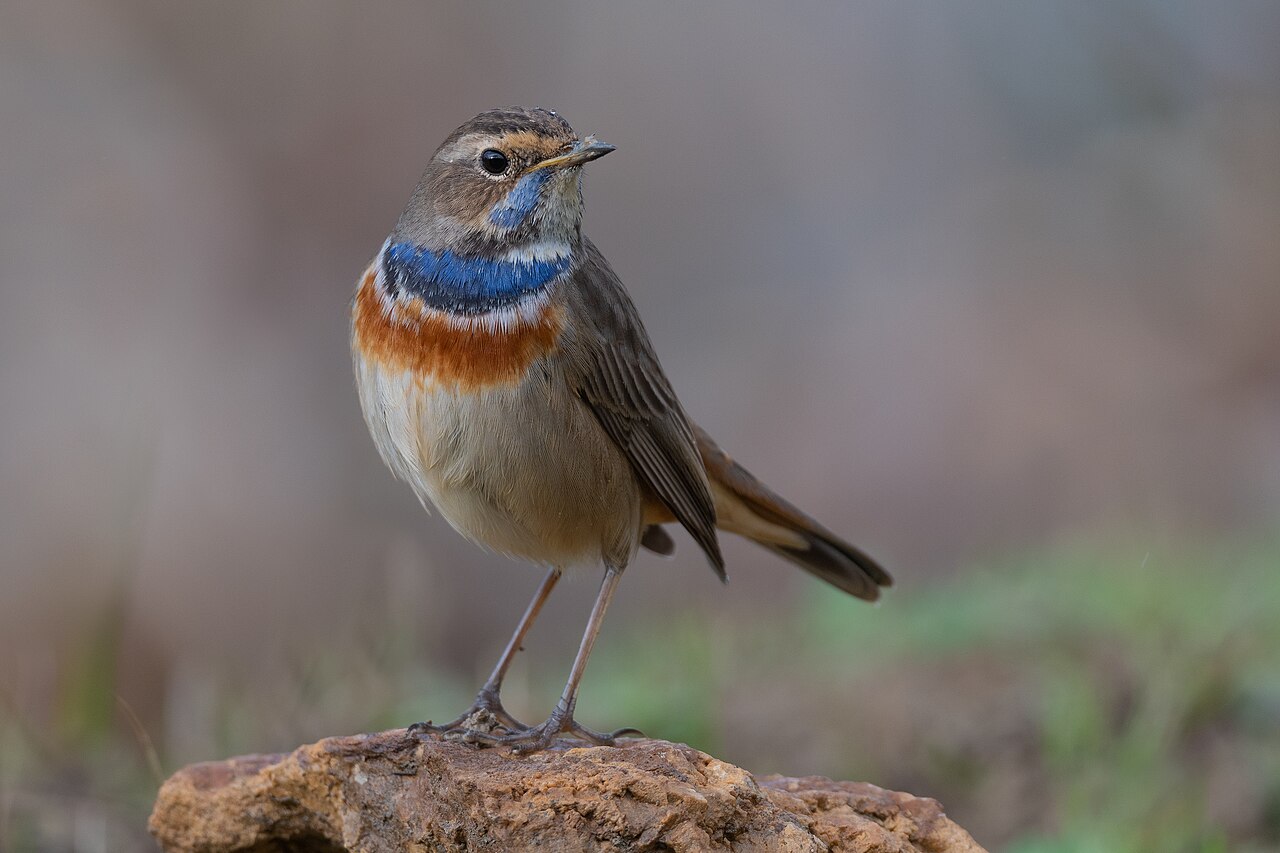
A slim chat the size of a robin, with a fine bill, long legs and a habit of cocking and spreading the tail. Both sexes share the diagnostic tail pattern: dark brown with an orange-red base and a black terminal band, flashing at every take-off. The male has a glossy blue throat and breast with a rufous central spot, a narrow black band below it and then a broad rusty band. The upperparts are plain brown, with a clear pale supercilium. The female has a cream throat edged by a black crescent and usually little blue. In fresh autumn plumage pale feather tips blur the throat pattern; those tips wear away during the winter.
Confusion species
No other North American songbird combines the orange tail base with a pale supercilium. Northern Wheatear, which breeds on the same tundra, has a white rump and an inverted-T tail pattern and sits on bare ground rather than in scrub. Females and young Bluethroats can suggest a Catharus thrush, but those lack the red tail base and have a heavier bill and a spotted rather than banded breast.
Habitat
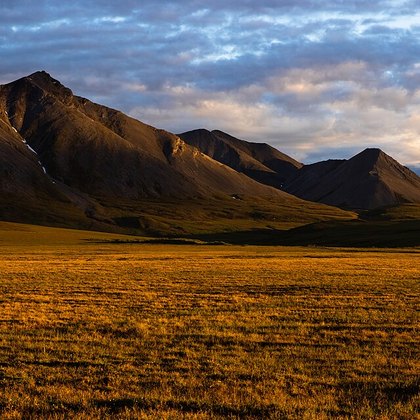
Damp tundra with dense willow and dwarf birch scrub, especially along creeks, lake edges and sedgy hollows; the nest is on the ground in a tussock or low in a bush. In Eurasia it also uses birch woodland, swampy thickets and, in the south of the range, lowland reedbeds. In winter it occupies marshy vegetation, reed edges and field margins.
Where the bird is most often found, arranged by the USNVC — the vegetation classification of the United States and Canada — and CMECS for sea and coast.





Range and movements
It breeds from Scandinavia across northern Eurasia to Kamchatka, with subspecies reaching south to France, northern Spain and central China. The American population is on the Seward Peninsula, in the foothills of the Brooks Range, across the North Slope to the Colville delta and just over the border into northern Yukon; it passes through St. Lawrence Island in spring. It is one of the few North American breeding birds that winters in Asia: where the Alaskan birds go has not been established, but the species as a whole winters in North Africa, the Middle East, the Indian subcontinent and South-East Asia.
- Breeding (summer)
- Passage
- dark = core range, pale = thinly spread
Where and when to look
In June work the willow strips along the Kougarok Road or the Teller Road out of Nome, or the Dalton Highway on the North Slope, and look early in the morning for a male singing above the scrub. Silent birds rarely show; then watch for the flash of the orange tail base as something drops back into the willows.
Conservation
The species is numerous worldwide and listed as of Least Concern (LC). The Alaskan population is small, hard to count and lies outside the reach of the standard breeding bird surveys, so there is no reliable trend. Scrub advancing under a warming climate increases the suitable area on the tundra, while drought along the flyway and loss of marsh vegetation in the Asian wintering grounds pull the other way.
Scientific name
Luscinia svecica | (Linnaeus, 1758)
Linnaeus described the species in 1758 as Motacilla svecica; because it was later moved to another genus, author and year stand in parentheses. Luscinia is the Latin word for nightingale. The species name svecica means 'Swedish', after the type from Swedish Lapland. Both the Dutch name and the English Bluethroat name the blue throat of the male.