All species › Passerines › Chats, Old World flycatchers and allies › Siberian Rubythroat
Siberian Rubythroat | Calliope calliope
Roodkeelnachtegaal | Ruiseñor calíope
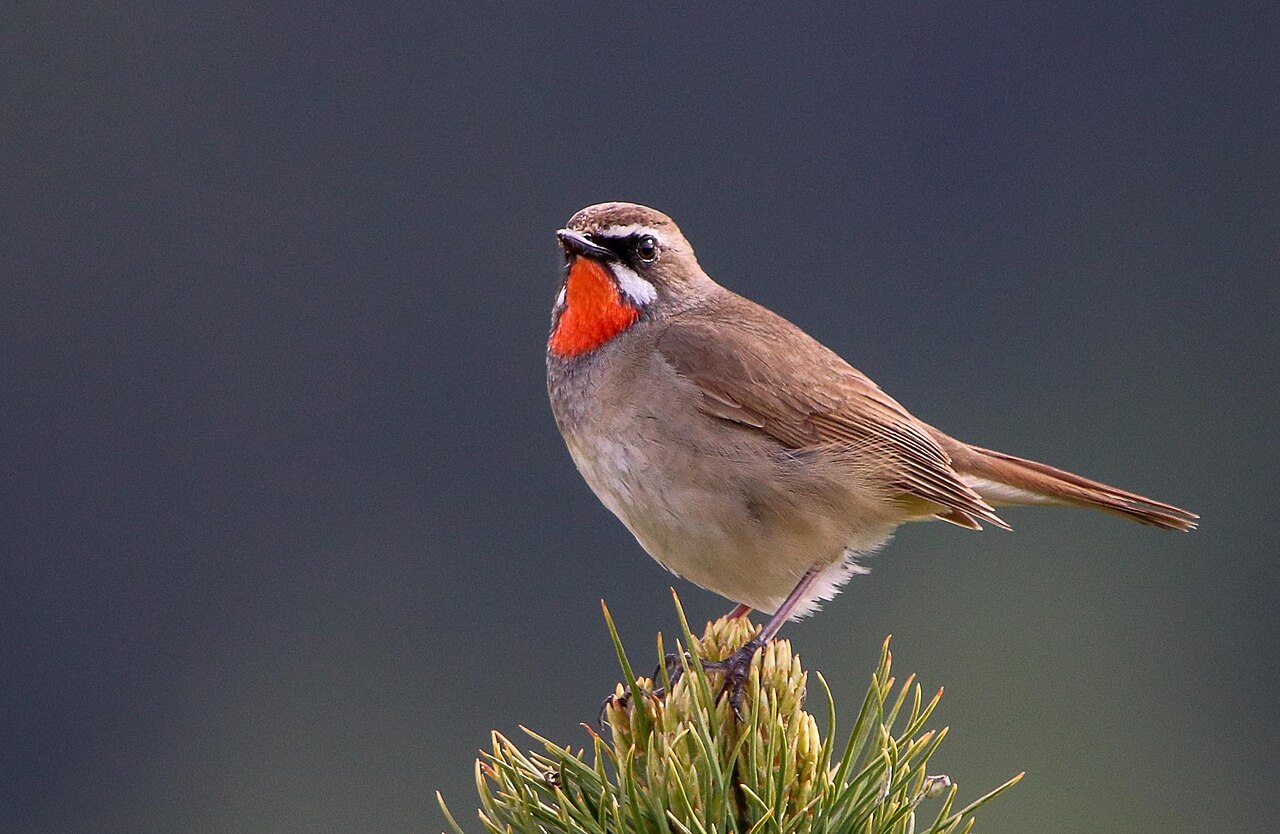
The Siberian Rubythroat is a large, brown chat of the Siberian taiga, the male with a sharply outlined scarlet throat. In the guide area it is a rare but near-annual migrant on the islands of western Alaska, chiefly in spring; it walks about on the ground and vanishes into dense cover at the slightest alarm.
Voice
The song is a long, linked series of whistles, rattles and imitations, in pace and build much like a Garden Warbler's but harder and with sharper transitions; it is delivered from a low bush top or from cover, at night as well. The contact call is a rising drawn-out whistle chew-eet, and in alarm a deep, short tchack like two stones knocked together.
Recording: Bo Shunqi 薄顺奇 — CC BY-NC-SA 4.0 · 鹞子沟, Xining, Qinghai, China · xeno-canto
Identification
Plain olive-brown above and dingy white to greyish brown below, with long legs and an upright stance. The face is marked with a white supercilium and a white malar stripe, separated by a dark eye-stripe. The male has a scarlet throat rimmed by a thin black line and a broad white border below it, and a grey breast. The female has the same face pattern but a dingy white throat; older females may show some red. The tail is brown and plain, without red or white patches.
Confusion species
Red-flanked Bluetail, which turns up on the same islands, has a blue tail and orange flanks and lacks the double white face stripe. Bluethroat has an orange-red tail base and a blue or black-rimmed throat. Female and young rubythroats are the hard ones: there the combination of white supercilium and white malar stripe, the plain brown tail and the heavy long legs is decisive. American Catharus thrushes are larger, have a spotted breast and lack the face stripes.
Habitat
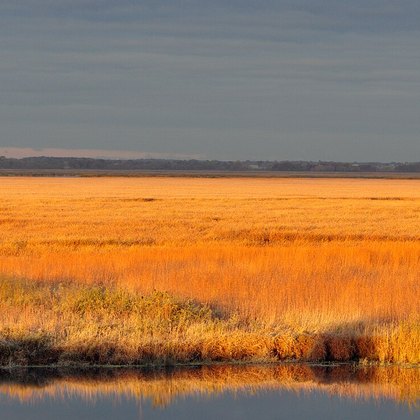
Breeds in damp coniferous and mixed forest with dense undergrowth, in willow and birch scrub along rivers, in rank clearings and in shrubby tundra at the northern edge of the range; the nest is on or just above the ground. In winter it uses reedbeds, scrub, tea gardens and field corners. Vagrants in Alaska keep to herb cover, piled driftwood and the sheltered boneyards of the villages.
Where the bird is most often found, arranged by the USNVC — the vegetation classification of the United States and Canada — and CMECS for sea and coast.




Range and movements
The breeding range runs from the Urals across Siberia to Kamchatka, the Kurils and Hokkaido, south to Mongolia, north-eastern China and the Chinese mountains. It winters in southern China, Taiwan, Indochina, Thailand, Bangladesh, India and the Indonesian islands. In the guide area it is a rare but almost annual visitor to the Aleutians, St. Lawrence Island and the Pribilofs, with most records in late May and June and far fewer in autumn. There are a few records from mainland Alaska and one winter record in Ontario.
Where and when to look
The best chance is late May and early June on St. Paul, Gambell or Attu, after a run of days with wind from the west. Search the edges of the boneyards and the tall grass, low down: the bird walks with the tail raised and stays in the open only a few seconds. A lit-up red throat is distinctive, but most birds first show only the double white face stripe.
Conservation
The species has a large range and population and is listed as Least Concern (LC). In parts of East Asia it is trapped for the cagebird trade, and scrub in the wintering grounds is being converted to farmland. In the guide area only migrants are involved, so the number of records depends mainly on the weather and on how many observers are on the islands in May and June.
Scientific name
Calliope calliope | (Pallas, 1776)
Pallas described the species in 1776 as Motacilla Calliope, from birds taken between the Yenisei and the Lena; because it was later moved to another genus, author and year stand in parentheses. Calliope is the name of the muse Calliope, from Greek kallos 'beautiful' and ops 'voice', thus 'the beautiful-voiced'; the genus was introduced by John Gould in 1836 and repeats the species name. The Dutch name and the English Siberian Rubythroat both refer to the male's throat colour.