All species › Passerines › Chats, Old World flycatchers and allies › Taiga Flycatcher
Taiga Flycatcher | Ficedula albicilla
Taigavliegenvanger | Papamoscas de la taiga
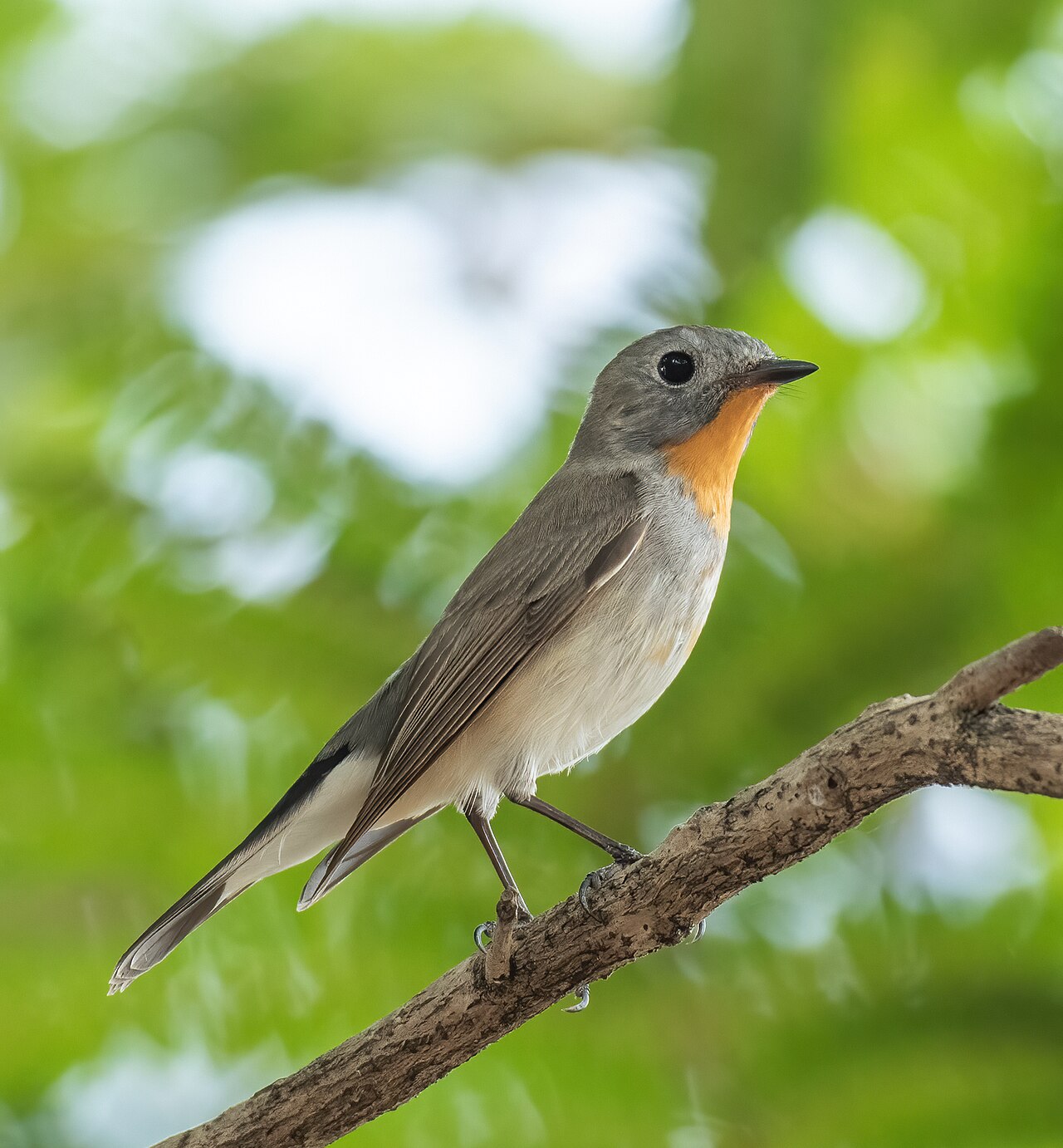
The Taiga Flycatcher is a small, short-billed flycatcher of the Siberian taiga, with a black tail carrying a white patch on either side of the base. In the guide area it is a vagrant to the islands of western Alaska, with most records in spring. It often cocks the tail and then lowers it slowly.
Voice
It calls freely well outside the breeding season: a dry, fast rattle, harder and more hurried than that of Red-breasted Flycatcher, often preceded by a short tsik. The song is a brief series of clear descending whistles falling away to a final note, given from the lower half of the canopy.
Recording: Richard E. Webster — CC BY-NC-SA 4.0 · Mungunmorit, Mo'ngonmorit, Töv, Mongolia · xeno-canto
Identification
A compact flycatcher with a round head, large dark eyes set off by a narrow pale eye-ring, and a short, wholly black bill without a pale base. Grey-brown above, white below with a cold grey wash on the sides of the breast and no warm or buff tones. The tail is black with a white panel each side of the base, and the longest uppertail coverts are a deeper black than the tail feathers themselves. The breeding male has an orange-red throat patch confined to the chin and sharply bordered by grey; outside the breeding season, and in females and young birds, the throat is white.
Confusion species
Red-breasted Flycatcher, a vagrant on the Atlantic side, has a pale bill base, browner uppertail coverts that are not darker than the tail, and warm buff tones on throat and breast; the male's red extends onto the breast. The two also sound different: a hard rattling call against the soft, dry rattle of Red-breasted. American Empidonax flycatchers have clear wingbars and a broad bill with a pale lower mandible, and lack the white tail patches.
Habitat
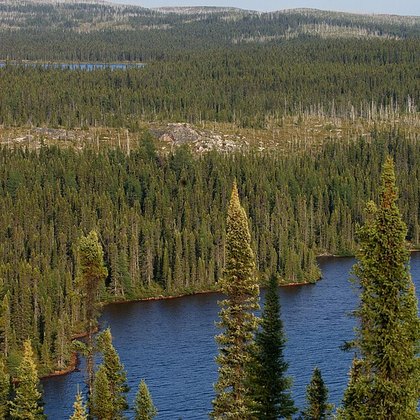
Breeds in taiga: conifer and mixed broadleaf-conifer forest with clearings, edges and old cuttings, and in the north also in birch and willow woodland along rivers. In winter it uses open woodland, gardens, orchards and field edges, hunting from low branches and posts. Birds in Alaska are seen in island scrub and herb cover, for want of any forest.
Where the bird is most often found, arranged by the USNVC — the vegetation classification of the United States and Canada — and CMECS for sea and coast.




Range and movements
It breeds from north-eastern European Russia across Siberia to Kamchatka and northern Mongolia and winters in South and South-East Asia, from India and Bangladesh to Indochina, southern China and Borneo. In the guide area there is a handful of records, nearly all from the Aleutians and the Pribilofs; a maximum of fourteen birds was recorded at Attu in June 1987, still the highest count for North America. Outside Alaska there are isolated records, including one in California and a first Canadian record near Vancouver.
Where and when to look
Look for it in late May and June on the Bering Sea islands, when most records fall. The call gives it away before the plumage does: a hard rattle from low scrub is worth following up. Then check the contrast between the jet-black uppertail coverts and the slightly browner tail, and the wholly black bill.
Conservation
The range is large and the population numerous; the Red List treats the species as Least Concern (LC). In the wintering grounds open woodland and scrub are being converted to farmland, but there is no evidence of rapid decline. None of this bears on the guide area: here only vagrants are involved, and the number of records follows observer presence on the islands.
Scientific name
Ficedula albicilla | (Pallas, 1811)
Pallas described the species in 1811 as Muscicapa Albicilla, from material taken in Dauria in Transbaikalia; because it was later placed in Ficedula, author and year stand in parentheses. Ficedula is the Latin name for a small fig-eating bird, from ficus 'fig'. The species name albicilla is built from Latin albus 'white' and -cilla 'tail', an ending that arose from a mistaken parsing of motacilla; it refers to the white tail patches. Both the Dutch and the English name refer to the taiga in which it breeds.