All species › Passerines › New World blackbirds, troupials and allies › Bobolink
Bobolink | Dolichonyx oryzivorus
Bobolink | Charlatán
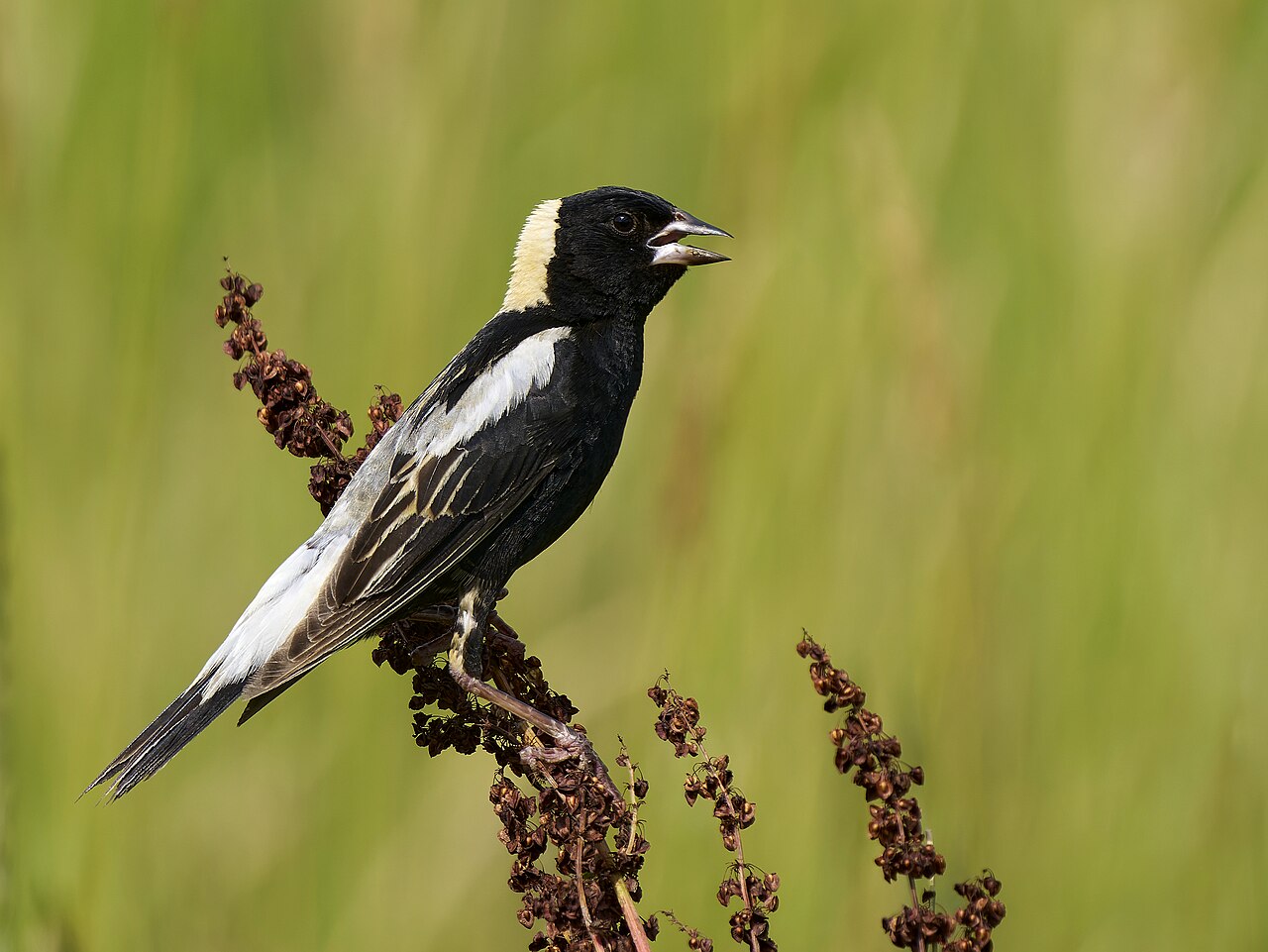
The Bobolink is the only North American songbird that is dark below and pale above in breeding plumage: the male is black with a buff-white nape and white shoulders and rump. It breeds in hayfields and grassland of the northern United States and southern Canada and winters on the grasslands and rice fields of South America, as far as Argentina. Almost none of that winter range lies within this guide's window; what you see here is a breeder or a migrant.
Voice
The song is a fast, bubbling run of metallic, rising notes tumbling over one another, and it gave the bird its English name. The male delivers it in a song flight with quick, shallow wingbeats low over the grass, and also from a fencepost or a stem. The flight call is a clear, rising pink, heard above all at night from birds passing overhead; in autumn that call is often the only sign that Bobolinks are moving through.
Recording: Jonathon Jongsma — CC BY-SA 4.0 · Keewaydin Farms, Richland County, Wisconsin, United States · xeno-canto
Identification
The breeding male is black on head, face and the whole underside, with a buff-white nape patch, white shoulder stripes and a white rump — the pattern is exactly the reverse of the usual songbird arrangement. The female is buff-brown with dark streaking on back and flanks, a dark crown with a pale central stripe, and an unstreaked warm yellow breast. The bill is short and conical, and the tail feathers end in sharp points. After breeding the male moults completely and then resembles the female.
Confusion species
In autumn plumage the species can be confused with sparrows of open grassland, but the pointed tail feathers, the short conical bill, the clear pale central crown stripe on a dark crown and the unstreaked buff-yellow breast settle it together. Female blackbirds are larger and have a long pointed bill. The black breeding male might briefly suggest a Lark Bunting or a pied blackbird; neither combines a pale nape with a white rump and black underparts. On migration the rising pink call identifies the bird without a view.
Habitat
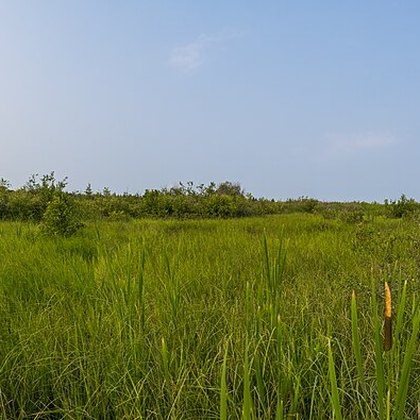
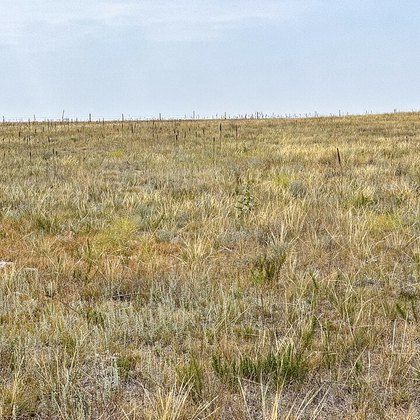
Originally tallgrass prairie and wet sedge meadow; today mainly hayfields, clover and alfalfa, lightly grazed grassland and wide grassy strips, with a preference for a mix of grasses and forbs on damp ground. In the west it uses irrigated hay meadows in valleys. On migration it appears in rice fields, marsh vegetation and field margins; along the Gulf coast and in the Caribbean rice and grass seed are its main food.
Where the bird is most often found, arranged by the USNVC — the vegetation classification of the United States and Canada — and CMECS for sea and coast.


Range and movements
The breeding range runs from southeastern British Columbia and the prairie provinces east to the Maritimes, and in the United States from Washington, Idaho and Montana to the Great Lakes and New England, with a southern limit around Maryland, West Virginia and the Appalachians. Migration goes largely via Florida and the West Indies to northern South America and on to the grasslands of Bolivia, Paraguay and Argentina. Within this guide's window the species is therefore virtually absent in winter, while in May and from August to October it passes through the southeastern states, Cuba, Jamaica and the Bahamas and along the Caribbean coast of Colombia and Venezuela.
- Breeding (summer)
- Passage
- dark = core range, pale = thinly spread
Where and when to look
The best chance is late May and June in a hayfield not yet cut: stand at the edge early in the morning and wait for the male's song flight over the grass. In autumn the bird is inconspicuous; on migration days listen instead for the short rising pink over fields and marsh vegetation.
Conservation
The species is Near Threatened on the Red List. Partners in Flight puts the breeding population at about 10 million birds; the Breeding Bird Survey shows a decline of roughly 63 percent between 1966 and 2023, placing the Bobolink on the American tipping-point list. In Vermont numbers fell by about 75 percent between 1966 and 2007. The main cause is the conversion of hayfields to maize and soy and the earlier and repeated cutting of hay, which destroys nests; cutting ten to eleven days later raises nesting success substantially. In the nineteenth century the species was shot in large numbers in the rice fields of the southern states, and it is still controlled locally as a rice pest in South America.
Scientific name
Dolichonyx oryzivorus | (Linnaeus, 1758)
Linnaeus described the species in 1758 as Fringilla oryzivora, the type locality later restricted to South Carolina; as it now stands in another genus, author and year go in parentheses. The genus Dolichonyx was introduced in 1827 by William Swainson, from Greek dolichos 'long' and onux 'claw', after the notably long hind claw. The species name means 'rice-eating', from Latin oryza 'rice' and vorare 'to devour', after the birds feeding in the rice fields of the southern states, where they were called ricebird. The English name bobolink renders the song, as does the Spanish charlatán, 'chatterer'.