All species › Passerines › New World blackbirds, troupials and allies › Yellow-headed Blackbird
Yellow-headed Blackbird | Xanthocephalus xanthocephalus
Geelkoptroepiaal | Tordo cabeciamarillo
The Yellow-headed Blackbird breeds in colonies in deep reed marshes of western and central North America, the male black-bodied with a bright yellow head and breast and a white wing patch that shows in flight. It nests over water in standing cattail and bulrush, often in the same marshes as Red-winged Blackbird but in the deeper part. Outside the breeding season it moves in large flocks to farmland and feedlots in the southwestern United States and Mexico.
Voice
The male's song is not a musical phrase but a sound forced out with effort: a few hesitant introductory notes followed by a long, grating, metallic rasp that dies away, delivered with the head thrown back and the wings half spread. There are two types: a louder one that carries across the marsh, and a shorter buzzing one used at close range within the vegetation. The call is a low, hard kruk or chek. A colony of dozens of singing males produces a continuous creaking chorus.
Recording: Richard E. Webster — CC BY-NC-SA 4.0 · San Bernardino National Wildlife Refuge, Cochise County, Arizona, United States · xeno-canto
Identification
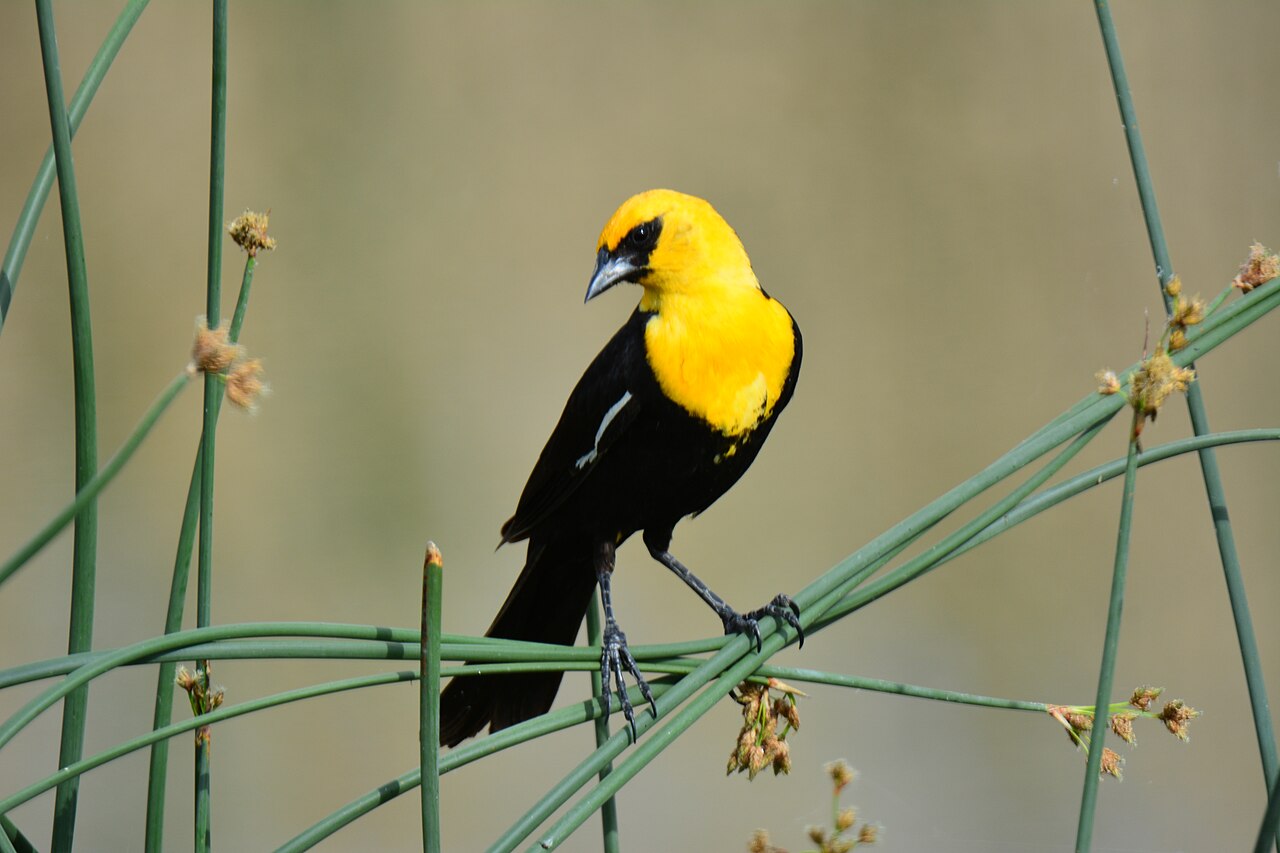
The male is black with a deep yellow head, throat and upper breast, a black mask around the eye and bill base, and a white patch on the primary coverts that shows mainly in flight. It is a bulky bird, 21 to 26 centimetres, with a heavy pointed bill and a stouter build than Red-winged Blackbird. The female is dull brown with a dingy yellow throat and upper breast, a pale supercilium and some white streaking on the lower breast, and no white wing patch. First-autumn males are brownish with a dull yellow head.
Confusion species
Within its range the male can be confused with nothing else. The female recalls a female Red-winged Blackbird, but that bird is coarsely streaked over the whole underside and shows no yellow; the female Yellow-headed is plain brown with a sharply bounded yellow throat and breast. Brewer's Blackbird lacks yellow entirely and has a shorter tail and a finer bill. A young Yellow-headed in winter may be taken for a cowbird, but it has a longer, more pointed bill and always a buff-yellow wash on head and throat.
Habitat
Freshwater marshes with tall, dense cattail, bulrush or reed in water half a metre to over a metre deep — deeper than the zone where Red-winged Blackbird nests. Prairie potholes, lake margins, mountain meadows and constructed waters such as irrigation basins and storage ponds are all used, provided there is enough standing vegetation over open water. It feeds in adjoining grassland, cropland and stockyards. In winter it spends the day almost entirely on farmland and roosts in reeds.
Where the bird is most often found, arranged by the USNVC — the vegetation classification of the United States and Canada — and CMECS for sea and coast.





Range and movements
The breeding range runs from central British Columbia, the prairie provinces and the Great Lakes region south to California, Arizona and New Mexico, with its core in the marshes of the northern Great Plains and the Great Basin. In California's Central and San Joaquin valleys and in the lower Colorado River valley of Arizona part of the population stays all year. The rest moves to southern Texas, the southwest and the Mexican plateau, wintering from Sonora and Chihuahua to Jalisco, Guanajuato and Veracruz; in the southernmost part of the winter range the flocks are largely female.
- Resident
- Breeding (summer)
- Winter
- Passage
- dark = core range, pale = thinly spread
Where and when to look
In May or June find a marsh with tall cattail and open water between the stands and watch for singing males on the stems at the edge of the colony. In winter it pays to scan large mixed blackbird flocks in the southwest, on stubble fields and around cattle sheds: one yellow head among thousands of black birds shows at a distance.
Conservation
Partners in Flight puts the breeding population at about 11 million birds and the Continental Concern Score at 9 out of 20. The total is fairly stable over the long run but swings strongly from year to year with water levels: in dry years whole colonies fail. The long-term pressure is the draining and fragmentation of prairie marshes and water abstraction in the Great Basin. At winter roosts near grain stores and livestock operations Yellow-headed Blackbirds are sometimes killed as part of control aimed at mixed blackbird flocks.
Scientific name
Xanthocephalus xanthocephalus | (Bonaparte, 1826)
Bonaparte described the species in 1826 as Icterus xanthocephalus, from a specimen taken at the Pawnee villages on the Platte in present-day Nebraska; because it was later placed in a genus of its own, author and year stand in parentheses. That genus Xanthocephalus Bonaparte himself introduced in 1850, which made genus and species name identical. Both are built from Greek xanthos 'yellow' and kephale 'head'. The Dutch and Spanish names state the same feature.