All species › Passerines › New World blackbirds, troupials and allies › Yellow-breasted Chat
Yellow-breasted Chat | Icteria virens
Geelborstzanger | Reinita grande
At 17 to 19 centimetres the Yellow-breasted Chat is far larger than the warblers it was long classed with, and it has a heavy, curved bill and a long tail. It breeds in dense scrub across the southern half of the United States and northern Mexico and winters from central Mexico to Central America. Its voice is a run of separate whistles, rattles and clucks that rarely comes out the same way twice.
Voice
The song is not a continuous phrase but a sequence of separate elements with silences between them: clear whistles, harsh chak notes, gurgling rolls, clucking and rattling sounds, sometimes with imitations of other species mixed in. The male sings from cover, at night as well as by day, and also performs a display flight, climbing above the scrub with dangling legs and exaggeratedly slow, high wingbeats and dropping back while singing. The call is a hard, low chak. After the breeding season the species falls almost completely silent.
Recording: Mario Reyes Jr — CC BY-NC-SA 4.0 · Hisle Park, United States · xeno-canto
Identification
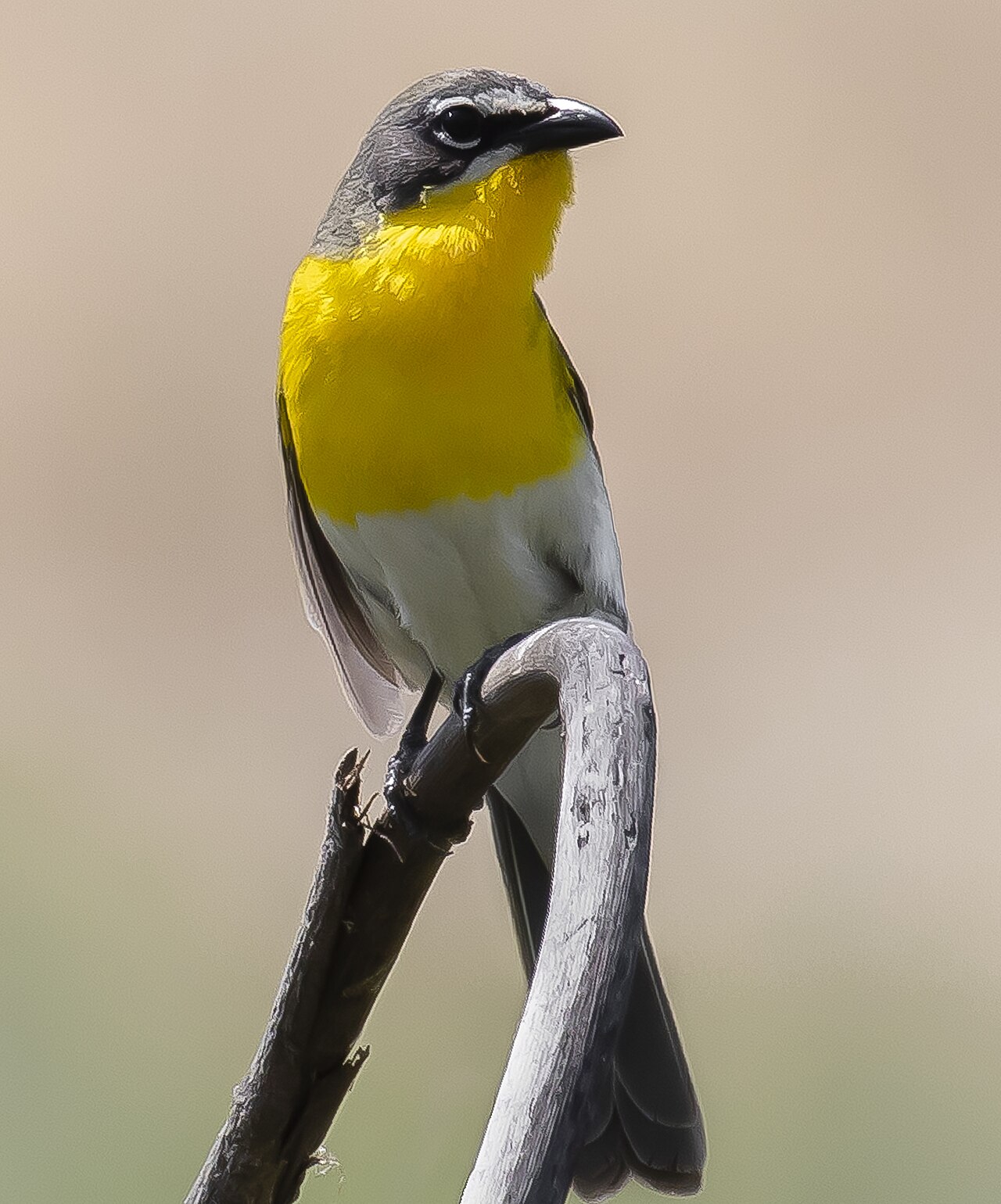
Olive-green above, with a bright yellow throat and breast ending in a sharp line against a white belly. The head carries a white eye-ring drawn forward into a short white line to the bill, and a white malar stripe below it, together forming a spectacled pattern on a grey head. The bill is black, thick and slightly curved, quite unlike the fine forceps bill of a warbler; the legs are dark grey to black. The tail is long and is often held up or flicked about.
Confusion species
Common Yellowthroat shares the rank streamside habitat and the yellow throat, but is under 13 centimetres, has a thin bill and, in the male, a black mask without a white eye-ring. The chat is nearly twice the weight. In orioles of the genus Icterus the yellow runs on to the undertail and the bill is pointed and straight, where the chat's is short, thick and curved. The combination of white spectacles, the sharp break between yellow breast and white belly, and the long tail settles it.
Habitat
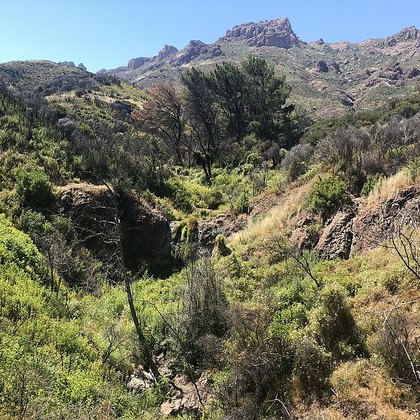
Dense, impenetrable scrub with a closed canopy at roughly two to four metres: bramble and rose thickets on abandoned farmland, regrowing clearcuts, utility corridors, forest edges and above all the willow and shrub zone along rivers and streams. In the west that riparian shrub layer of the dry states is almost its only breeding habitat. In winter it uses similar dense scrub and second growth in Mexico and Central America.
Where the bird is most often found, arranged by the USNVC — the vegetation classification of the United States and Canada — and CMECS for sea and coast.




Range and movements
The breeding range runs from southern British Columbia, southern Alberta and southern Ontario south across most of the United States apart from the northern border states and Florida, and in Mexico from northern Baja California and Sonora to Nayarit and over the plateau to Zacatecas. The winter range lies on both slopes of Mexico, from Tamaulipas and the Yucatán Peninsula and from southern Sinaloa southward, and on through Central America. A few birds linger through winter in the Gulf states or on the Atlantic coast, often at a garden feeder.
- Resident
- Breeding (summer)
- Winter
- Passage
- dark = core range, pale = thinly spread
Where and when to look
Look for it between mid-May and late June, while the male is still singing; after that it is rarely found. The best chance is early morning, or by moonlight, along a river thicket: work towards the sound and wait for the bird to climb to the top of a shrub. In a display flight above the scrub the whole bird shows, dangling legs and all.
Conservation
Partners in Flight puts the world population at about 17 million birds. Numbers fell by roughly 32 per cent between 1966 and 2019, but the picture is twofold: in the east the species declines as abandoned farmland reverts to forest, while western populations have locally increased. The pressure in the west is loss of the riparian zone through water abstraction, grazing and bank hardening. The subspecies of southwestern British Columbia is listed as endangered in Canada, where it numbers a few dozen pairs.
Scientific name
Icteria virens | (Linnaeus, 1758)
Linnaeus described the species in 1758 as Turdus virens, placing it with the thrushes; as it now stands in another genus, author and year go in parentheses. The genus Icteria was introduced in 1808 by Louis Pierre Vieillot, from Greek ikteros, jaundice and the yellow bird believed to cure it. The species name virens is Latin for 'becoming green', after the olive upperparts. Its place in the system has long been disputed: it is now usually given a family of its own next to the blackbirds rather than being kept with the New World warblers.