All species › Passerines › Spindalises › Western Spindalis
Western Spindalis | Spindalis zena
Westelijke spindalis | Cabrero
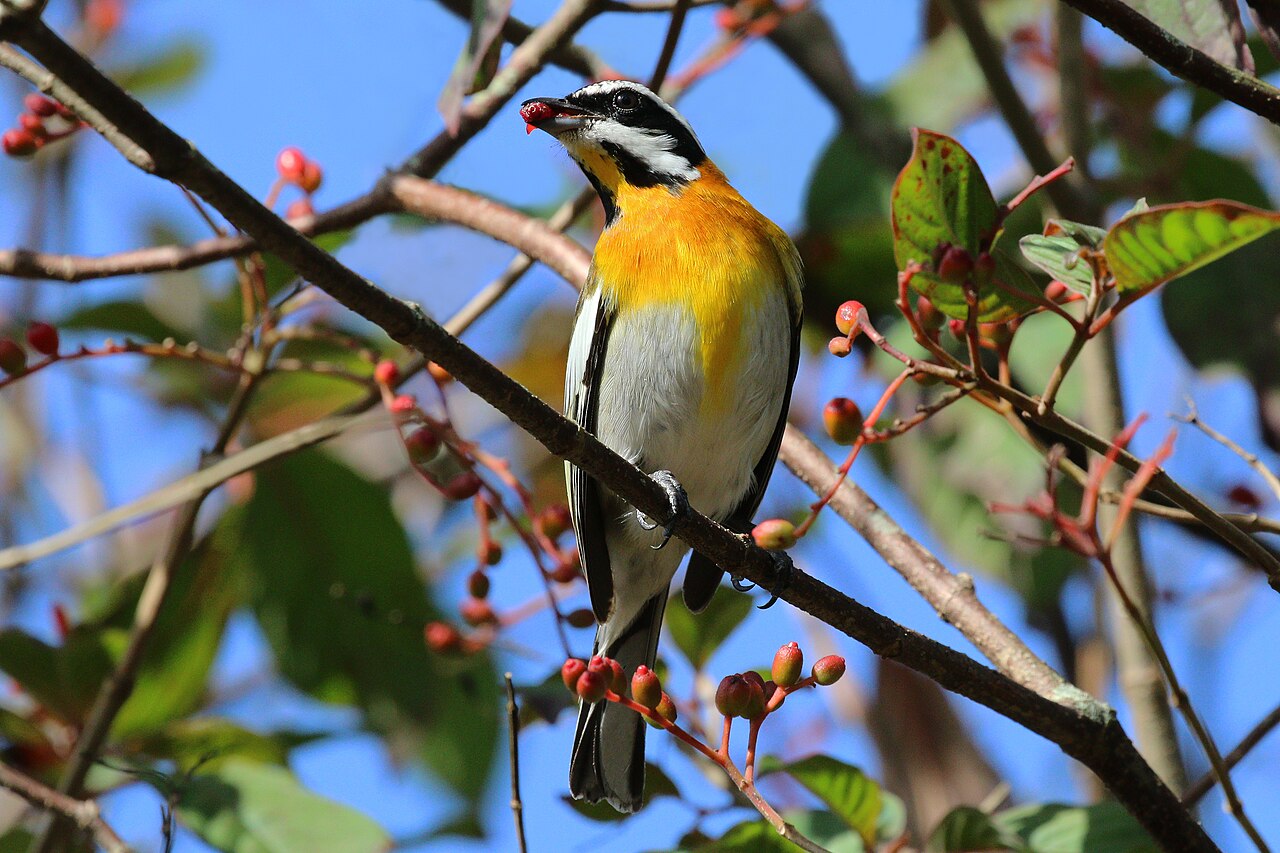
The Western Spindalis is a boldly marked island bird: a black-and-white striped head, an orange breast, nape and rump, and a white spot in the black wing. It is resident in the Bahamas, the Turks and Caicos, Cuba, Grand Cayman and the Mexican island of Cozumel, with a separate subspecies on each island group. From the Bahamas it reaches the far southeast of Florida, where a pair bred successfully for the first time in 2009.
Voice
The song is a long, irregular string of thin notes, now in groups of two or three, now accelerating into a wispy squeaking, and it carries no more than twenty metres or so. It is delivered from a hidden branch high in the canopy and seldom in full view, mostly in early spring. The call is a short tseep that is lost among rustling leaves. The birds that reach Florida are usually silent, and there they are found not by ear but by watching fruiting trees.
Recording: FREDERIC Lionel — CC BY-NC-SA 4.0 · Soroa, Artemisa, Cuba · xeno-canto
Identification
The male has a black head with two sharp white stripes — one above the eye, one across the cheek — and below them a white throat with an orange patch in the middle. Breast, nape and rump are orange to chestnut, the belly is white to pale grey, and the back is black or olive-green depending on the form. The wing is black with a white spot at the base of the primaries and pale edges along the coverts, which flashes as a short white line in flight. The female is dull olive-grey, greyish brown below, with at most a wash of orange on breast and rump and no more than a shadow of the head pattern; the pale wing spot she keeps. Young males wear the head pattern dull and incomplete at first, with brown where the adult is black.
Confusion species
A male cannot be confused with anything else in this region; the female, by contrast, is almost plain olive-grey, with the head pattern barely showing. The best handle is then the pale spot at the base of the wing — but the female Black-throated Blue Warbler (Setophaga caerulescens) has that too, and shares the same gardens; she is less than half the weight, has a thin insect-eater's bill and a clear pale eyebrow. A female spindalis is also heavier than any warbler, with a short conical bill and a grey throat bordered by a pale malar line. Anyone who knows the bird of one island group can be caught out by the colour of the back: on the southern Bahamas a black-backed form predominates, on the northern islands a green-backed one.
Habitat
In the Bahamas the dry, dense hardwood scrub known there as coppice (low, dense scrub on limestone, Caribbean and south Florida), and the open pine woods of the northern islands; in Cuba woodland from the coast up into the mountains, including old coffee plantations and their shade trees. What a site must offer is a canopy in fruit: it follows the crop of figs, palms and berry-bearing shrubs and moves on as soon as it is finished. In Florida it is found almost always close to the coast, in the hammocks — the slightly raised stands of tropical hardwood — and in parks and gardens with plenty of fruiting trees. Bare open country it avoids.
Where the bird is most often found, arranged by the USNVC — the vegetation classification of the United States and Canada — and CMECS for sea and coast.




Range and movements
Resident in the Bahamas and the Turks and Caicos, in Cuba and the Isla de la Juventud, on Grand Cayman and on Cozumel off the Yucatán coast; five subspecies, each on its own island group. It does not migrate, but it wanders after the fruit crop and crosses stretches of sea in doing so. That is how it reaches south Florida: in most years a few are recorded in Miami-Dade, in Broward and on the Keys, usually between October and May. North of Palm Beach County it is rare, and inland records are few. Its American occurrence therefore hangs entirely on the wind and on the harvest of the islands to the east and south.
- Resident
- Breeding (summer)
- Winter
- Passage
- dark = core range, pale = thinly spread
Where and when to look
In south Florida, look between December and April for trees in fruit in the coastal parks and hammocks; the parks of Key Biscayne and the stands of the Keys have produced most of the birds. Be there early and look up into the canopy rather than into the shrub layer: it feeds high, moves little, and disappears among the leaves the moment it sits still. When a bird does give itself away it is usually by a brief movement in the foliage or by a short tseep.
Conservation
Least Concern (LC): in Cuba and on the larger Bahamian islands it is an ordinary forest bird. The forms with a small range stand differently: those of Grand Cayman and Cozumel each occupy a single island, where a hurricane or the clearing of woodland can remove a large part of the living space in one season. What is seen in Florida depends entirely on those island populations; there is no self-sustaining population there.
Scientific name
Spindalis zena | (Linnaeus, 1758)
Linnaeus described the bird in 1758 as Fringilla Zena, among the finches; because it was later moved to another genus, author and year stand in parentheses. The genus Spindalis was introduced in 1837 by Jardine and Selby, with the Jamaican species as its type. Linnaeus wrote the epithet with a capital, as he did for words he took over as proper names, and gave no explanation with it; what zena means has therefore remained uncertain. As the type locality he gives the Bahama Islands; Hellmayr restricted this to New Providence in 1936.