All species › Passerines › New World blackbirds, troupials and allies › Western Meadowlark
Western Meadowlark | Sturnella neglecta
Geelkaakweidespreeuw | Turpial gorjeador
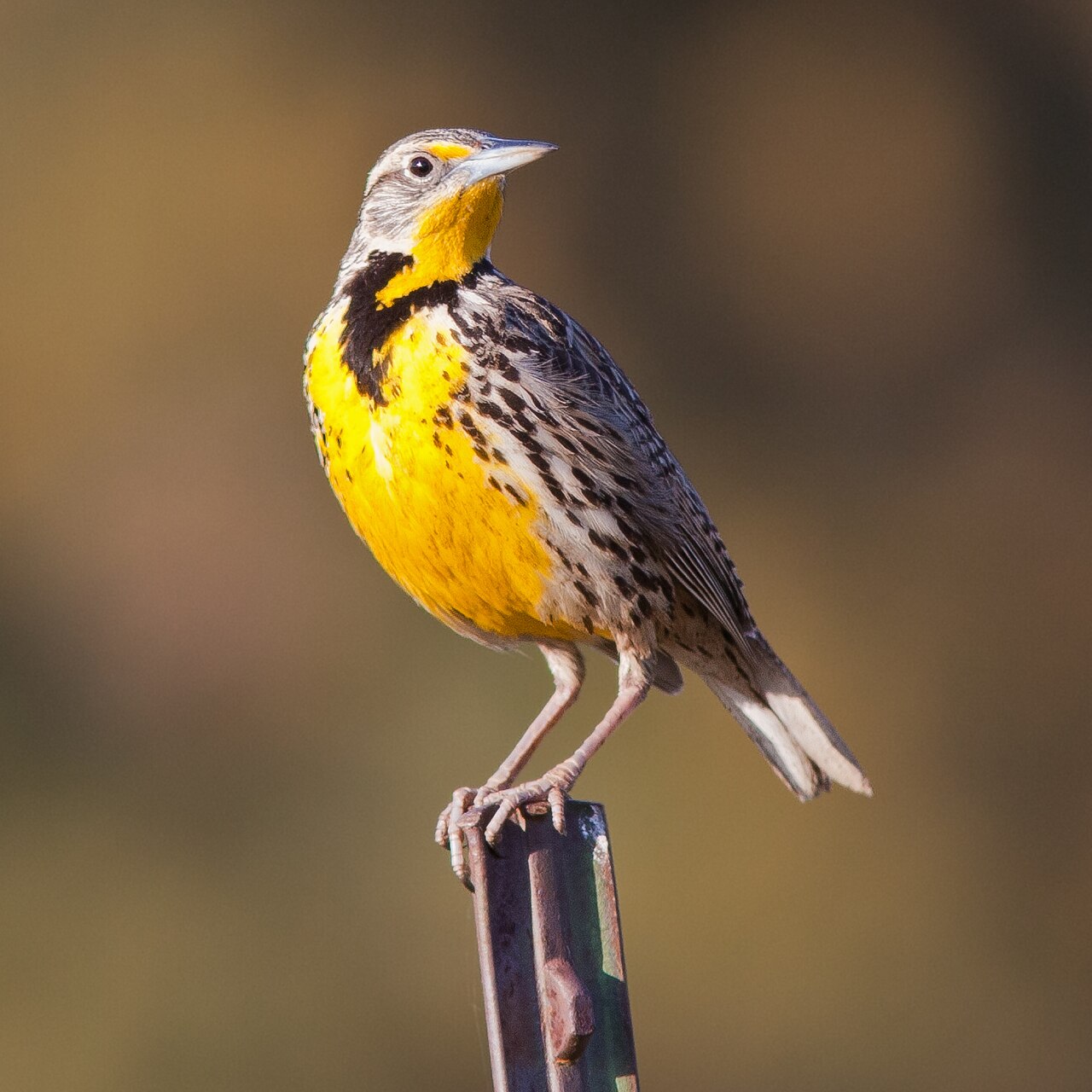
The Western Meadowlark is the meadowlark of the grasslands west of the Mississippi: stocky, short-tailed and bright yellow below with a black V across the breast. It sings from fenceposts and wires along prairie roads and has been adopted as the state bird of six states. From the nearly identical Eastern Meadowlark it is most safely separated by song and by the yellow that runs out on to the malar stripe.
Voice
The song is a short, flowing series of whistles running into a tumbling, gurgling final figure of seven to ten notes — a single connected, flute-like whole. Eastern Meadowlark instead gives two to four slow, thin, downslurred whistles without that gurgling ending, a difference usable at any distance. The call is a low, dry chuck and a short rattle given on taking off; the flight call is a high, short tseep.
Recording: Ed Pandolfino — CC BY-NC-SA 4.0 · Peterson Road, Colusa County, California, United States · xeno-canto
Identification
The underside is bright yellow with a broad black V across the breast; the sides and flanks are white with dark streaking. The upperparts are brown with black and buff streaking, and the head is striped black and brown with a pale central crown stripe and a yellow supercilium in front of the eye. The bill is long, pointed and grey-blue with a dark tip; the tail is short and stiff and is briefly spread on landing, showing the white outer feathers. In winter the black breast shield is partly veiled by pale feather fringes.
Confusion species
In Eastern Meadowlark the malar stripe below the eye is white; in Western the yellow of the throat runs out on to that malar stripe, up to the eye-line. Western is also paler and greyer above, has more diffusely bounded flank streaks and less white in the tail: usually the outer two to three tail feathers are partly white, against three to four largely white feathers in Eastern. Where the two meet on the Great Plains silent birds often cannot be named at all, and the song remains the most reliable character. Chihuahuan (Lilian's) Meadowlark is paler and greyer still on the back but has more white in the tail and a white malar stripe.
Habitat
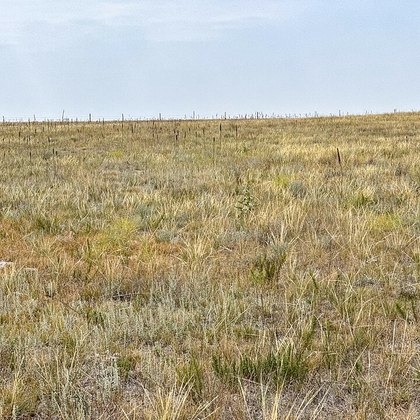
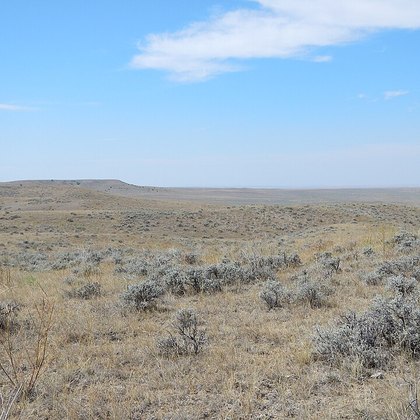
Open grassland without shrubs or trees: shortgrass and mixed-grass prairie, pasture and hay meadow, sagebrush (grey-green sagebrush scrub of the dry western interior) steppe with a grassy understorey, roadsides and fallow field margins, from sea level to over 3000 metres in mountain meadows. Dense shrub layers and woodland are avoided. In winter it feeds on nearly bare ground, stubble and heavily grazed pasture, where Eastern Meadowlark instead seeks more vegetated ground. The nest sits on the ground in a hollow, usually with a woven grass roof over it.
Where the bird is most often found, arranged by the USNVC — the vegetation classification of the United States and Canada — and CMECS for sea and coast.


Range and movements
The range covers western and central North America, from southern British Columbia, Alberta, Saskatchewan and southern Manitoba south to northern Mexico and east to Wisconsin, Illinois and eastern Texas. In the southern half it is present all year; birds of the prairie provinces and northern Great Plains move out and winter in the southern United States, Arkansas and Louisiana and on the Mexican plateau. The range expanded eastward during the twentieth century as forest was cleared to pasture in the Great Lakes states. The division among Mexican states is coarse: resident in Baja California, Sonora, Chihuahua, Coahuila and Nuevo León, a winter visitor south to Jalisco and the Mexican highlands.
- Resident
- Breeding (summer)
- Winter
- Passage
- dark = core range, pale = thinly spread
Where and when to look
Drive a prairie road in March or April and watch the fenceposts: a singing male almost always takes the highest point in its territory and turns the yellow breast to the sun. On a silent bird, look at the malar stripe below the eye — yellow in this species, white in Eastern Meadowlark — and count the white tail feathers as it flushes.
Conservation
Partners in Flight puts the breeding population at about 100 million birds, making this one of the most numerous grassland birds on the continent. The Breeding Bird Survey nonetheless shows a steady decline of about 0.9 per cent a year between 1966 and 2019, roughly 37 per cent in total. The causes lie in the conversion of prairie to cropland, the loss of hay meadow, pesticides and the spread of non-native grasses and shrubs into grassland. The species nests on the ground and is sensitive to disturbance and to mowing during the breeding season.
Scientific name
Sturnella neglecta | Audubon, 1844
Audubon described the species in 1844 from a specimen taken on the Missouri above Fort Croghan in present-day North Dakota; author and year stand without parentheses, since the species is still in the genus in which it was described. The genus Sturnella is a diminutive of Latin sturnus 'starling', after the silhouette and the walking gait; it is not related to starlings but belongs to the blackbird family. The species name neglecta means 'overlooked': Audubon pointed out that travellers in the west, among them the Lewis and Clark expedition, had until then taken the bird for the eastern species. The Dutch name states the character that separates the two: the yellow malar stripe.