All species › Passerines › New World blackbirds, troupials and allies › Eastern Meadowlark
Eastern Meadowlark | Sturnella magna
Witkaakweidespreeuw | Turpial oriental
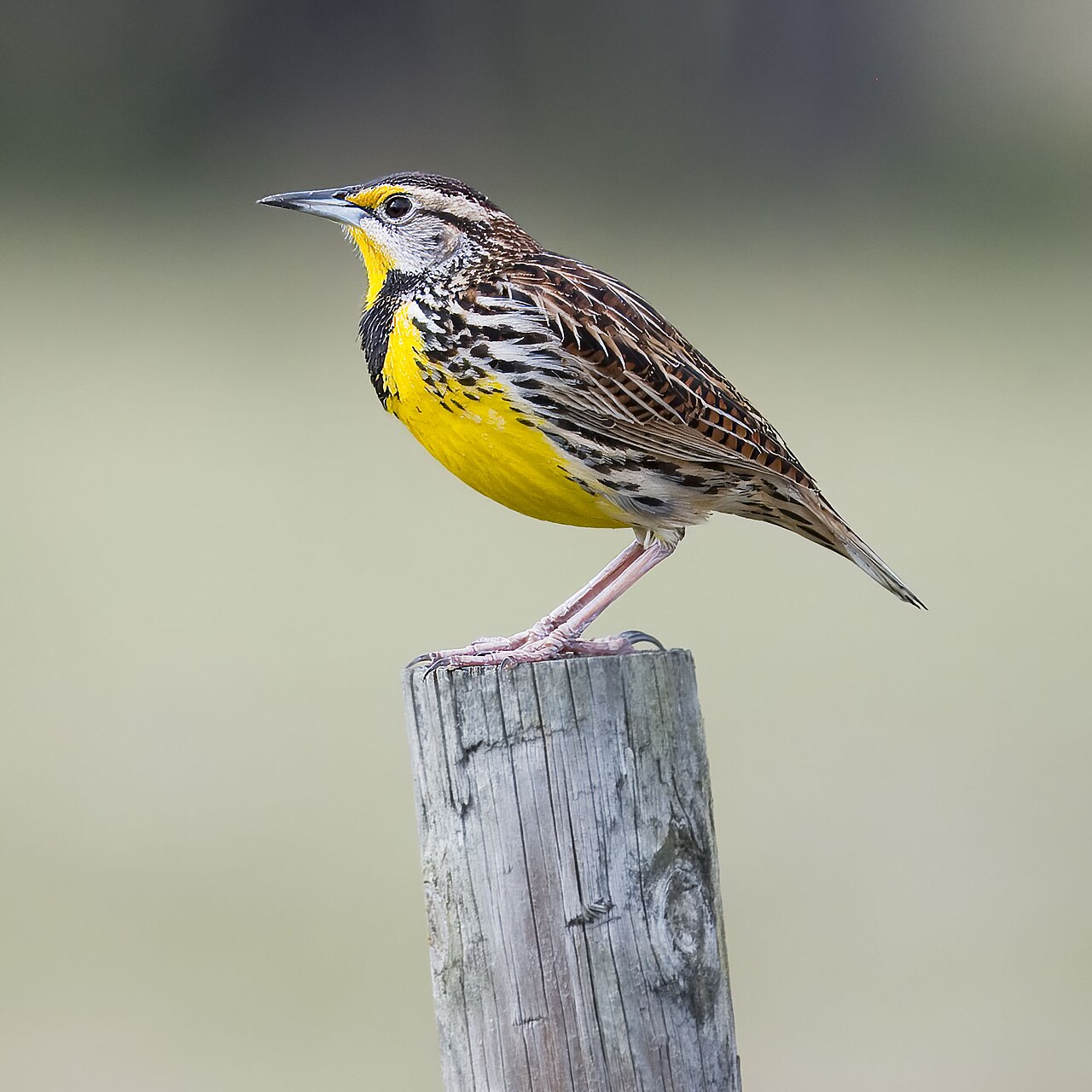
The Eastern Meadowlark is the bunting-like songbird of the open grasslands of eastern North America: stocky, short-tailed, with a yellow breast carrying a black V. It sings from a fencepost or wire and then drops into the grass, where it is all but invisible. The range runs from southern Canada to Central America, Cuba and northern South America.
Voice
The song is two to five clear, descending whistles, often written see-you, see-yeeer; the whole phrase lasts about a second and a half and slides downward at the end. It is a simple series of separate whistles, without the tumbling, gurgling finish of the Western Meadowlark. When disturbed it gives a high, sharp dzert and a dry rattle; birds flushing from the grass deliver a short run of those rattling notes. A male holds several phrase types and alternates them from a fixed song perch.
Recording: Manuel Grosselet — CC BY-NC-SA 4.0 · Colonia Yanashi, San Jerónimo Tlacochahuaya, Oaxaca, Mexico · xeno-canto
Identification
A chunky bird with a long, pointed, pale bill, a short tail and long legs. The underparts are yellow, with a broad black V across the breast that is dulled and veiled with brown in winter plumage. The head is striped lengthwise: dark crown stripes with a pale central stripe, a yellow supercilium in front of the eye and a white malar area. The upperparts are brown with black bars that merge into long streaks on the mantle and shoulders. In flight the short, stiff wingbeats alternating with glides stand out, as do the white outer tail feathers that flash as the bird takes off.
Confusion species
Three meadowlarks look much alike and song is the most reliable character. Western Meadowlark has a tumbling, gurgling, flute-like song that accelerates at the end, while Eastern gives separate descending whistles; in addition, the yellow of Western's throat runs on into the malar area, which stays white in Eastern. Chihuahuan Meadowlark also gives clear whistles, but higher, thinner, with more notes and faster in succession. The visible difference is in the tail: on Chihuahuan the three outer tail feathers are almost entirely white, so the tail flashes white as the bird flushes, against a narrower white edge on Eastern. Chihuahuan is also paler and greyer above, with bars that stay separate rather than merging into streaks, and with a whiter, less streaked ear covert. The ranges barely overlap: Chihuahuan belongs to the desert grassland of Arizona, New Mexico and West Texas, Eastern to the grasslands east of that.
Habitat
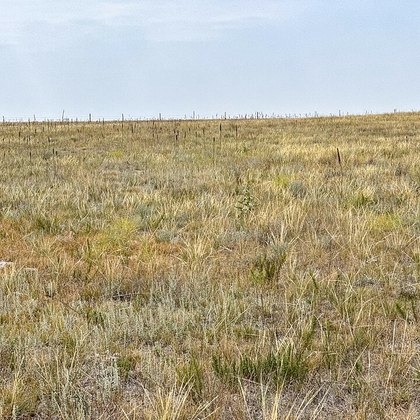
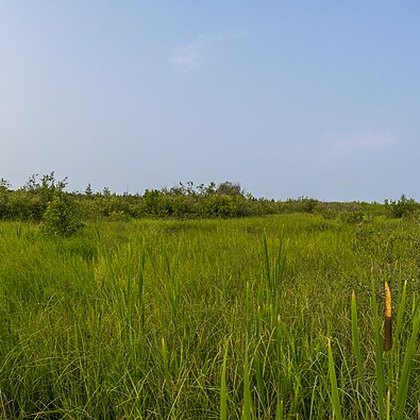
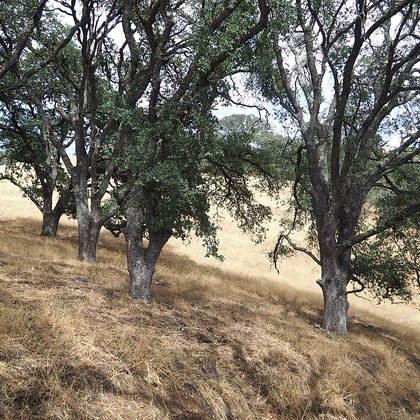
Open grassland with tall, dense vegetation: originally tallgrass prairie and wet meadows, today mainly hayfields, lightly grazed pasture, fallow fields and wide verges. It takes taller, fuller grass than Western Meadowlark and avoids ground with much shrub or tree growth. The nest is a domed grass cup on the ground, hidden under the sward, which makes the species vulnerable to mowing during the breeding season. In the tropics it also occupies grazed savanna and grassland created by clearance of forest.
Where the bird is most often found, arranged by the USNVC — the vegetation classification of the United States and Canada — and CMECS for sea and coast.



Range and movements
The range covers eastern and central North America east of the Rocky Mountains, from southern Ontario and southern Quebec to the Gulf Coast and Florida, and on southward through eastern Mexico and Central America as far as Nicaragua, with Cuba and a set of populations in Colombia, Venezuela and the Guianas besides. Over most of that area it is resident; only the northern breeders of Canada and the northern states withdraw and spend the winter further south within the same range, often in loose parties in stubble fields. In the west the distribution meets that of Western Meadowlark along the prairie edge, where both species sing side by side.
- Resident
- Breeding (summer)
- Winter
- Passage
- dark = core range, pale = thinly spread
Where and when to look
Look for it between April and June along a country road through hayfields: the male then sings from a post, wire or bush and carries far. Outside the song period it gives itself away mainly in flight, by the run of quick, stiff wingbeats followed by a glide and by the white tail edges. Do not walk into the grass to find it — the nests are on the ground.
Conservation
The species is still widespread, with a North American population estimated in the tens of millions, but numbers have fallen steeply for decades; the Breeding Bird Survey shows a loss of well over two thirds since 1970 and the IUCN lists Sturnella magna in the broad sense as Near Threatened (NT). The causes lie in the loss of grassland: conversion to arable land, earlier and more frequent mowing that destroys clutches, heavy grazing, and scrub invasion of unmanaged fields. Delaying the first cut and keeping large unbroken grasslands are the measures management is built on. In Central America the species has instead expanded with deforestation.
Scientific name
Sturnella magna | (Linnaeus, 1758)
Linnaeus described the species in 1758 as Alauda magna, placing it with the larks; because it later moved to another genus, author and year stand in parentheses. The genus Sturnella was introduced in 1816 by Vieillot and is a diminutive of Latin sturnus 'starling', after the compact build and pointed bill. The species name magna means 'large'. The type locality was first given as 'in America, Africa' and was restricted to South Carolina in 1931. The Dutch name points to the white malar stripe, the mark that separates it from Western Meadowlark.