All species › Waders, gulls and terns › Sandpipers and allies › Bristle-thighed Curlew
Bristle-thighed Curlew | Numenius tahitiensis
Zuidzeewulp | Zarapito del Pacífico
The Bristle-thighed Curlew breeds on two small patches of hill tundra in western Alaska and nowhere else on earth, then disappears in a single flight across the Pacific to the coral islands of the tropics. It is the only wader known to use stones to break open seabirds' eggs, and the only one that moults into flightlessness on its wintering islands. Its breeding grounds stayed hidden so long that the first nests were not found until 1948, more than a century and a half after the bird was named.
Voice
The call is a loud, clear, plaintive whistled chee-weet of two syllables with the second falling away — more a plover's whistle than a curlew's, and the best way to pick it out of a flock of curlews. Over the breeding tundra the male delivers a long rolling song in a slow display flight, swelling and then ebbing away. On the atolls its whistle carries right across the reef and is usually heard before the bird is seen. Disturbance brings a sharp, repeated kweek. Unlike Hudsonian Whimbrel it lacks the even, rattling series of short notes on one pitch.
Recording: AUDEVARD Aurélien — CC BY-NC-SA 4.0 · Tuamotus Islands, The Tuamotu and Gambier Islands, France · xeno-canto
Identification
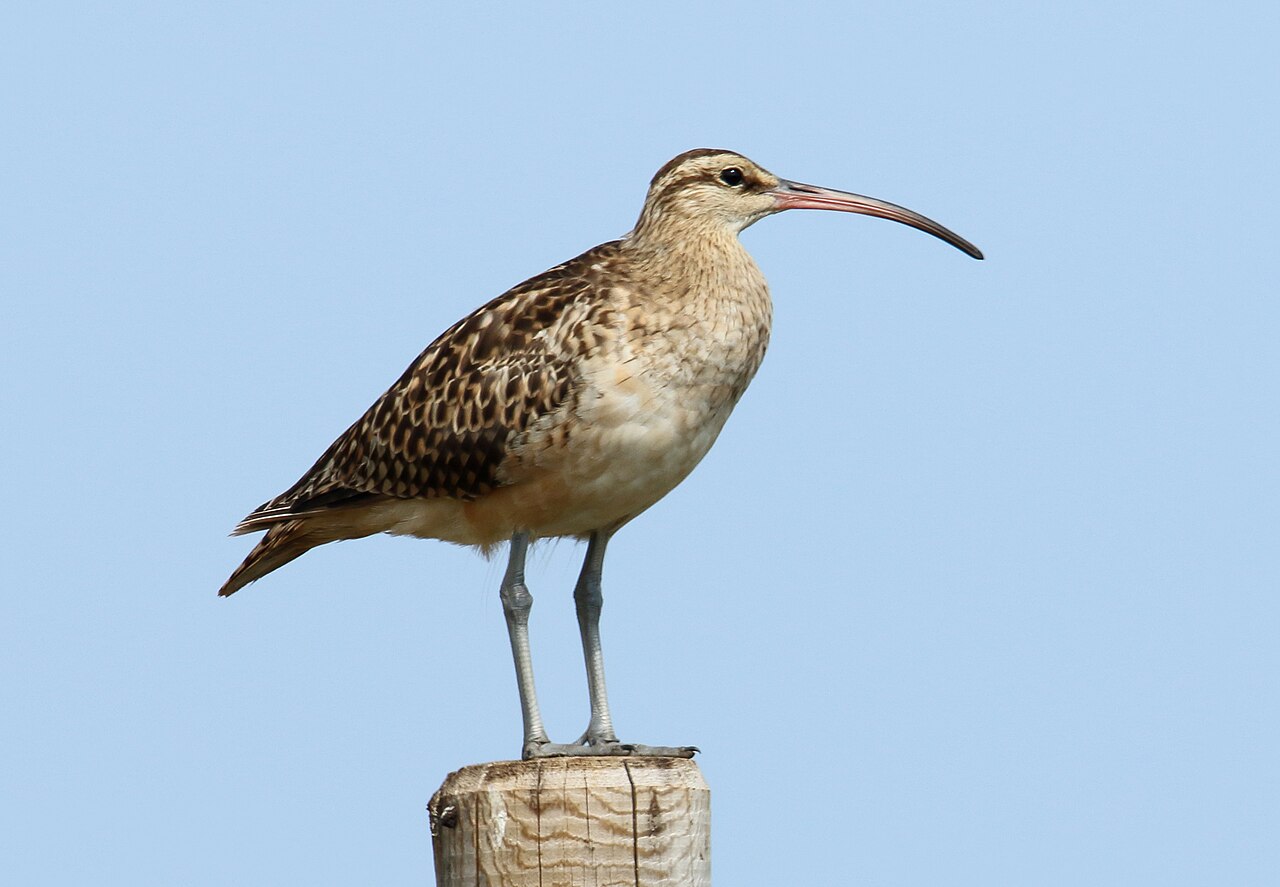
A large wader with a long down-curved bill that shows a kink rather than an even arc; the base runs from black to fleshy pink. The head is striped, with a dark brown crown split by a pale central stripe and a dark eyeline below a pale supercilium. The upperparts are brown with coarse, warm buff spotting that gives a spangled look, the neck and breast are finely streaked, and the belly is plain buff with almost no marking on the flanks. The decisive feature is rump and tail: bright cinnamon, standing out clearly against the back. At very close range the long, stiff, hair-like feathers on the thighs are visible, and these gave the bird its English name. Male and female look alike; the female has the longer bill.
Confusion species
Hudsonian Whimbrel is the same size and has the same striped head, but is a colder grey-brown, more finely and evenly marked, streaked right down the flanks, and its rump is brown like the back instead of cinnamon. In western Alaska the two stand together in August; watch the bird as it flies off, because at range the cinnamon rump is the only sure character. Long-billed Curlew is considerably larger, with a far longer bill and a plain, unstriped head. The voice settles it as well: a clear two-syllable whistle against an even rattling series.
Compare sandpipers, snipes and allies: bill, legs, wing bar and rump
Habitat
Breeds on rolling upland tundra of dwarf shrubs, lichen and sedge, on hill ridges above the wet flats. Before departure it gathers on the salt marshes, sedge meadows and tidal flats of the western Alaskan coast, where it gorges on crowberries until it weighs almost twice as much. The winter is spent on coral islands: reef flats, sandy beaches and the grassy and scrubby interiors of low atolls. It makes no use of fresh water or of forest.
Where the bird is most often found, arranged by the USNVC — the vegetation classification of the United States and Canada — and CMECS for sea and coast.




Range and movements
The entire breeding range comes to two small areas in western Alaska: the northern Seward Peninsula and the hills east of the Yukon delta. From there it flies in late summer more than four thousand kilometres non-stop over open sea to the north-western Hawaiian Islands, and on to Micronesia, Fiji and all of Polynesia; apart from Hawaii that wintering range lies outside the guide area and so is not shown on the map. Young birds stay on the islands for their first years and return to Alaska only as adults. Where it turns up in North America away from Alaska and Hawaii it is as a stray, not on any regular passage route.
- Resident
- Breeding (summer)
- Winter
- Passage
- dark = core range, pale = thinly spread
Where and when to look
The realistic chance is in the last week of May and the first half of June on the tundra hills near Nome or in the delta of the Yukon and Kuskokwim; take a guide, because the breeding grounds lie far from any road. Work through every flock of curlews and look for a warmer, more heavily spotted bird with a pale belly, then wait for it to take off: the cinnamon rump is the proof. In Hawaii it can be found in winter on Kauaʻi and on the coastal golf courses and grasslands. Its clear two-note whistle often gives it away before the eye does.
Conservation
The species is assessed as Near Threatened (NT), and the world population is estimated at fewer than ten thousand birds spread over a tiny breeding range. The greatest danger comes in winter: adults renew all their flight feathers at once on the atolls and cannot fly for a time, so introduced cats, rats and dogs take them easily. Added to that is the degradation of the low islands themselves, through building, introduced plants and rising sea level. There is room enough on the breeding grounds, but the range is so small that one failed berry crop or one poor season counts heavily.
Scientific name
Numenius tahitiensis | (Gmelin, 1789)
Gmelin described the species in 1789 as Scolopax tahitiensis, among the snipes; because it was later placed in another genus, author and year stand in parentheses. He worked from Latham's account of an 'Otaheite Curlew' from Tahiti in the Society Islands, and that type locality gave the epithet: tahitiensis means 'from Tahiti'. The bird is thus named for its wintering ground, since where it bred was then unknown and was not found in Alaska until 1948. The genus Numenius was introduced by Brisson in 1760 and goes back to Greek noumenios, 'of the new moon', after the crescent shape of the bill.