All species › Waders, gulls and terns › Sandpipers and allies › Upland Sandpiper
Upland Sandpiper | Bartramia longicauda
Bartrams Ruiter | Correlimos batitú
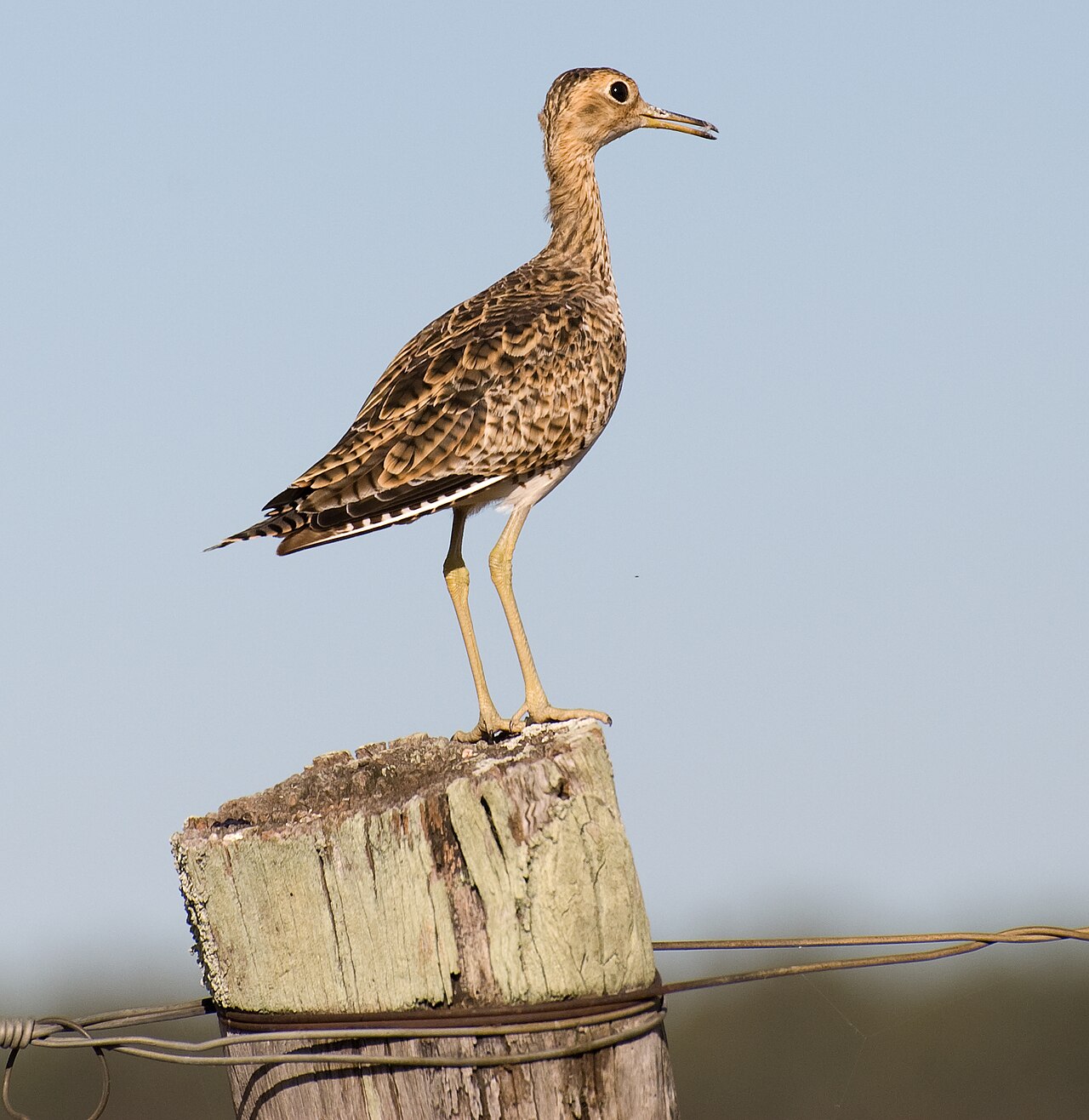
The Upland Sandpiper belongs with the sandpipers and snipes but never comes to the shore: it lives in grass, from open prairie to a hayfield or the verge of an airstrip. On a roadside post it is unmistakable — a small dove-like head with a large dark eye on a long thin neck, and a long tail that reaches past the wingtips. On landing it holds its wings straight up for a moment, and from high over the field comes its long, rising whistle.
Voice
The display call is one of the most penetrating sounds of the prairie: a long, liquid wheee-you that slides up and then sinks slowly away, like someone whistling for a dog far off. The male gives it in a slow circling flight high above the field, on short fluttering wingbeats, and keeps it up for minutes at a time. On the ground and on take-off there is a fast bubbling quip-ip-ip-ip, often in a series. On clear nights in May and August that bubbling note over towns and fields is the sign that migration is under way. At the nest it becomes a short, hard queep.
Recording: Jonathon Jongsma — CC BY-SA 3.0 · Oak Draw Rd, Custer State Park, South Dakota, United States · xeno-canto
Identification
The build is the first character: a small round head with a large dark eye and a white eyering, on a strikingly long thin neck, behind that a compact body with a long tail projecting past the wingtips — unusual in a wader. The bill is short, straight and slender, yellow with a dark tip; the legs are long and ochre-yellow. The upperparts are marbled golden brown and black, the throat white, and the breast and flanks carry dark streaks that turn into chevrons towards the rear; the belly is white. Male and female look alike, and juveniles differ only in the neater fringes of the back feathers. In flight the narrow pointed wing stands out, with no wingbar and dark primaries contrasting against the paler inner wing. Just after landing the wings are held straight up for a second before being folded.
Confusion species
Buff-breasted Sandpiper (Calidris subruficollis) stands in the same fields and also has a small head and yellow legs, but is clearly smaller, plain buff below without chevrons, and flashes a bright white underwing in flight. Lesser Yellowlegs is as long in the leg but has brighter yellow legs, a longer bill, a short tail and a white rump, and stands at the water instead of in the grass. A juvenile Long-billed Curlew in short grass can mislead at range, but is much larger and has a long curved bill. When in doubt, look at the tail: only in Upland Sandpiper does it project beyond the wingtips.
Habitat
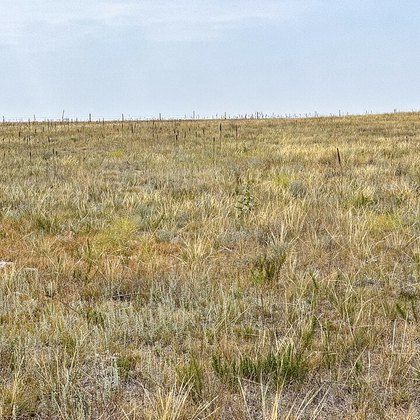
Grassland of intermediate structure: a mixture of taller grass to nest in and shorter, open patches to walk and feed in. On the Great Plains that means native prairie and grazed range; further east it means hayfields, airfields, military training grounds and old strip mines grown back to grass. It avoids exactly what the rest of its family seeks: mud, shorelines and open water. Land mown too short is left alone, and once shrubs come up the bird goes as well.
Where the bird is most often found, arranged by the USNVC — the vegetation classification of the United States and Canada — and CMECS for sea and coast.



Range and movements
Breeds in interior Alaska and Yukon, east through the prairie provinces to Ontario and Quebec, and in the United States from Montana and Oregon across the core range on the Great Plains — North and South Dakota, Nebraska, Kansas — into the Midwest, with scattered small populations in the north-east as far as Maine. It leaves North America entirely and winters on the grasslands of Argentina, Uruguay, Paraguay and southern Brazil, outside this map window. Both legs of the journey run mainly up and down the Great Plains, followed by a broad crossing of the Gulf of Mexico and Central America. In the nineteenth century it first increased as the eastern forests were cleared, and was then, after the collapse of the Passenger Pigeon, shot so heavily that it nearly disappeared; after the hunting ban it recovered on the prairie, but in the east it remains very local.
- Breeding (summer)
- Passage
- dark = core range, pale = thinly spread
Where and when to look
From late April to June, drive the dirt roads through grazed grassland at sunrise and scan every post, wire and stone: the bird likes to sit on something high and is then visible from far off. Wind the window down, because the long rising whistle out of the sky often gives it away before the eye does. In the east the grass margins of small airfields are the most reliable place. Watch a bird as it lands for the wings held straight up — no other wader of the region does it so deliberately.
Conservation
The species is assessed as Least Concern, with a population put at roughly three quarters of a million birds; numbers are reasonably stable on the Great Plains but have fallen sharply in the east of the range. The loss of native grassland to arable farming is the heart of the problem, together with early and repeated mowing of hay, which destroys nests and chicks. On the South American wintering grasslands the grass is going under the plough as well. Grazing at moderate stocking rates, by contrast, keeps the grassland suitable.
Scientific name
Bartramia longicauda | (Bechstein, 1812)
Bechstein described the species in 1812 as Tringa longicauda, among the shanks; because it was later placed in another genus, author and year stand in parentheses. The description appeared in his German edition of Latham's general survey of birds, with no more than 'North America' as the type locality. longicauda is Latin for 'long-tailed', from longus 'long' and cauda 'tail', after the tail that reaches beyond the wingtips. The genus Bartramia was introduced by Lesson in 1831 and is named for William Bartram, the travelling naturalist of Philadelphia; the Dutch name of the bird follows that tribute.