All species › Passerines › Nuthatches › Brown-headed Nuthatch
Brown-headed Nuthatch | Sitta pusilla
Bruinkopboomklever | Trepador cabecipardo
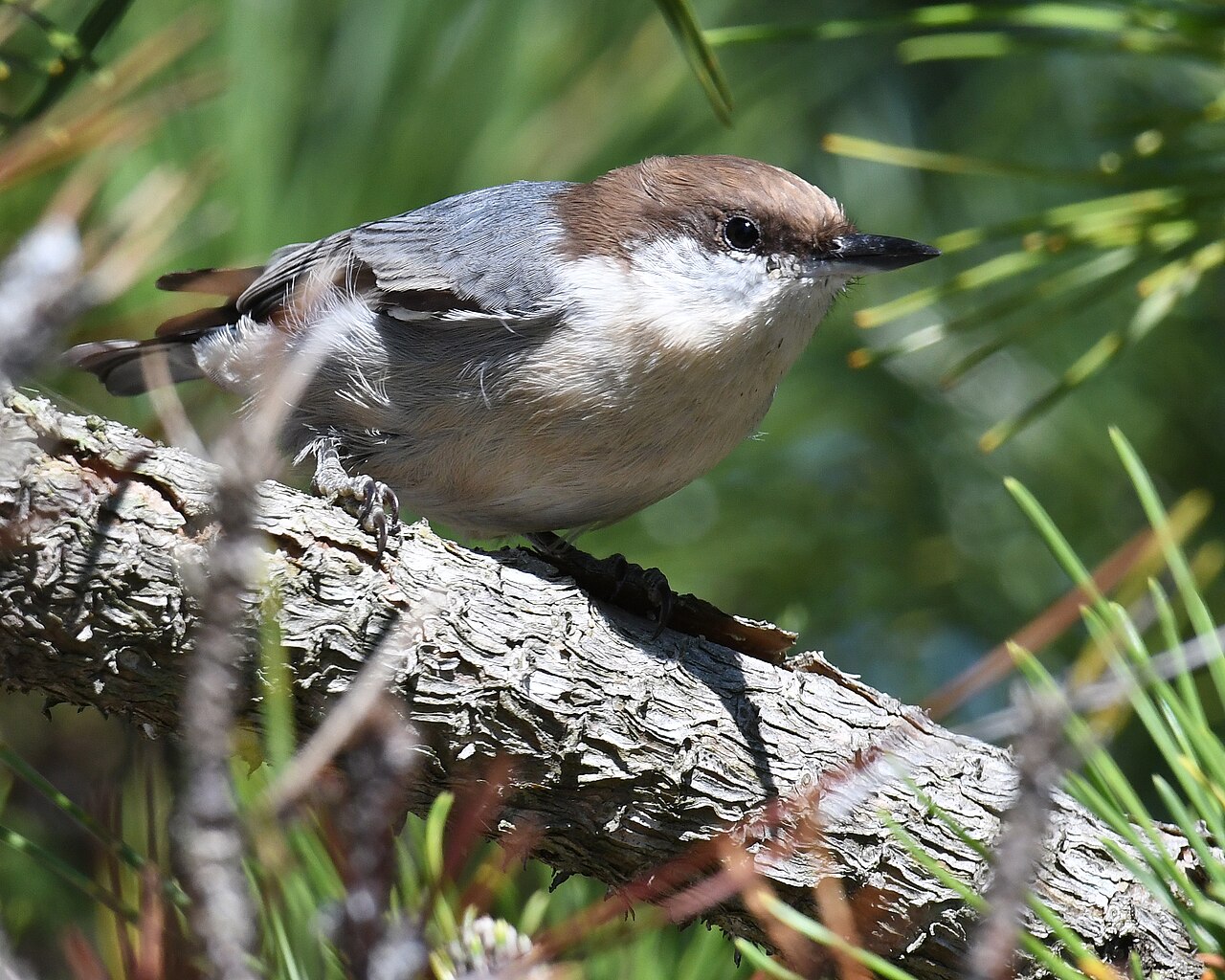
The Brown-headed Nuthatch is the small nuthatch of the pine forests of the southeastern United States, where it moves about in family parties the year round. It belongs to old, open stands of longleaf and loblolly pine, and is one of the few songbirds that uses a tool: with a loose flake of bark it pries up bark from the trunk to expose insects.
Voice
The call is a high, double kit-dee that recalls the squeeze of a rubber duck — loud for a bird of ten centimetres, and usually the first sign that a party is up in the crowns. Alongside it comes a soft pit-pit while foraging and in flight, and a fast rattling series when the birds are excited. Male and female sometimes call in duet, the two sounds running into one another.
Recording: Valerie Heemstra — CC BY-NC-SA 4.0 · Bald Point State Park, Saint Teresa, Franklin County, Florida, United States · xeno-canto
Identification
Small and short-tailed, with a plain brown cap running down to just below the eye and a narrow dark eye-line. The upperparts are blue-grey, the cheeks, throat and underparts dingy white to buff. A small white spot sits on the nape where the brown cap meets the grey mantle. The bill is straight and sharp, the legs short. The sexes are alike; young birds have a duller, greyer cap.
Confusion species
Pygmy Nuthatch is almost identical, but has a greyer-brown cap and lives in the West; the two ranges do not overlap. Red-breasted Nuthatch, which may share the same pine wood in winter, has a black cap, a white supercilium and rusty underparts. White-breasted Nuthatch is considerably larger, with a white face and a black cap. In the Bahamas lives the Bahama Nuthatch, treated as a subspecies of this bird until recently, with a longer bill and a narrower nape spot.
Habitat
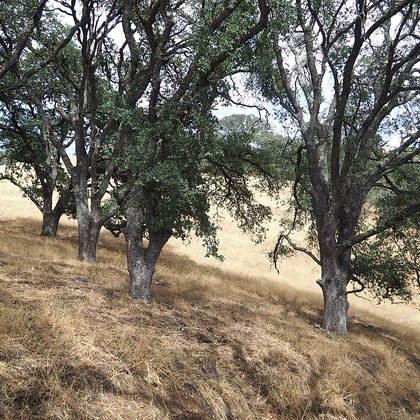
Open, mature pine forest of longleaf, loblolly, shortleaf and slash pine, preferably with a grassy understorey kept open by regular fire. Dead snags and thick dying limbs are essential, since the nest is an excavated cavity. Planted pine stands, pines in gardens and parks and the pine fringe of fields all count, as long as dead wood is left standing; in dense young plantations without snags it is absent.
Where the bird is most often found, arranged by the USNVC — the vegetation classification of the United States and Canada — and CMECS for sea and coast.



Range and movements
A resident of the coastal plain and low interior of the Southeast, from Delaware and Maryland south along the coast through the whole of Florida, and west through Georgia, Alabama, Mississippi, Louisiana and East Texas into Arkansas, Tennessee and southeastern Oklahoma. It does not migrate and hardly wanders, so gaps in the forest are not refilled of their own accord. In Missouri, where it died out in the nineteenth century, birds have been released again in the Ozarks since 2020.
- Resident
- Breeding (summer)
- Winter
- Passage
- dark = core range, pale = thinly spread
Where and when to look
Look for it in open pine woodland that has been burned not long before, and listen for the squeaky kit-dee high in the crowns. Once you hear it, stand still: a party normally works from tree to tree and comes closer of its own accord. In gardens with pines it takes peanuts and suet, and it will use nest boxes with a small entrance.
Conservation
The species is listed as of Least Concern (LC) and numbers across the range have held roughly level since 1966, but the distribution has become fragmented. The cause is the loss of old longleaf pine forest, cut back to a fraction of its former extent, and the suppression of fire, which lets the understorey close in. Removing dead snags during harvest takes away the nest sites. Where fire is used and dead wood is left standing the species recovers; the population in southern Florida is small and genetically impoverished.
Scientific name
Sitta pusilla | Latham, 1790
Latham described the species in 1790 as Sitta pusilla; the type locality stands in the original work as 'Carolina, Jamaica', but has been read as South Carolina since 1917. As the bird still stands in the same genus, author and year go without parentheses. Sitta is Greek sittē, the name Aristotle used for a nuthatch; pusilla is Latin for 'very small'. The English and Dutch names refer to the brown cap instead.