All species › Passerines › Crows, jays and magpies › Chihuahuan Raven
Chihuahuan Raven | Corvus cryptoleucus
Woestijnraaf | Cuervo llanero
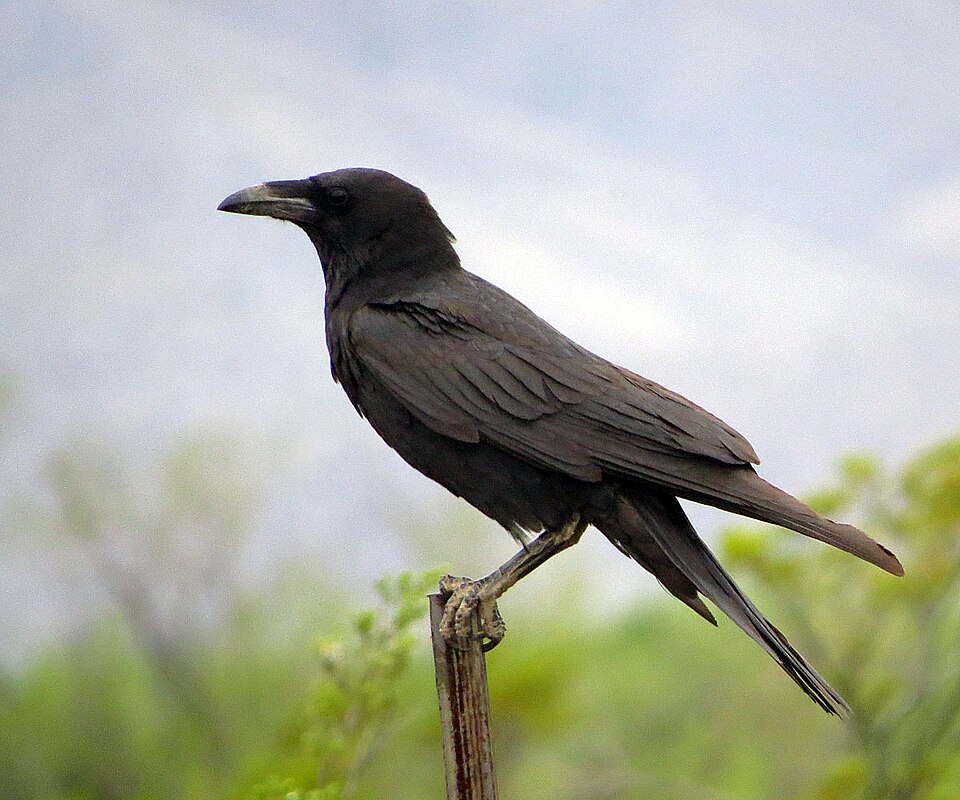
The Chihuahuan Raven is the raven of the dry lowlands of the American Southwest and the Mexican plateau. It stands between American Crow and Common Raven in size and lives in grassland, yucca flats and ranch country, moving in flocks outside the breeding season.
Voice
The call is a harsh, short kraak, higher than Common Raven and with a nasal, quacking quality reminiscent of an agitated female Mallard. The uniformity is diagnostic: where a group of Common Ravens runs through ten different tones in a minute, Chihuahuan Ravens repeat essentially the same sound. A group of black birds all giving the same nasal croak is therefore almost certainly this species. The sound is deeper and far burrier than the caw of American Crow.
No freely licensed recording has been found for this species yet; what to listen for is described below.
Identification
Entirely black with a purple-blue gloss. The feather bases on the neck and breast are white rather than grey, but this shows only when wind parts the feathers or the bird raises its neck in display. More reliable are the nasal bristles, which run about two-thirds of the way down the bill, further than in any other Corvus. The bill is shorter and less curved than Common Raven's, the tail is slightly wedge-shaped, and the bird soars less and flaps more than a Common Raven.
Confusion species
From Common Raven it differs in smaller size, a shorter and less heavy bill, a less pronounced wedge to the tail, shorter throat hackles, and above all the monotonous high nasal call against the wide tonal range of Common Raven. From American Crow it differs in the wedge-shaped rather than squared tail, the longer bristles along the bill, and the burry call instead of a clean caw; the crow also hardly soars. Where both ravens occur together, in west Texas and southern New Mexico, lowland and grassland favour Chihuahuan and cliffs and mountains favour Common, but that split is not absolute.
Habitat
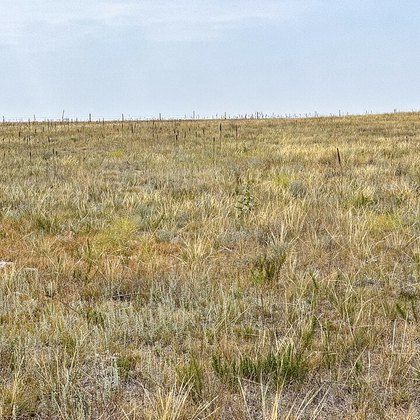
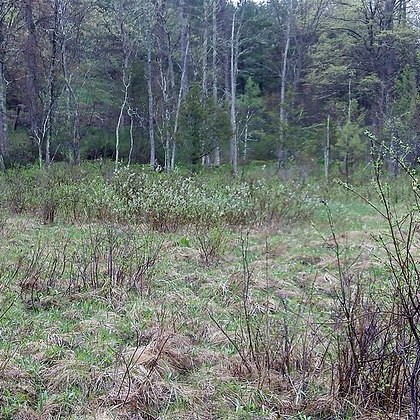
Dry and semi-arid grassland, thorn scrub, yucca and creosote flats, ranch country and town edges. It avoids both closed woodland and the most extreme sand desert. The nest is placed in a tree, a large shrub, a yucca or on a utility pole, two to twelve metres up, built of sticks and thorny twigs and lined with grass, bark fibre and animal hair. The clutch is usually five to six eggs, laid late in the season in May, when insects are most abundant. Outside the breeding season flocks gather at landfills, feedlots and harvested fields.
Where the bird is most often found, arranged by the USNVC — the vegetation classification of the United States and Canada — and CMECS for sea and coast.




Range and movements
Resident in southeastern Arizona, southern New Mexico, southeastern Colorado, western Kansas, western Oklahoma and southern and western Texas, and in Mexico from Chihuahua, Coahuila, Durango, Zacatecas, Nuevo León, Tamaulipas, San Luis Potosí and eastern Sonora into the central highlands. At the northern edge part of the population withdraws in autumn; in eastern Colorado and western Kansas the species is much scarcer now than in the nineteenth century. In winter the distribution shifts towards concentrations of food, where hundreds of birds may come together.
- Resident
- Winter
- Passage
- dark = core range, pale = thinly spread
Where and when to look
In winter, drive open grassland and cattle country in southern New Mexico or west Texas and look for flocks of black birds on the ground or along fence lines; ravens in flocks of dozens there are almost always this species, since Common Raven is usually in pairs. Listen first and look second: the uniform nasal croak is the quickest mark.
Conservation
The IUCN lists the species as least concern, with a population estimated at about 840,000 birds. In the core range it is stable to increasing, helped by landfills, livestock operations and nest sites on utility poles. The northern edge is a different picture: in eastern Colorado, western Kansas and western Oklahoma numbers have fallen sharply since the nineteenth century, alongside the loss of the bison and the conversion of shortgrass prairie to cropland. In places nests are removed from utility poles because of the risk of short circuits.
Scientific name
Corvus cryptoleucus | Couch, 1854
Darius Nash Couch described the species in 1854 from material from Tamaulipas, probably from Charco Escondido; as it has stayed in Corvus, author and year stand without parentheses. The species name cryptoleucus comes from Greek kruptos 'hidden' and leukos 'white', after the white feather bases on the neck that normally lie concealed under the black tips. The English name refers to the Chihuahuan Desert, the Spanish cuervo llanero to the flat grassland the bird occupies.