All species › Passerines › Crows, jays and magpies › Northern Raven
Northern Raven | Corvus corax
Raaf | Cuervo grande
The Common Raven is the largest songbird in the world and by far the heaviest: adults weigh from seven hundred grams to well over two kilos. It occupies the whole of the northern hemisphere, from the Arctic coast to the Mexican plateau and from sea level to above six thousand metres in the Himalaya.
Voice
Its voice is the most varied of any North American corvid: researchers distinguish fifteen to thirty categories of call. The best known is a deep, resonant prruk-prruk that carries for kilometres. Alongside it come a metallic knocking tok, a high nasal whine, screams, muttering and imitations of other sounds; in captivity human words are copied as well. Besides the voice the bird makes non-vocal sounds: bill snapping and an audible wing rush in the display dive. A group of black birds whose pitch keeps changing is almost certainly ravens; Chihuahuan Ravens repeat the same call instead.
Recording: Doug Hynes — CC BY-SA 4.0 · Seal Island, Nova Scotia, Canada · xeno-canto
Identification
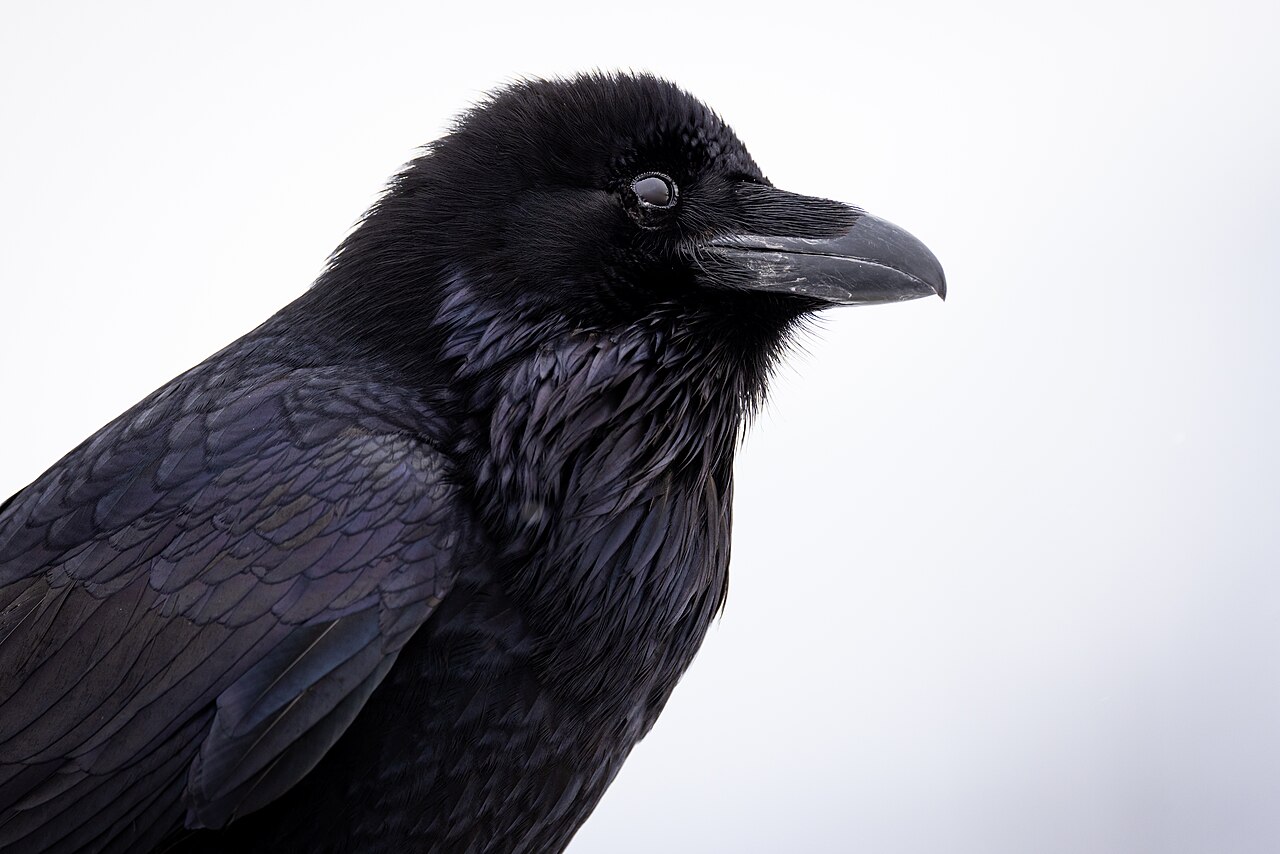
Entirely black with a strong gloss. Size alone settles most cases: at 54 to 67 centimetres long, with a wingspan from just over a metre to a metre and a half, it is considerably larger than any crow. The bill is heavy, deep at the base and curved at the tip; the throat feathers are long and shaggy and stand out when the bird calls. In flight the tail is clearly wedge-shaped and the wings are long and narrow with spread fingers at the tip. It soars and glides a great deal, rolls and dives in the display season, and flaps more slowly than a crow.
Confusion species
American Crow is smaller, has a squared tail, a shorter and straighter bill, smooth throat feathers and a clean caw-caw; it almost never soars and flaps nearly continuously. Chihuahuan Raven is intermediate in size, with a shorter bill, a less pronounced wedge to the tail, shorter throat hackles and a high, nasal, monotonous call; it keeps to dry lowland and travels in flocks, while ravens are usually in pairs or small groups. For a single distant black bird the tail shape in flight is the most usable mark: wedge against fan.
Habitat
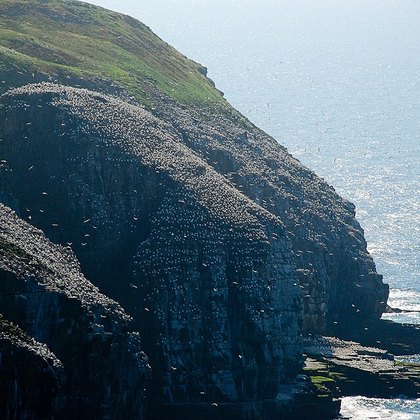
Almost everything except closed tropical lowland: coniferous and deciduous forest, tundra, rocky coasts, sea cliffs, desert, sagebrush, alpine slopes, chaparral and, increasingly, farmland, highway verges and town edges. The nest, built by the female from sticks up to a metre long and lined with wool, bark and hair, sits on a cliff ledge, in a tall tree or on a structure. The clutch is three to seven eggs. The diet is exceptionally broad: carrion, invertebrates, small mammals, eggs and nestlings, fish, grain, berries and refuse.
Where the bird is most often found, arranged by the USNVC — the vegetation classification of the United States and Canada — and CMECS for sea and coast.






Range and movements
In North America a resident of Alaska and all of Canada, including Greenland and the high Arctic, through the western United States into Mexico and, along the mountains of Guatemala and Honduras, as far as Nicaragua. In the eastern United States the range follows the Appalachians and the Great Lakes country. From the eastern lowlands the species had largely vanished by the nineteenth century through persecution; since about 1980 it has been returning and now breeds again in states where it was absent for a century. In most areas it does not migrate, though young birds wander widely.
- Resident
- Winter
- Passage
- dark = core range, pale = thinly spread
Where and when to look
Watch the tail the moment the bird takes off; the wedge shows at distance and against the light, when colour and size no longer tell you anything. A second usable signal is the flight action: ravens soar on still wings where crows keep flapping. In the display season, February to April, the rolling flights of pairs over cliffs and ridges are the quickest way to find them.
Conservation
The IUCN lists the species as least concern; the world population is put at about 29 million birds and North American numbers have risen since 1966. That increase is tied to human food sources: landfills, roadkill along highways, livestock operations and nest sites on pylons in otherwise treeless country. In the Mojave and the Great Basin the increase has consequences for other species: ravens there take the nests and young of desert tortoise and Greater Sage-Grouse among others, and local control is carried out to reduce their numbers. Poisoning and shooting, for centuries the main cause of death, have declined sharply across much of the range.
Scientific name
Corvus corax | Linnaeus, 1758
Linnaeus included the species in the tenth edition of the Systema Naturae in 1758 as Corvus Corax, with Europe as the type area; Hartert restricted that to Sweden in 1903. As the type species of Corvus it could never be moved, so author and year stand without parentheses. Corvus is the ordinary Latin word for raven or crow and corax its Greek counterpart korax; the scientific name thus says the same thing twice. English raven, Dutch raaf and German Rabe all go back to a Germanic stem that probably imitates the call.