All species › Passerines › Crows, jays and magpies › American Crow
American Crow | Corvus brachyrhynchos
Amerikaanse kraai | Cuervo americano
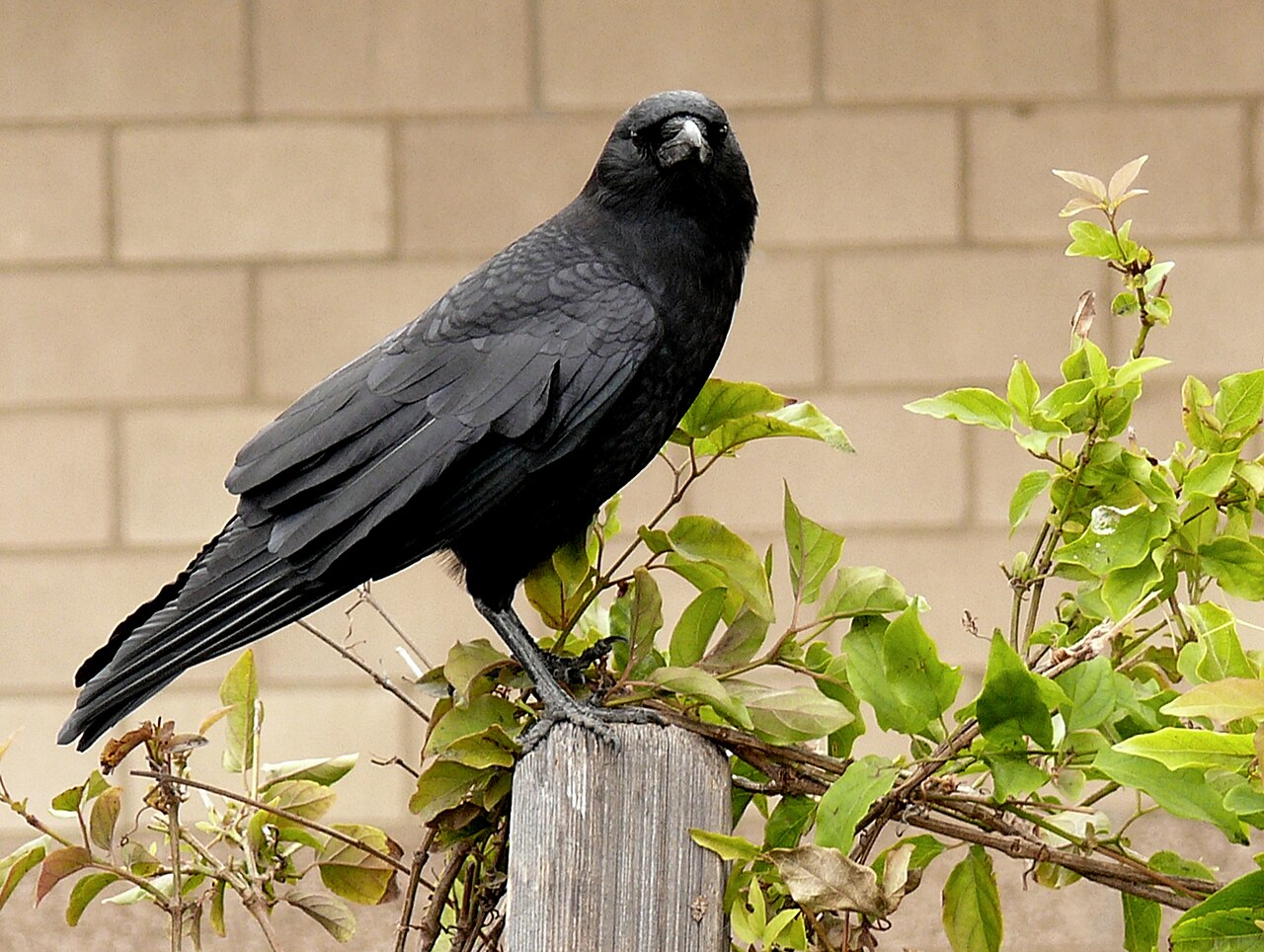
The American Crow is the ordinary black crow of almost the whole continent south of the treeline: from beach and farmland to city centre. In winter crows gather in communal roosts that range from a few hundred to two million birds, and some of those sites have been in use for well over a century.
Voice
The main sound is a loud, clear caw-caw-caw, usually in series of three to five and often with a jerk of the head on each note. Beyond it come a rattling grating call, a knocking koh, and a range of soft sounds at the nest and at the roost. Young birds beg with a nasal, drawn-out note that can resemble that of Fish Crow. Alarm at an owl or hawk is a sustained, repeated cawing that draws in dozens of birds: this mobbing is one of the most reliable ways of locating raptors.
Recording: Rachel Thurman — CC BY 4.0 · Dimond Park (near Juneau), Juneau City and Borough, Alaska, United States · xeno-canto
Identification
Entirely black, bill and legs included, with a blue to purple gloss in good light. Length runs from 40 to 53 centimetres and wingspan from 85 to 100 centimetres. The bill is straight and fairly short, the throat feathers lie smooth, and the tail is squared off and slightly rounded at the tip. In flight the wing action stands out: even, methodical flapping, rarely broken by a glide.
Confusion species
Common Raven is markedly larger, with a heavy curved bill, shaggy raised throat feathers and a wedge-shaped tail in flight; it soars at length and calls deeply and variably. Chihuahuan Raven is intermediate in size, with a slightly wedged tail and a harsh nasal call. Fish Crow of the southeast and the Atlantic coast is barely smaller and is safely separated only by voice: it gives a nasal, two-syllable uh-uh with the throat feathers puffed out, where American Crow gives a clean caw. Northwestern Crow, of the coast of British Columbia and Washington, has not been recognised as a separate species since 2020 and now counts as part of this species.
Habitat
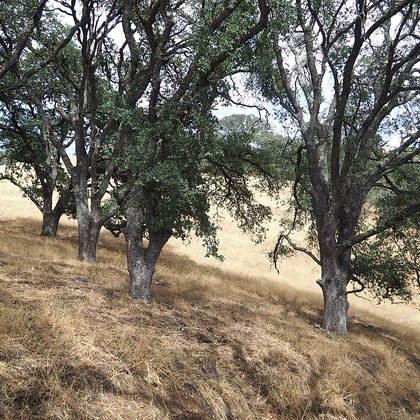
Almost every landscape except tundra and the sand deserts of the Southwest: open woodland and woodland edge, farmland, pasture, riparian woods, beaches, parks, cemeteries, playing fields, campgrounds, parking lots and city centres. The nest is placed high in a tree, often a conifer. Young crows do not breed until their second to fourth year and usually help raise their parents' young until then; a family group may reach fifteen birds.
Where the bird is most often found, arranged by the USNVC — the vegetation classification of the United States and Canada — and CMECS for sea and coast.






Range and movements
Coast to coast in the United States and across southern Canada, with breeding reaching the southern Northwest Territories. Largely absent from the deserts of the Southwest and reaching Mexico only in the extreme northwest of Baja California. Birds in the United States are mostly resident; Canadian populations move south in autumn, so numbers in the northern states rise in winter. Roosts are flown to in winter from distances of up to fifty kilometres.
- Resident
- Breeding (summer)
- Winter
- Passage
- dark = core range, pale = thinly spread
Where and when to look
To learn crow from raven, watch the tail in flight and the wing action rather than the colour: steady flapping with a fanned tail is crow, soaring with a wedged tail is raven. For the roosts, the last hour before sunset from November to February is the moment; the approach routes can be followed as long ribbons across the sky hours beforehand.
Conservation
The IUCN classifies the species, also in its current taxonomic circumscription, as Least Concern (LC), with an estimated population of about 31 million birds around 2012. Since West Nile virus reached North America in 1999 the species has been hit hard: in affected areas up to 72 per cent of birds died in a single season, and national numbers fell by about 45 per cent. Part of that loss has since been made up. The species is also hunted in several states, and large urban roosts are actively dispersed as a nuisance.
Scientific name
Corvus brachyrhynchos | Brehm, 1822
Christian Ludwig Brehm described the species in 1822; Howell restricted the type area in 1913 to the vicinity of Boston, Massachusetts. As the bird has stayed in Corvus, author and year stand without parentheses. Brachyrhynchos is from Greek brakhus 'short' and rhunkhos 'bill' and means 'short-billed' — short, that is, next to the raven, against which Brehm compared it. The English, Dutch and Spanish names all refer to the continent.