All species › Passerines › Penduline tits › Verdin
Verdin | Auriparus flaviceps
Goudmees | Baloncillo
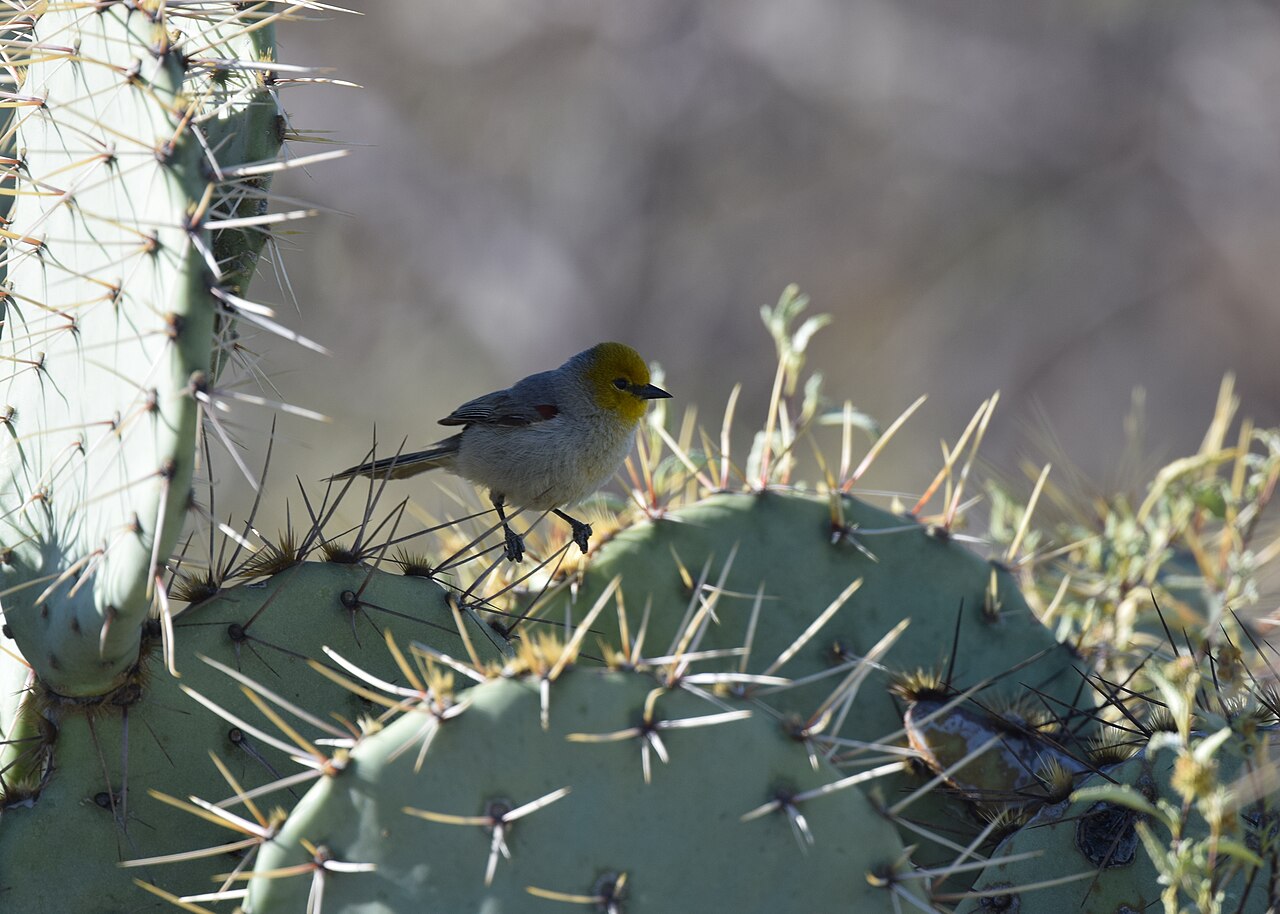
The Verdin is the smallest bird of the desert scrub of the southwest: grey as the thorn bushes it sits in, with a golden-yellow head and a chestnut shoulder patch that is often hidden. It weighs five to eight grams and holds out in low scrub where summer temperatures run well past forty degrees. Usually its spherical nests catch the eye before the bird does.
Voice
The song is a series of three or four clear, piercing whistles on almost the same pitch, tsee-tsee-tsee, the last one sometimes dropping; it is heard all year and most of all from February to May. The common call is a sharp, hard chep that runs into a fast rattle the moment a snake or a shrike comes near the nest. Both sexes call, and the two birds of a pair keep in touch with these notes as they work through the scrub. Anyone looking for it will almost always hear it before seeing it.
Recording: Pat Goltz — CC BY-NC-SA 4.0 · Tucson, Pima County, Arizona, United States · xeno-canto
Identification
A minute bird of nine to eleven centimetres with a short tail, a proportionally large head and a sharp, needle-like bill — that bill is the most reliable mark. The body is plain grey, the head and throat bright yellow, and on the bend of the wing sits a small chestnut patch that often disappears under the shoulder feathers. The female is a shade duller yellow; otherwise the sexes are alike. Young birds are wholly grey-brown for their first months, without yellow and without chestnut, and are regularly taken for something else. It forages restlessly in the outer twigs and often hangs upside down while doing so.
Confusion species
A young Verdin without yellow is the classic mistake: it resembles the Bushtit, but that bird has a short blunt bill, a much longer tail and travels in parties, while the Verdin lives alone or in pairs. Blue-gray Gnatcatcher and Black-tailed Gnatcatcher are slimmer and blue-grey, with a long tail that is black and white from below and is flicked from side to side without pause. Lucy's Warbler (Leiothlypis luciae) is paler and has a thin straight warbler bill, a rusty rump and a rusty crown patch, and it leaves for the south in winter. In doubt the bill decides: only the Verdin has one that looks like a needle.
Habitat
Low, dense thorn scrub of mesquite (a thorny pod-bearing shrub of the Southwest that forms dense thickets), acacia, palo verde (a green-barked desert tree of the Southwest) and creosote bush, most thickly settled along dry washes where the shrubs grow tallest. It avoids bare flats without shrubs, and closed woodland just as much. In desert towns it holds on wherever gardens keep thorny shrubs and flowering plants, and there it also visits the sugar-water feeders hung out for hummingbirds. This is a bird of the low, hot deserts; higher in the mountains it is absent.
Where the bird is most often found, arranged by the USNVC — the vegetation classification of the United States and Canada — and CMECS for sea and coast.




Range and movements
Resident in the southwest: from southeastern California, southern Nevada and the extreme southwest of Utah through Arizona and New Mexico to western and southern Texas, and south over the Baja California peninsula and the dry interior of Mexico as far as Sinaloa and Hidalgo. It does not migrate; only young birds wander some distance in their first winter. In southern California it has gone from large parts of its former range because the low desert scrub there has been built over. Where building leaves shrubbery standing, it stays put.
- Resident
- Breeding (summer)
- Winter
- Passage
- dark = core range, pale = thinly spread
Where and when to look
In winter look for the nests first: balls of thorny twigs the size of a fist, at eye height in a low shrub along a dry wash. Where several hang close together the bird is almost certainly within a stone's throw. Then stand still and listen during the first hour after sunrise; that is when it calls most, and it often comes closer of its own accord.
Conservation
Least Concern (LC), with an estimated seven million breeding birds. The picture is nonetheless less calm than that category suggests: the North American breeding bird surveys show a decline of about 1.9 per cent a year from 1968 to 2015, over sixty per cent all told. The cause is sought above all in the building over of low desert scrub around the fast-growing cities of the southwest; in southern California that shows most clearly.
Scientific name
Auriparus flaviceps | (Sundevall, 1850)
Sundevall described the species in 1850 as Aegithalus flaviceps, among the penduline tits of the Old World; because it was later placed in another genus, author and year stand in parentheses. The genus Auriparus was introduced by Baird in 1864, from Latin aurum, 'gold', and parus, 'tit'. flaviceps means 'yellow-headed', from flavus, 'yellow', and ceps, 'head'. The label of the first specimen described read 'Sitka vel California' — Sitka in Alaska or California, more than four thousand kilometres apart; Grinnell showed in 1931 that the bird had most likely come from near Loreto on the Baja California peninsula.