All species › Passerines › Tits, chickadees and titmice › Bridled Titmouse
Bridled Titmouse | Baeolophus wollweberi
Harlekijnmees | Carbonero embridado
The Bridled Titmouse is the only North American titmouse with a black-and-white patterned face and a pointed crest. It is a resident of the oak and pine-oak woodland of the mountains of Arizona, New Mexico and Mexico, and the only North American member of its family in which helpers at the nest are the rule.

Voice
The song is a series of four to five rapidly repeated peeta phrases, faster and harsher than the songs of the larger titmice. It serves for territorial defence and mate attraction and is heard all year, peaking in early spring. The usual call is a low, rapid, nasal chatter in the manner of a chickadee. In mixed foraging flocks the species acts as sentinel: at a raptor or a snake it gives a sharp, harsh series that chickadees, kinglets, nuthatches and vireos respond to as well.
Recording: Barry Edmonston — CC BY-NC-SA 4.0 · Bahuichivo, Bocoyna Municipality, Chihuahua, Mexico · xeno-canto
Identification
A small grey titmouse with a pointed crest and a white face crossed by a black line through the eye, which arcs upward behind the ear coverts and joins a black band along the side of the crown; below it lies a black throat patch. The crest itself is edged black with a grey central field. The upperparts are olive-grey, the underparts pale greyish white, the wings unmarked. The bird often forages upside down at the tips of the slenderest oak twigs. The sexes look alike.
Confusion species
No other North American titmouse has that face pattern, so confusion is limited to poor conditions. Against the light, or in silhouette only, Black-crested Titmouse of Texas might come to mind, but that bird has a plain pale face without a line and its range barely overlaps. Mountain Chickadee has a white eyebrow but no crest, and a black crown rather than a grey one. The Eurasian Crested Tit has a comparable crest and face pattern, but that resemblance is external: genetically the Bridled Titmouse sits closer to the other American titmice of the genus Baeolophus.
Habitat
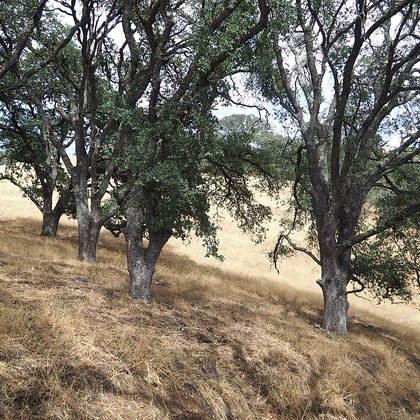
Oak, pine-oak and juniper-oak woodland in the mountains, mostly between 1200 and 2700 metres, and riparian woodland of sycamore (American plane tree of stream and river valleys) and walnut in the canyons below. In Mexico also open oak savanna. It nests in cavities: old woodpecker holes, natural rot holes and nest boxes. Outside the breeding season parties of five to fifteen birds wander, often with chickadees, kinglets, nuthatches, warblers, vireos and tanagers. The food is insects and spiders, supplemented with acorns.
Where the bird is most often found, arranged by the USNVC — the vegetation classification of the United States and Canada — and CMECS for sea and coast.




Range and movements
Resident, without migration. In the United States confined to the mountains of central and southeastern Arizona and southwestern New Mexico, with the Huachuca, Santa Rita, Chiricahua and Santa Catalina ranges as the core. In Mexico the range runs south along both Sierra Madres: Sonora, Chihuahua, Sinaloa, Durango, Zacatecas, Nuevo León, Tamaulipas, Jalisco, Colima, Michoacán, Puebla, Veracruz, Guerrero and Oaxaca. Four subspecies are recognised. In winter some birds drop a few hundred metres into lower canyons.
- Resident
- Breeding (summer)
- Winter
- Passage
- dark = core range, pale = thinly spread
Where and when to look
In the canyons of southeastern Arizona, such as Madera Canyon or Cave Creek, look for a mixed flock moving through the oaks; the Bridled Titmouse is usually the first to call. Go by sound and then look up: it often hangs upside down at the end of a twig, which shows the face pattern well. The species is present all year but noisiest in March and April.
Conservation
The IUCN lists the species as Least Concern (LC). In the United States the population is small but stable; the bird benefits from the retention of old oaks with cavities and uses nest boxes. In Mexico the main pressure is the loss of oak woodland to logging, charcoal production and conversion to farmland, which has removed the species locally. Because the range consists of separate mountain woodlands, local populations are poorly connected, and increasing wildfire in the mountains of the Southwest is a point of attention. The oldest ringed bird reached at least six years and seven months.
Scientific name
Baeolophus wollweberi | (Bonaparte, 1850)
Charles Lucien Bonaparte described the species in 1850 as Lophophanes wollweberi, from material from the state of Zacatecas; as it was later moved to Baeolophus, author and year stand in parentheses. Baeolophus is from Greek baios 'small' and lophos 'crest'. The species name honours Wollweber, a German collector who assembled material in Mexico that reached Bonaparte; little else is known of him, and even his first name is unsettled. The English name refers to the face markings as a bridle; the Dutch name refers to the same black-and-white pattern.