All species › Passerines › Tits, chickadees and titmice › Oak Titmouse
Oak Titmouse | Baeolophus inornatus
Grijze Mees | Carbonero sencillo
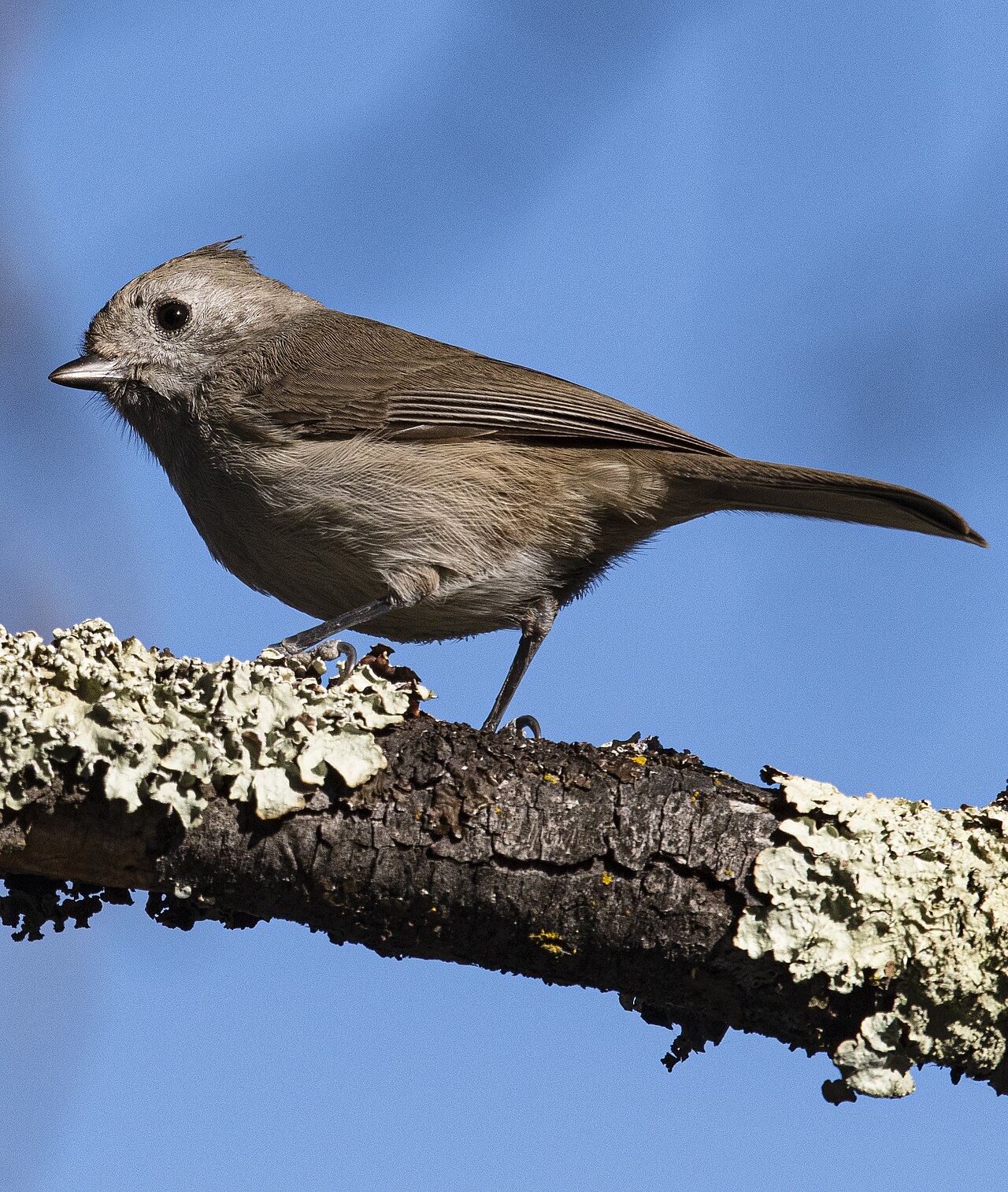
The Oak Titmouse is a plain grey-brown titmouse with a short pointed crest and a face without any markings. It is tied to the oak woodland of the Pacific slope, from southwestern Oregon to Baja California, and holds the same territory there all year.
Voice
The song is a series of repeated phrases of two or three notes, the last note lower than the ones before, so the pattern shifts audibly in pitch. The male sings mostly in early spring from an open perch. The contact call is a scratchy tschick-a-dee, drier and thinner than the song. The pair calls throughout the year, including midwinter, and is usually heard before it is seen.
Recording: Jonathon Jongsma — CC BY-SA 3.0 · Picchetti Ranch Open Space Preserve, Santa Clara, California, United States · xeno-canto
Identification
A small titmouse of 13 to 14 cm, grey-brown above and slightly paler below, sometimes with a faint buff wash on the flanks. The head carries a short, pointed crest that is raised and lowered. The face is plain: no eye-stripe, no cheek patch, no markings on wing or tail. As a result the large black eye stands out strongly. The bill is short and stout, the tail medium-long. Male and female cannot be told apart by plumage.
Confusion species
Juniper Titmouse is the only real pitfall. It is a purer grey, without the brown cast on mantle and flanks, averages slightly larger and longer-tailed. Habitat and range matter more: Oak Titmouse occupies oak woodland west of the Sierra Nevada, Juniper Titmouse pinyon-juniper woodland behind it, and the two ranges meet only along the eastern Sierra edge and the rim of the Mojave. Voice separates them as well: the Oak Titmouse song alternates high and low notes, that of Juniper Titmouse is a fast dry trill on one pitch. Tufted Titmouse does not occur in the west and has rusty flanks and a black forehead patch. Bushtit is smaller, lacks the crest and has a long tail; Gray Vireo has no crest, a fine hooked bill and a wing-bar.
Habitat
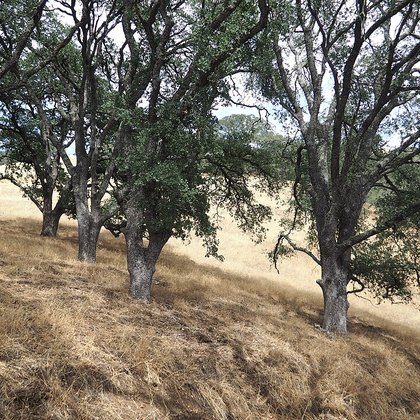
Warm, dry, open oak and oak-pine woodland on low to middle slopes. Coast live oak and valley oak supply both the acorns and the natural cavities it nests in; it uses an intact hole in preference to an old woodpecker hole. Also in gardens, parks and orchards with old oaks, and locally in juniper and pine without oak. Foraging is usually below ten metres, gleaned from bark and foliage.
Where the bird is most often found, arranged by the USNVC — the vegetation classification of the United States and Canada — and CMECS for sea and coast.




Range and movements
Resident on the Pacific slope: from southwestern Oregon south through California west of the Sierra Nevada to Baja California. The central San Joaquin Valley stays empty, because oak woodland is absent there. There is no migration; young birds move only short distances and the pair stays together for life in the same area. About eleven percent of the world population is in Mexico.
- Resident
- Winter
- dark = core range, pale = thinly spread
Where and when to look
Work by ear. In oak woodland in March and April it calls and sings almost continuously, and the pair responds to imitated calls. For a difficult bird look at the face first: a wholly plain head with a large black eye and a short crest is, in Californian oak woodland, nearly always this species.
Conservation
Partners in Flight puts the world population at about 500,000 birds, 89 percent in the United States and eleven percent in Mexico; the Continental Concern Score is 14 out of 20. The species was on the 2014 State of the Birds watch list, after a cumulative decline of 57 percent since 1966. The decline tracks the loss and fragmentation of Californian oak woodland through housing, agriculture and altered fire regimes; oak regeneration fails on many grazed parcels, so no new cavity trees come through.
Scientific name
Baeolophus inornatus | (Gambel, 1845)
Gambel described the species in 1845 as Parus inornatus; because it was later moved to another genus, author and year stand in parentheses. The genus Baeolophus is from Greek baios 'small' and lophos 'crest'. The species name inornatus is Latin for 'unadorned', after the unmarked plumage. The specimen described came from Upper California, near Monterey. Until 1996 this bird and the Juniper Titmouse formed one species, the Plain Titmouse; the split rests on differences in song, habitat and genetics.