All species › Passerines › Tits, chickadees and titmice › Juniper Titmouse
Juniper Titmouse | Baeolophus ridgwayi
Ridgways Mees | Herrerillo de Ridgway
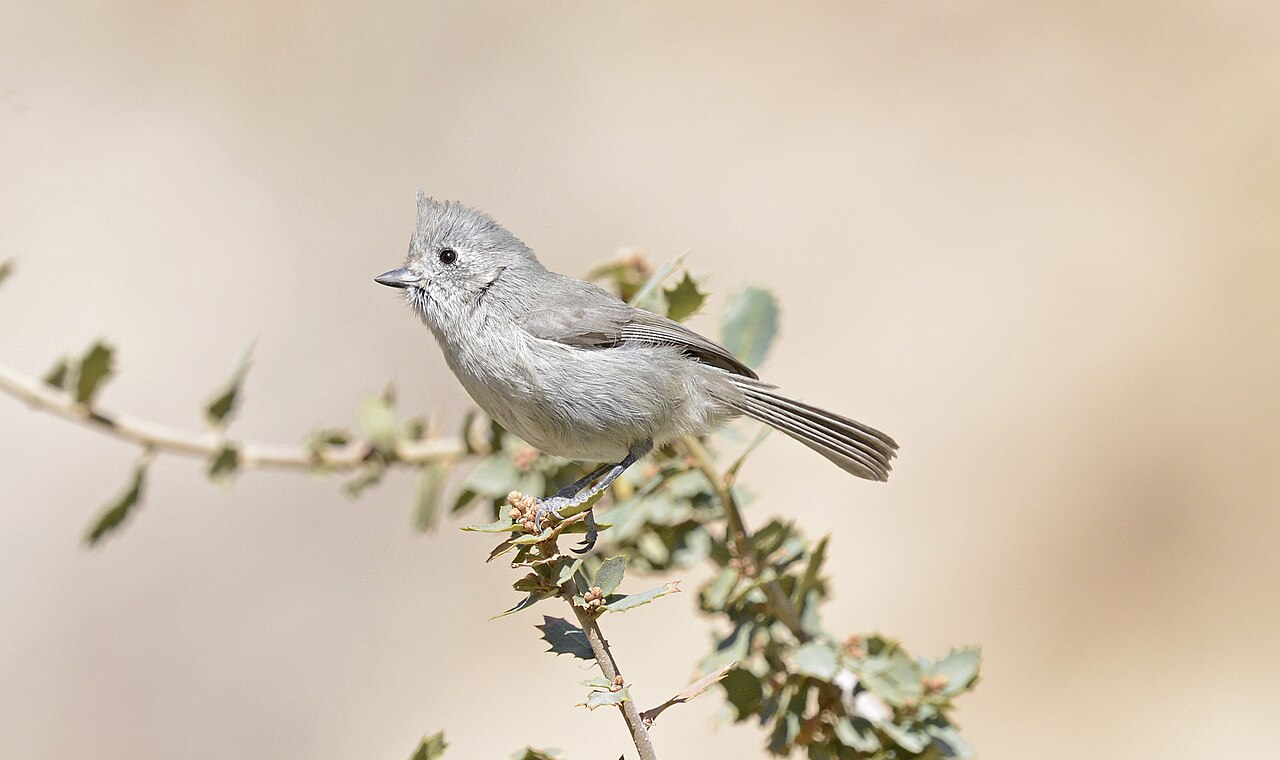
The Juniper Titmouse is a plain grey titmouse with a short crest and an unmarked face, tied to the pinyon-juniper woodland of the Great Basin and the Colorado Plateau. Until 1996 it counted as one species with the Oak Titmouse.
Voice
The song is a rolling series of notes on one pitch, fast and dry, close to a trill. That sets it apart from the Oak Titmouse, whose song alternates high and low notes. The call is a harsh, raspy tschick-a-dee. In the nest cavity an incubating female hisses when disturbed, a snake-like sound that drives a hand out of the hole.
No freely licensed recording has been found for this species yet; what to listen for is described below.
Identification
A grey titmouse of roughly 13 to 15 cm, with a long body and a medium-long tail that make it look larger than it is. The plumage is plain grey, the belly slightly paler than the upperparts, without any brown cast and without markings. The head is fairly large, with a pointed crest often held half raised, and a large black eye that stands out in the empty face. The bill is short, stout and dark.
Confusion species
Oak Titmouse is the mirror species: browner in tone on mantle and flanks, averaging slightly smaller and shorter-tailed, and living in oak woodland west of the Sierra Nevada. The two ranges meet only along the eastern Sierra edge and the northern rim of the Mojave, so location usually decides; where they do approach each other, song separates them: a dry trill on one pitch against alternating high-low phrases. Tufted Titmouse has rusty flanks and a black forehead and does not reach this far west. Bushtit lacks the crest and has a long tail; Gray Vireo lacks the crest and has a fine hooked bill.
Habitat
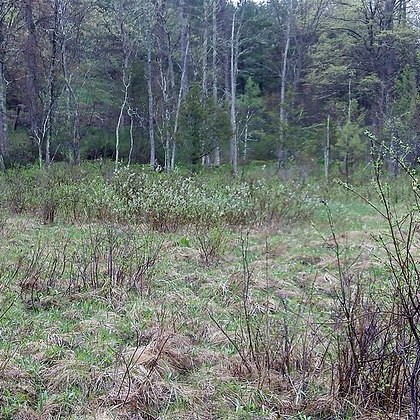
Open pinyon-juniper woodland, pure juniper and dry riparian strips with juniper, roughly between 700 and 2400 metres. It depends on mature trees: only those provide the natural cavities it nests in. Pinyon nuts are the main winter food, supplemented by beetles, caterpillars, flies, leafhoppers and spiders; it comes to feeders for sunflower seed and suet.
Where the bird is most often found, arranged by the USNVC — the vegetation classification of the United States and Canada — and CMECS for sea and coast.




Range and movements
Resident in the interior West: from southeastern Oregon and southern Idaho through Nevada and Utah to southwestern Wyoming and central Colorado, and south through the eastern Mojave in California, Arizona and New Mexico to west Texas, the Oklahoma panhandle and extreme northeastern Sonora. The pair holds its territory year-round; there is no migration.
- Resident
- Breeding (summer)
- Winter
- Passage
- dark = core range, pale = thinly spread
Where and when to look
Drive through the juniper belt in March and April and stop at every dry trill. Birds respond to imitated calls by coming close with the crest raised. A plain grey crested bird in pinyon-juniper needs no further work in most states: Oak Titmouse does not occur there.
Conservation
The population is estimated at about 180,000 birds, 99 percent of them in the United States. Between 1966 and 2015 the breeding population held stable and the Continental Concern Score stands at 11 out of 20. The pressure is on the habitat: pinyon-juniper is cleared or chained on a large scale to create pasture, and the old cavity-bearing trees are the first to go. Extensive wildfire and drought-driven tree mortality also reduce the range.
Scientific name
Baeolophus ridgwayi | (Richmond, 1902)
Richmond described the bird in 1902 as Parus inornatus ridgwayi, that is, as a subspecies; because it was later moved to another genus, author and year stand in parentheses. The species name honours Robert Ridgway, curator of birds at the Smithsonian. The genus Baeolophus is from Greek baios 'small' and lophos 'crest'. The specimen described came from Iron City, Utah. In 1996 the form was raised from subspecies to species, together with the Oak Titmouse.