All species › Passerines › New World sparrows › Chipping Sparrow
Chipping Sparrow | Spizella passerina
Musgors | Chimbito común
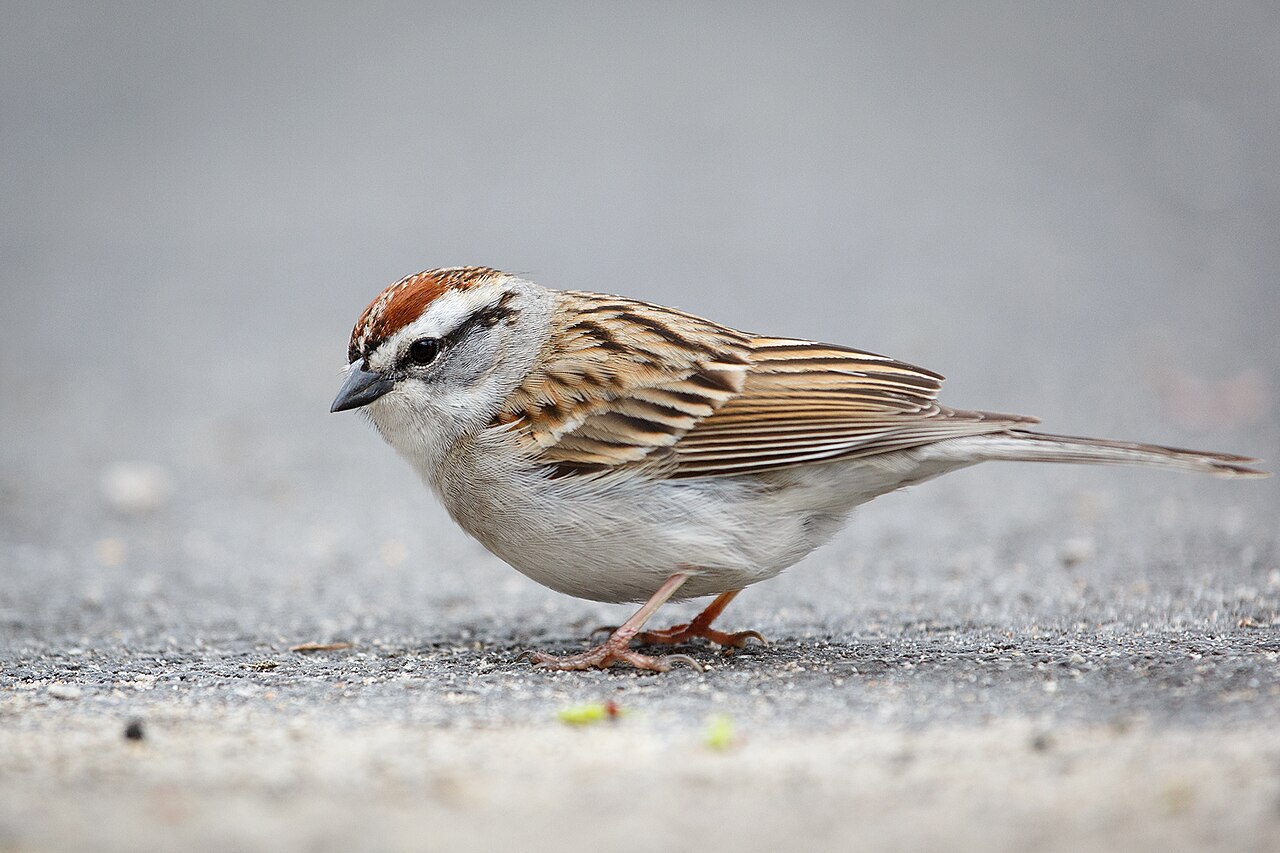
The Chipping Sparrow is a small, slim sparrow with a rusty crown, a black eyeline and an unstreaked grey underside. It breeds from the treeline in Canada to Nicaragua, and in gardens, parks and open conifer woodland it is one of the commonest songbirds in North America.
Voice
The song is an even, dry trill on one pitch, three to four seconds long, rather like a small ratchet running down; speed and hardness vary between birds, from a clattering series of separate notes to an almost flat buzz. It sings from a treetop, often early in the morning and at times at night. The call is a short, hard chip — hence the English name — and on migration a thin, high seep carries over the rooftops at night.
Recording: Don Profota — CC BY-NC-SA 4.0 · South Bozeman, Gallatin County, Montana, United States · xeno-canto
Identification
In breeding plumage the crown is plain rusty red, cut off from the grey cheek by a black line running forward past the eye, with a white supercilium above it. Nape and underparts are unstreaked grey, the back brown with dark streaking, and there are two narrow white wingbars. The rump is grey, which shows in flight. The bill is black in summer. In winter plumage the crown is brown and finely streaked, the face pattern softer and the bill pink. Juveniles have a streaked breast but keep the grey rump and unstreaked nape.
Confusion species
American Tree Sparrow also has a rusty crown, but a two-toned bill — dark above, yellow below — and a dark spot in the middle of the plain grey breast. Field Sparrow has a pink bill, a white eye-ring and a plain face with no black eyeline. Clay-colored Sparrow has a brown rump, a pale median crown stripe and a grey collar, and its dark eyeline does not continue in front of the eye. In winter plumage, the grey rump and the unstreaked grey underparts remain the best marks of Chipping Sparrow.
Habitat
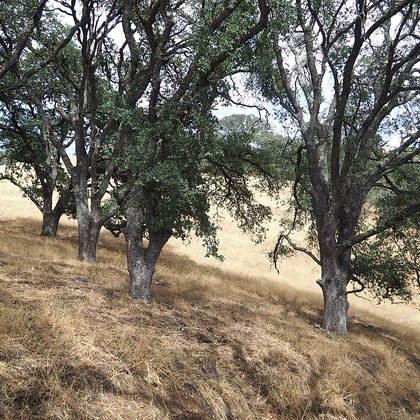
Open woodland and woodland edge with grassy openings: conifer forest in the west and north, mixed deciduous woodland in the east, and aspen and birch growth up to the treeline. Also gardens, parks, cemeteries, roadsides and yards with scattered trees and short grass. It nests readily in a conifer and feeds on the open ground beneath, which makes it a fixture in settled country.
Where the bird is most often found, arranged by the USNVC — the vegetation classification of the United States and Canada — and CMECS for sea and coast.






Range and movements
It breeds from the southern edge of Alaska, Yukon and the Northwest Territories across Canada and nearly all of the United States, and in the mountains of Mexico and Central America as far as Nicaragua. Males arrive in southern Texas as early as March, in southern Alberta and northern Ontario not until mid-May. Northern populations winter in the southern United States and Mexico; from California and the Gulf states south it is present all year, with resident subspecies of its own on the Mexican plateau.
- Resident
- Breeding (summer)
- Winter
- Passage
- dark = core range, pale = thinly spread
Where and when to look
Listen in April and May in a park or cemetery for the flat trill from a treetop; it resembles that of Pine Warbler and Dark-eyed Junco, but is drier and more even. After breeding they gather in parties of a few dozen that work the ground under feeders.
Conservation
The world population is put at about 240 million birds and the species is listed as Least Concern (LC), though survey data indicate a decline of some 28 per cent since 1966. It gains from urban growth and park planting, which create open ground with scattered trees; locally cat predation in gardens and the loss of insects from pesticide-treated lawns are pressures.
Scientific name
Spizella passerina | (Bechstein, 1798)
Johann Matthäus Bechstein described the species in 1798 as Fringilla passerina, from material out of Canada; because it was later moved to another genus, author and year stand in parentheses. Passerina is Latin for 'sparrow-like', from passer 'sparrow'. The genus Spizella is a diminutive of Greek spiza 'finch', hence 'little finch'. The English name comes from the short chip call; the Dutch name points to the resemblance to a House Sparrow in size and colour.