All species › Passerines › New World sparrows › Lark Sparrow
Lark Sparrow | Chondestes grammacus
Roodoorgors | Chingolo arlequín
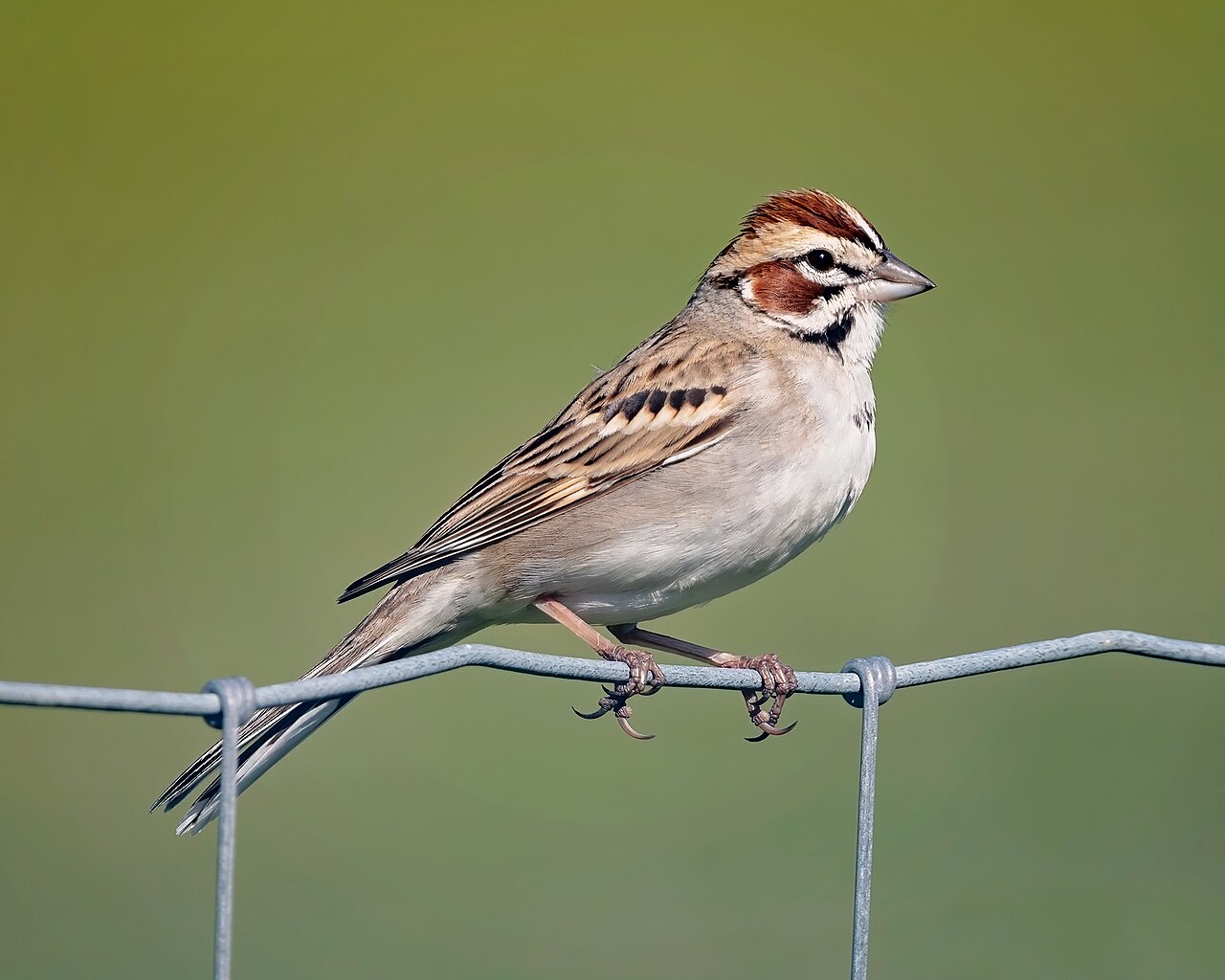
The Lark Sparrow is a large sparrow with a sharply marked head of chestnut, white and black, a black spot in the middle of the white breast and a long, rounded tail with white corners. It lives in open grassland with scattered trees and shrubs, from southern Canada to northern Mexico.
Voice
The song opens with two clear, separated whistles and then runs into a loose string of rattles, buzzes and short trills, differently built each time; one song may last ten seconds. It sings from a fencepost, a wire or a low tree, and sometimes in flight. The call is a thin, sharp tsip, often in series of two or three in flight.
Recording: Manuel Grosselet — CC BY-NC-SA 4.0 · Colonia Yanashi, San Jerónimo Tlacochahuaya, Oaxaca, Mexico · xeno-canto
Identification
The head carries a broad pattern of chestnut crown sides and ear patches, a white median crown stripe, a white supercilium and a black malar stripe along the white throat. Underparts are unstreaked white with a single black spot in the centre of the breast. The back is brown with dark streaking. The tail is long and rounded at the tip, with broad white tips to the outer feathers that frame it in white as the bird flushes. Juveniles show the same head pattern in muted tones, with streaking on breast and flanks.
Confusion species
Chipping Sparrow also has a rufous crown, but lacks the chestnut ear patch, the black breast spot and the white tail corners, and is clearly smaller and slimmer. Field Sparrow has a plain grey face, a rufous crown and a pink bill, but no chestnut ear patch. White-throated Sparrow, or in the west Sagebrush Sparrow, has neither the white tail corners nor the chestnut face. In doubt, the combination of a single black breast spot and white corners in a long, rounded tail settles it.
Habitat
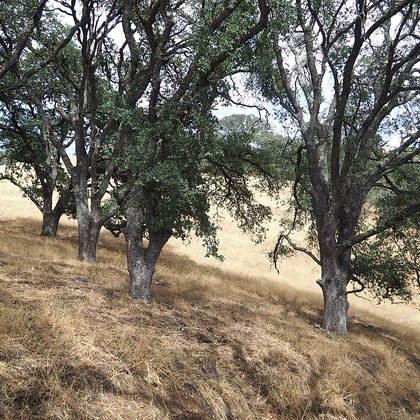
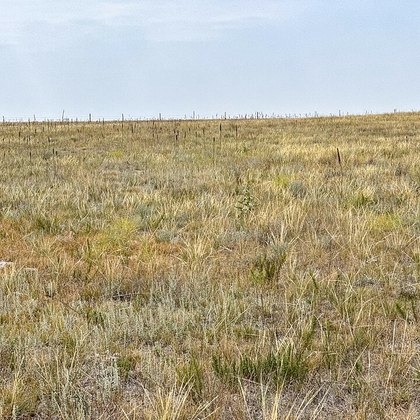
Open grassy ground with scattered trees and shrubs: savanna and open oak woodland, grassland with mesquite (a thorny pod-bearing shrub of the Southwest that forms dense thickets), orchards, fallow fields, roadsides and the edge of sagebrush (grey-green wormwood scrub of the dry western interior) steppe. It avoids bare cropland without standing cover, and closed forest equally. In winter and on migration it also uses pine-oak woodland, thorn scrub and farmland with scattered shrubs.
Where the bird is most often found, arranged by the USNVC — the vegetation classification of the United States and Canada — and CMECS for sea and coast.



Range and movements
It breeds from southern British Columbia, southern Alberta, southern Saskatchewan and southern Manitoba south through the western United States and the Great Plains into northern Mexico, east to Minnesota, Iowa, Missouri and Arkansas. In the east it expanded to New York during the nineteenth century, but that ground has been given up since the 1930s as forest returned and towns spread. Northern birds winter in southern California, southern Arizona, New Mexico and Texas, in Louisiana and Florida, and on through Mexico to Guatemala and Belize. In northern Mexico and parts of California and Texas it stays all year.
- Resident
- Breeding (summer)
- Winter
- Passage
- dark = core range, pale = thinly spread
Where and when to look
Look for it from May to July along a dirt road through open pasture with scattered oaks or mesquite: it perches readily on wires and fenceposts and flushes with the tail spread, showing the white pattern at once. Outside the breeding season it walks on the ground in small parties, often with White-crowned Sparrows.
Conservation
The world population is put at about 11 million birds and the species is listed as Least Concern (LC), though numbers fell by 32 per cent between 1970 and 2014. The decline is steepest in the east of the range, where it has disappeared from many states. Loss of open grassland with scattered trees, the closing in of fallow land and rising fire frequency in grasslands taken over by non-native grasses are the main pressures.
Scientific name
Chondestes grammacus | (Say, 1822)
Thomas Say described the species in 1822 as Fringilla grammaca, from a specimen taken on the lower Missouri; because it was later moved to another genus, author and year stand in parentheses. Grammacus goes back to Greek gramme 'line, stripe', after the stripes on the head. The genus Chondestes was introduced in 1827 by William Swainson, from Greek chondros 'grain' and edestes 'eater', hence 'grain-eater'; it holds this one species. The English name refers to the song, which was heard as lark-like; the Dutch and Spanish names refer to the head pattern.