All species › Passerines › New World sparrows › Lark Bunting
Lark Bunting | Calamospiza melanocorys
Prairiegors | Chingolo albinegro
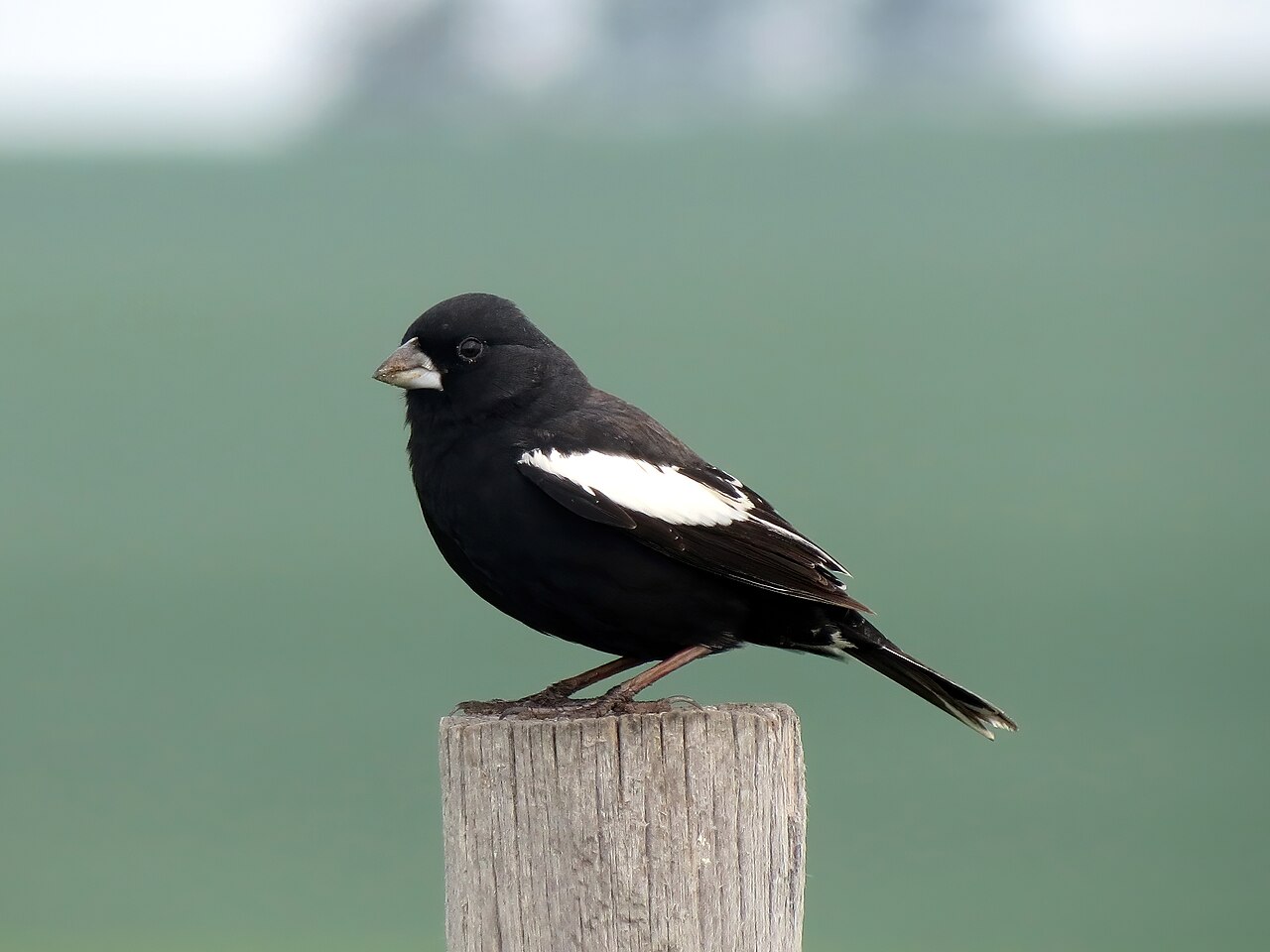
The Lark Bunting is the largest and heaviest sparrow of the North American shortgrass prairie: the breeding male is entirely black with a large white wing patch. It breeds from southern Canada to New Mexico and moves in flocks to the desert grasslands of northern Mexico.
Voice
The male sings in flight: he climbs at an angle to ten or fifteen metres, spreads his wings and glides back down singing. The song is a long, irregular series of clear whistles, rattles and dry trills, each motif repeated several times before he moves to the next; it often runs over ten seconds. The contact call is a soft, low hoo-ee, a reliable mark on a flock passing overhead in winter.
Recording: Thomas G. Graves — CC BY-NC-SA 4.0 · Santa Margarita, San Luis Obispo County, California, United States · xeno-canto
Identification
The breeding male is black with a large snow-white patch on the wing coverts and narrow white edges to the inner flight feathers; the tail corners are white. Female and nonbreeding male are sandy brown with coarse dark streaking on breast and flanks, a pale supercilium, a dark malar stripe and a white throat patch. In every plumage the bill stands out: large, conical and pale blue-grey, heavier than that of any other sparrow of this ground. The white wing patch remains visible as a pale panel on females and young birds.
Confusion species
Females and winter birds recall the longspurs. Chestnut-collared Longspur is smaller and shorter-tailed, with a black-and-white tail pattern shaped like an inverted triangle; Thick-billed Longspur is paler, with a heavy pink bill and a black tail band. Both lack the pale wing panel and the heavy blue-grey bill of the Lark Bunting. The black summer male can be confused with nothing else: no other prairie songbird is plain black with a single white wing field.
Habitat
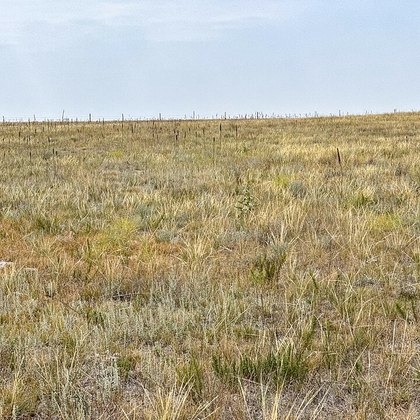
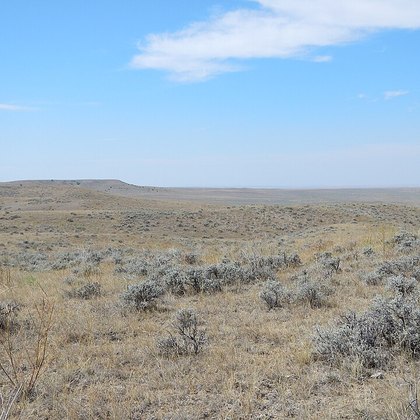
Shortgrass and mixed-grass prairie with wheatgrass and blue grama, usually with some sagebrush (grey-green wormwood scrub of the dry western interior), saltbush (a dry western steppe shrub) or yucca for song posts and nest cover. It avoids bare ground and heavily grazed range, but will breed in hayfields and fallow cropland. In winter it is nomadic, following the rains through desert grassland, field edges and stubble, sometimes at cattle feedlots, in flocks that may run to hundreds of birds.
Where the bird is most often found, arranged by the USNVC — the vegetation classification of the United States and Canada — and CMECS for sea and coast.



Range and movements
It breeds from southern Alberta, southern Saskatchewan and southwestern Manitoba south through Montana, the Dakotas, Wyoming, Nebraska, Colorado and Kansas to Oklahoma, the Texas Panhandle and northeastern New Mexico. Arrival falls in May, departure in August and September. It winters in southern Arizona, southern New Mexico, west and south Texas and on the northern Mexican plateau, from Sonora and Chihuahua to Zacatecas and San Luis Potosí. The edges of the winter range shift from year to year with the summer rains, so its division among Mexican states cannot be drawn sharply.
- Resident
- Breeding (summer)
- Winter
- Passage
- dark = core range, pale = thinly spread
Where and when to look
Drive a gravel road across the shortgrass prairie of eastern Colorado or western Kansas in June and watch for black birds rising off a barbed-wire fence and gliding back down in song; the display flight can be followed for hundreds of metres. In winter look not for a single bird but for the flock: a dense, rolling swarm over desert grassland.
Conservation
The species is listed as Least Concern (LC); the world population is put at about 10 million birds, but survey data indicate a decline of some 86 per cent since 1970 — among the steepest of the prairie birds. Conversion of prairie and shrubsteppe to cropland and the use of pesticides are the main causes; grassland restoration under the Conservation Reserve Program creates new breeding ground. The species carries a Continental Concern Score of 12 out of 20.
Scientific name
Calamospiza melanocorys | Stejneger, 1885
John Kirk Townsend described the species in 1837 as Fringilla bicolor, but that name was preoccupied; Leonhard Stejneger gave it the name Calamospiza melanocorys in 1885, which now stands, and so author and year appear without parentheses. The genus Calamospiza was introduced in 1838 by Charles Lucien Bonaparte, from Greek kalamos 'reed' and spiza 'finch'. Melanocorys is from melas 'black' and korydos 'lark', hence 'black lark', after the display flight and the black summer plumage of the male. Colorado adopted the species as its state bird in 1931.