All species › Nightjars › Nightjars and nighthawks › Chuck-will's-widow
Chuck-will's-widow | Antrostomus carolinensis
Carolinanachtzwaluw | Chotacabras de la Carolina
Chuck-will's-widow is the largest nightjar in North America, a bird far more often heard than seen: its name is exactly the call it repeats for hours on summer evenings. By day it lies pressed flat against the forest floor like a dead leaf, its eyes closed to slits.

Voice
The song is a rolling, four-note chuck-will's-widow, in which the first syllable is quiet and often inaudible at a distance — what carries is will's-widow, will's-widow, repeated for minutes without a break. Males sing from a branch or the ground, mainly in late spring and early summer, at dusk and on bright moonlit nights. Up close a short, clucking chuck note can also be heard between song phrases.
Recording: steve — CC BY-SA 4.0 · Frisco Campground (near Frisco), Dare County, North Carolina, United States · xeno-canto
Identification
A stocky bird with a large flat head, small bill and large gape, cloaked in finely patterned brown, rufous and black that matches dead leaves almost exactly. The throat is creamy, the breast more darkly mottled. The male shows broad, buffy-cream — not pure white — tips to the outer tail feathers, visible in flight but less contrasting than in its smaller relatives. The female lacks this pale tail pattern almost entirely. By day it sits flat on a branch or the forest floor, motionless and nearly invisible.
Confusion species
Eastern Whip-poor-will (Antrostomus vociferus) and Mexican Whip-poor-will (A. arizonae) are both markedly smaller and show pure white, not buffy, corners to the male's tail; their song also lacks the soft first syllable and sounds higher-pitched and faster. Lesser Nighthawk (Chordeiles acutipennis) has long, pointed wings with a white wing bar and hunts on the wing in active flight, whereas Chuck-will's-widow sallies from a perch. On its southern wintering grounds it can be confused with smaller, similarly rufous Caribbean nightjars, which give an entirely different song.
Habitat
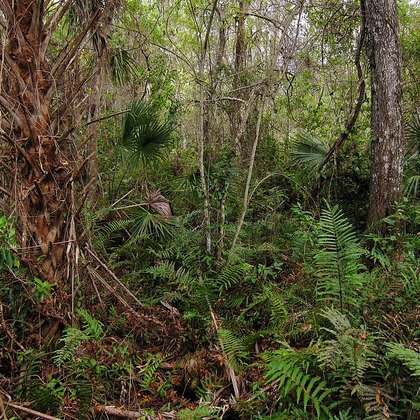
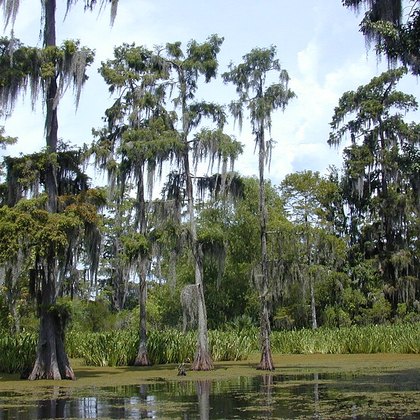
Dry, open pine and mixed woodland with a generous layer of dead leaves on the floor: pine forest, oak-hickory woods, and the edge where these meet sandy fields or clearings. It also breeds in swamp forest and along the margins of wetlands, as long as dry ground nearby offers a place to rest by day and hunt by night. It avoids closed, damp broadleaf forest without openings, and built-up land.
Where the bird is most often found, arranged by the USNVC — the vegetation classification of the United States and Canada — and CMECS for sea and coast.


Range and movements
Breeds across the southeastern United States, from Texas and Oklahoma east to the Atlantic coast and north to Missouri, Kentucky, Virginia and New Jersey, with a few small, isolated breeding outposts further northeast still. In autumn it withdraws to Florida, the West Indies, Central America and northern South America. Numbers fell sharply through the second half of the twentieth century, most likely through loss of open pine forest and the closing-in of former fire-maintained clearings.
- Resident
- Breeding (summer)
- Winter
- Passage
- dark = core range, pale = thinly spread
Where and when to look
On a mild evening in May or June, walk to the edge of a pine woods bordering open ground just after sunset and wait for the first call — once it starts it often continues unbroken for minutes, and a torch beam swept low across the grass can catch the red eyeshine. By day it is almost never found unless you happen to walk right past it.
Conservation
The global population is estimated at over five million birds, but numbers fell by roughly 58 per cent between 1966 and 2019 — the reason for its Near Threatened (NT) status on the international Red List. Loss of open pine forest, pesticides that reduce its insect prey, and disturbance of ground nests are considered the main causes.
Scientific name
Antrostomus carolinensis | (Gmelin, 1789)
Gmelin described the species in 1789 as Caprimulgus carolinensis; it has since been moved to another genus, hence the parentheses around author and year. Bonaparte placed it in the newly erected genus Antrostomus in 1838, built from Ancient Greek for 'cave' and 'mouth' — a reference to its big gape. The species name carolinensis refers to the type locality, originally given as Virginia and Carolina but later restricted to South Carolina, following the work of the eighteenth-century naturalist Mark Catesby.