All species › Nightjars › Nightjars and nighthawks › Common Poorwill
Common Poorwill | Phalaenoptilus nuttallii
Nuttalls nachtzwaluw | Chotacabras Pachacua
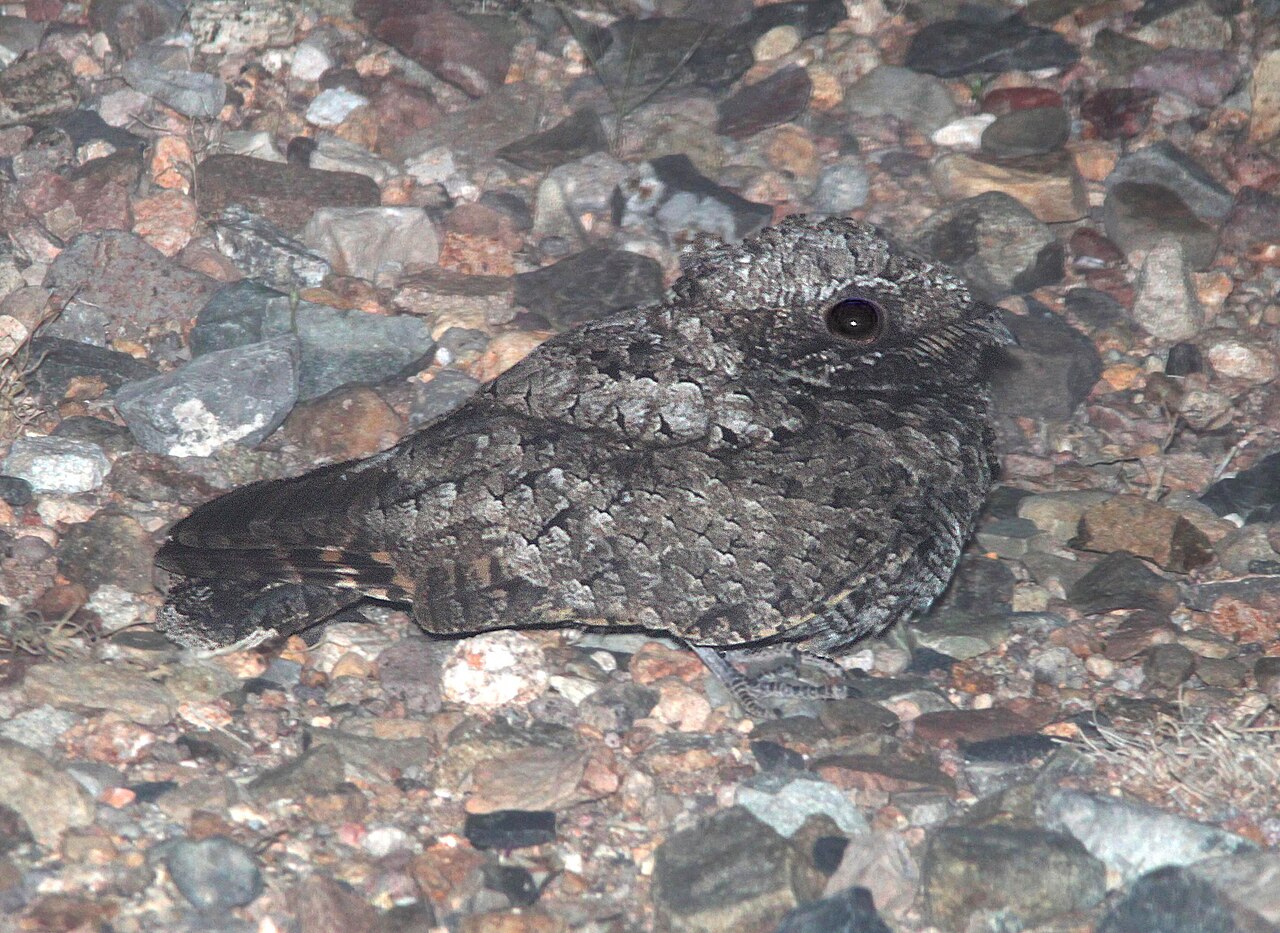
Common Poorwill is North America's smallest nightjar, and the only bird in the world proven capable of true, weeks-to-months-long hibernation. By day, like its relatives, it rests motionless and perfectly camouflaged on bare ground among rocks or shrubs. Its English name is an onomatopoeia of its monotonous call, repeated from dusk to dawn.
Voice
The call gives the species its name: a clear, three-syllable poor-will-ip, heard up close as poor-will-low, repeated for hours from the ground at dusk and under moonlight. Singing begins in mid-May, and the species is rarely heard after September. In flight it also gives a short chuck note.
No freely licensed recording has been found for this species yet; what to listen for is described below.
Identification
Common Poorwill is a compact, rounded bird with a short bill, short rounded wings whose tips just reach the tail tip at rest, and a finely patterned grey-brown plumage that blends perfectly with bare ground and rock scree. The tail is short, with white corners broader in the male than the female. In flight it shows none of the white wing patch of the larger nightjars, and its wingbeats are notably soft and fluttering. Small size alone sets it apart from almost every other North American nightjar.
Confusion species
Common Nighthawk (Chordeiles minor) has long, pointed wings with a white band and hunts high in the air, quite unlike the short, rounded wings and low, fluttering flight of Common Poorwill. Mexican Whip-poor-will (Antrostomus arizonae), of higher-elevation pine forest, is considerably larger, longer-tailed and gives an entirely different, three-syllable call that does not resemble poor-will. On the ground, in headlights, Common Poorwill's small size and the absence of the Pauraque's red eyeshine at a distance usually make it easy to tell apart.
Habitat
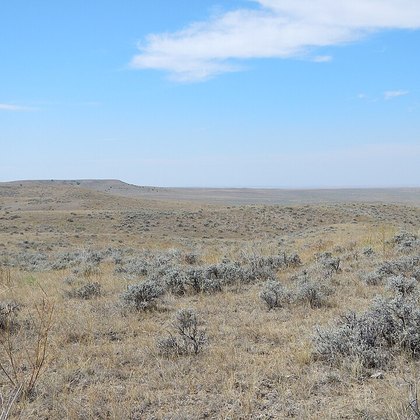
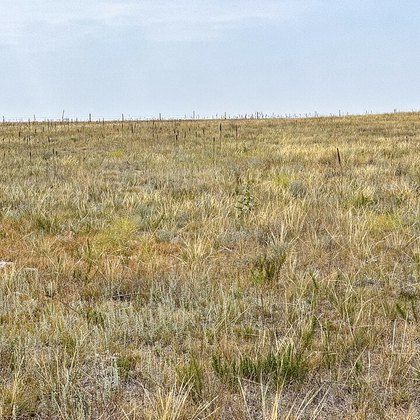
The species favours dry, open terrain with sparse plant cover: sagebrush steppe, short-grass prairie, rocky desert slopes and open pine-juniper woodland, often on ground littered with loose stones against which the bird disappears completely. It avoids dense vegetation and damp terrain. For hibernation it seeks rock crevices or piles of stones on south-facing slopes, where the temperature swings less than in the open air even in cold weather.
Where the bird is most often found, arranged by the USNVC — the vegetation classification of the United States and Canada — and CMECS for sea and coast.



Range and movements
Breeds from southern British Columbia and southeastern Alberta south through almost the entire western United States to northern Mexico. Most northern and high-elevation breeders withdraw in winter to central and western Mexico; in southern Arizona and New Mexico birds remain present year-round at low elevation, and in parts of California and New Mexico some birds overwinter without leaving at all, concealed in hibernation among piles of stones.
- Resident
- Breeding (summer)
- Winter
- Passage
- dark = core range, pale = thinly spread
Where and when to look
Listen at dusk on a dry, rocky hillside in western North America for the monotonous, repeated poor-will call — often kept up for hours from the same spot. By day the best chance of a chance find comes from walking close along a trail scattered with loose stones and almost accidentally flushing a bird; it sits so close to its hiding place that it rarely flies more than a few metres.
Conservation
The global breeding population is estimated at 1.4 million birds, with a decline of about 29 percent between 1970 and 2017 according to North American surveys. The main causes are the loss of dry, open habitat at the edge of towns and collisions with vehicles, to which the bird is vulnerable, like the Pauraque, through its habit of sitting on roads.
Scientific name
Phalaenoptilus nuttallii | (Audubon, 1844)
Audubon described the species in 1844 as Caprimulgus Nuttallii, named for the English botanist and ornithologist Thomas Nuttall; because it has since been moved to another genus, author and year stand in parentheses. Ridgway introduced the genus Phalaenoptilus in 1880, from the Greek phalaina, 'moth', and ptilon, 'feather' — a reference to the soft, moth-like plumage. The type locality lies on the east side of the upper Missouri, between Fort Pierre and the mouth of the Cheyenne River in South Dakota.