All species › Passerines › Thrushes and allies › Clay-colored Thrush
Clay-colored Thrush | Turdus grayi
Grays lijster | Zorzal pardo
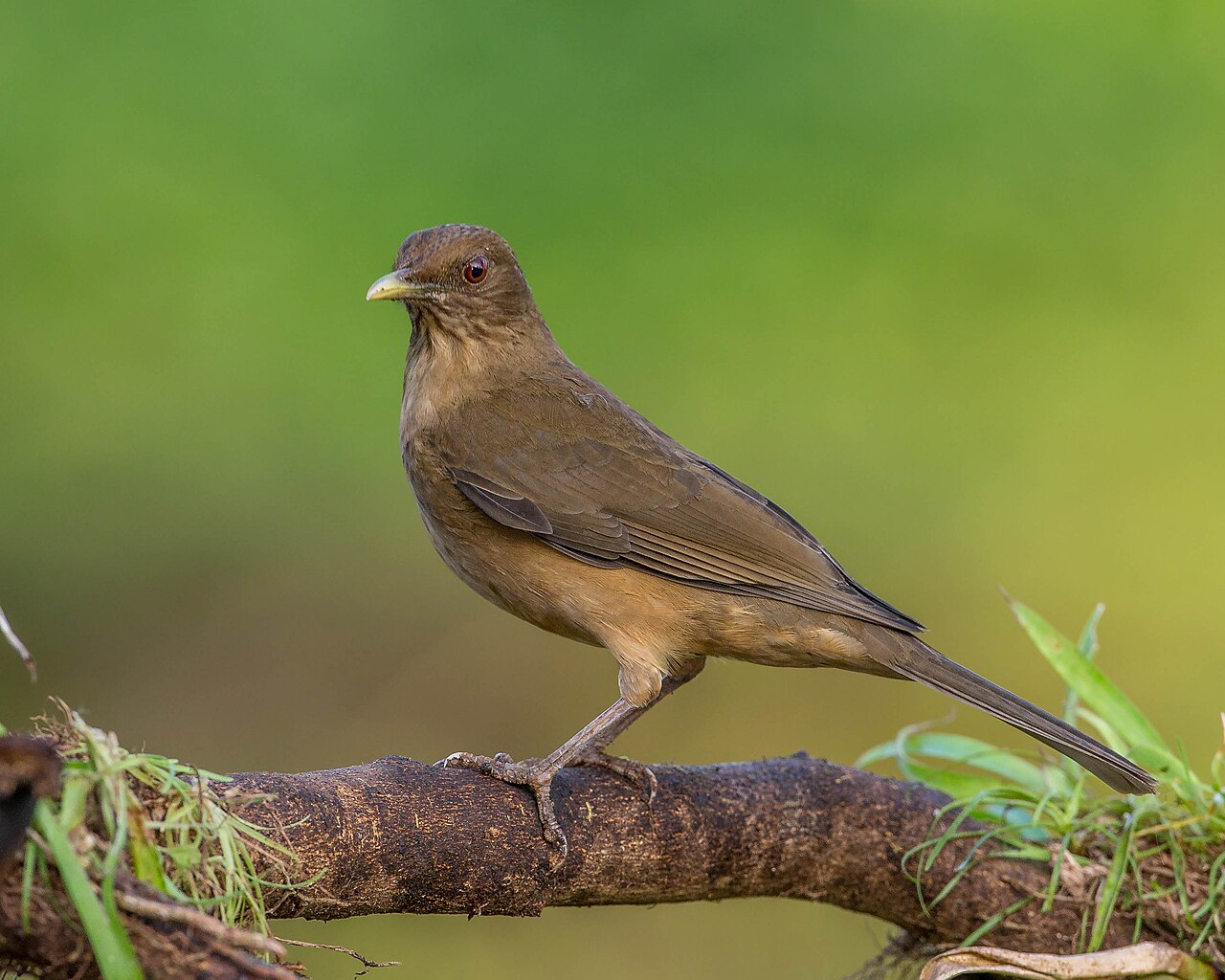
The Clay-colored Thrush is a plain buff-brown thrush of gardens, villages and semi-open woodland, from South Texas to northern Colombia. There is little to see in its colour; what stands out is the long, varied song, which in Central America coincides with the onset of the rains and which was chosen as a national symbol in Costa Rica.
Voice
The song is a low, unhurried series of slurred musical phrases, strung together and repeated irregularly, and it can run on for minutes; it is slower and deeper in tone than American Robin's. The flight call resembles American Robin's but is harsher, and there is also a nasal upward-bending weeur and a hard chuck. Song is heard most in the dry season shortly before the rains, and it differs measurably between areas only a short distance apart.
Recording: Leander Khil — CC BY-NC-SA 4.0 · Antigua Guatemala, Antigua Guatemala, Sacatepéquez, Guatemala · xeno-canto
Identification
A medium-sized thrush in plain brown plumage, slightly lighter below than above and lightest on the flanks; birds from humid regions are darker than those from arid ones. The bill is greenish-yellow with a dark base, the legs flesh-coloured, the iris reddish-brown. There is no breast spotting, no eye-ring to speak of and no white in the tail. Young birds show faint mottling on the back and underparts and a dully streaked breast.
Confusion species
The likeliest confusion is with female and young American Robins: these are dull too, but always keep white corners to the tail, a broken white eye-ring and a darker head. Rufous-backed Robin has a rusty mantle and orange-brown flanks. White-throated Thrush has a clear white throat patch and an orange eye-ring. Northern Mockingbird is slimmer, greyer and shows white in wing and tail. Where no other feature gives a hold, the combination of plain buff-brown, greenish-yellow bill and reddish-brown iris settles it.
Habitat
Semi-open ground with trees and shrubs: forest edge, second growth, gallery woodland, plantations, coffee gardens, yards, village squares and city parks. The species avoids the closed interior of rainforest and seeks out precisely the edges that farming and building create. It feeds on or near the ground on earthworms and other invertebrates, with fruit added; small parties gather at fruiting trees, and it sometimes follows army ant swarms.
Where the bird is most often found, arranged by the USNVC — the vegetation classification of the United States and Canada — and CMECS for sea and coast.






Range and movements
Resident from South Texas through the eastern and southern half of Mexico and all of Central America to northern Colombia. West and north of the Isthmus of Tehuantepec it holds mainly to the Atlantic slope, with an isolated population near Oaxaca City. In Texas it has bred only since the late twentieth century: first in the Lower Rio Grande Valley, then northward along the coast and inland, with nesting recorded beyond San Antonio. Outside the breeding season single birds appear farther north in Texas still.
- Resident
- Breeding (summer)
- Passage
- dark = core range, pale = thinly spread
Where and when to look
In Texas winter is the best time: birds then gather at fruiting trees and water features in the parks of the Lower Rio Grande Valley, coming out of the shade to drink. Go by ear, since the song carries far and betrays a bird that stays invisible in the canopy; then check the tail for the absence of white.
Conservation
The IUCN lists the species as Least Concern (LC). The population is large and rising rather than falling, since the species profits from clearance that replaces closed forest with gardens, pasture and forest edge; the Texas expansion fits that pattern. In Costa Rica the yigüirro has been the national bird since 1977, which gives the species a place in nature education there.
Scientific name
Turdus grayi | Bonaparte, 1838
Charles Lucien Bonaparte described the species in 1838 as Turdus Grayi, from material taken in Guatemala; Griscom restricted the type locality in 1930 to Alta Verapaz. The species name honours the British ornithologist George Robert Gray, who was in charge of the bird collection at the British Museum in the nineteenth century. Turdus is Latin for thrush. The English and Spanish names refer to the clay-coloured, dull brown plumage; in Costa Rica the bird is the yigüirro, a name linked to calling up the rain.